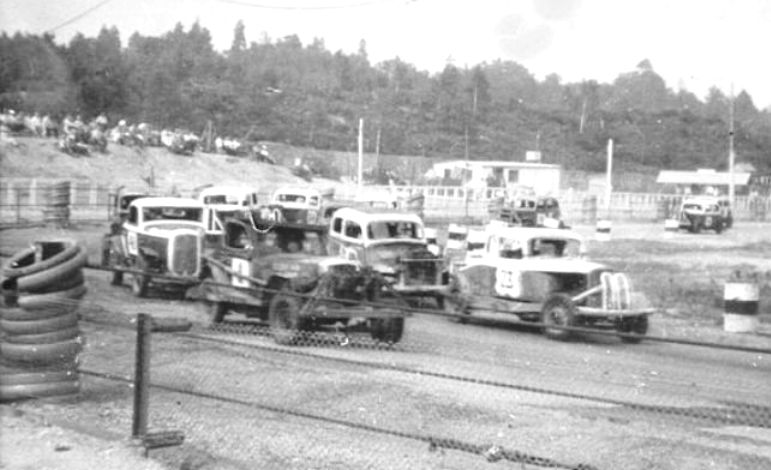
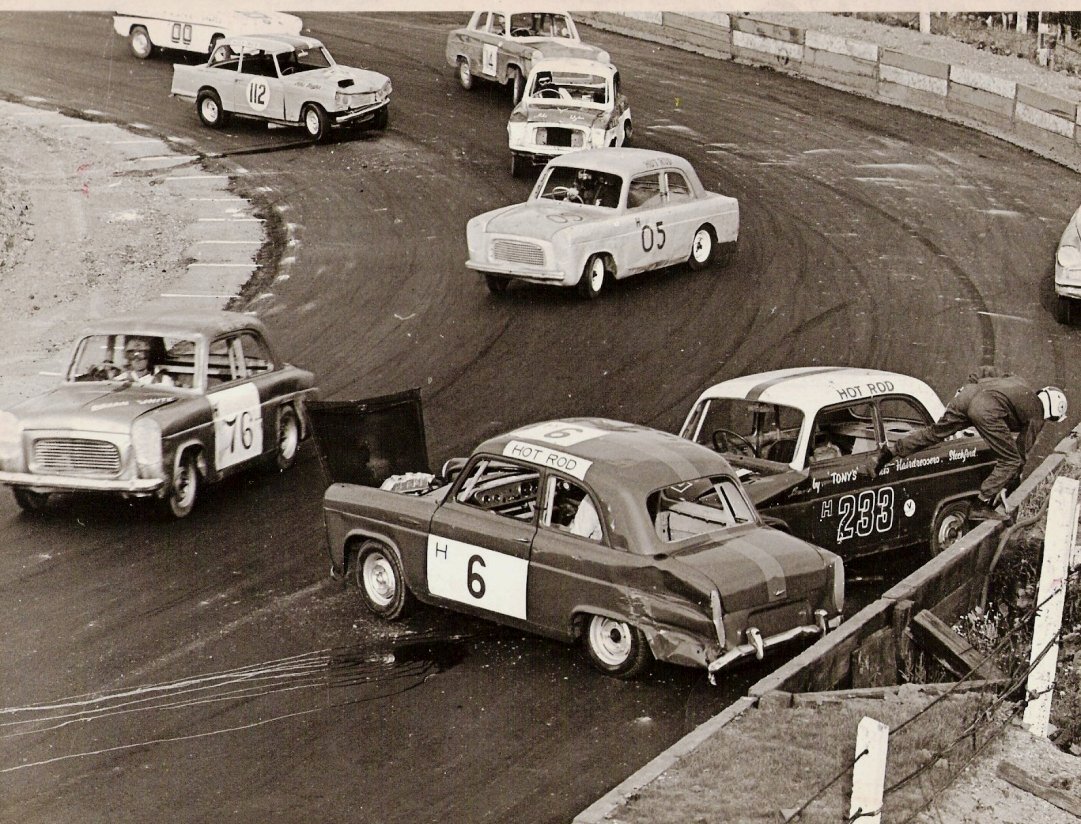
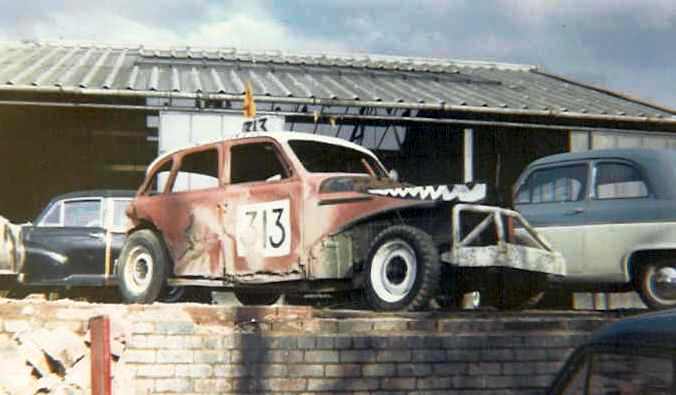
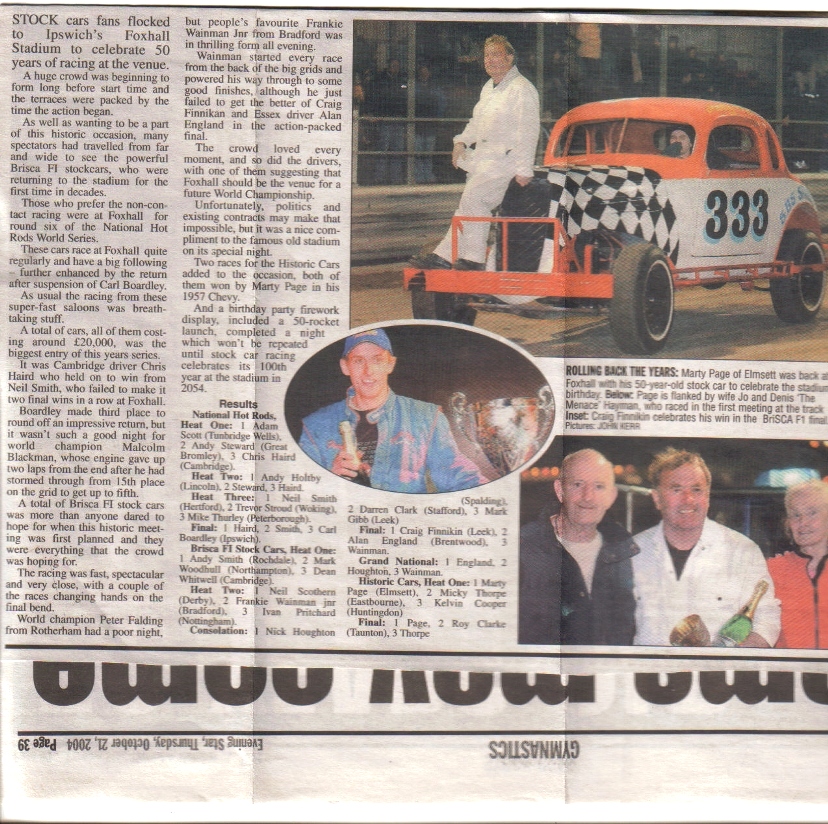
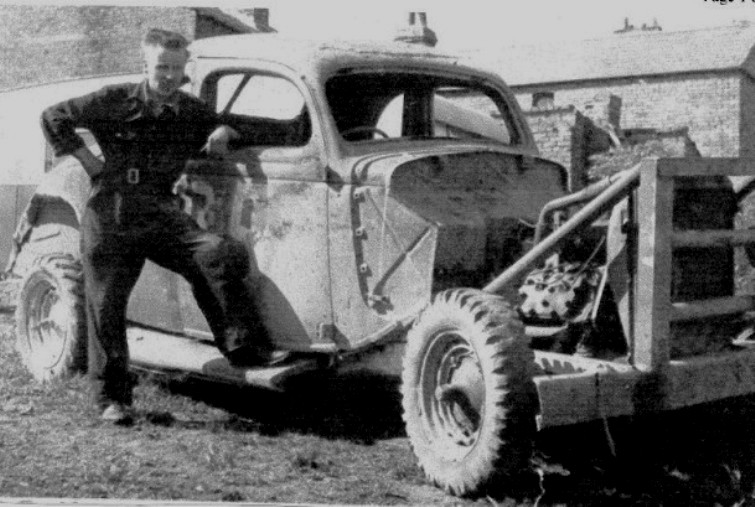
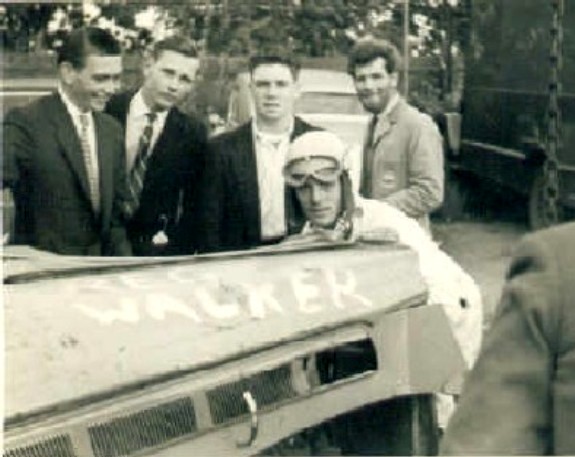
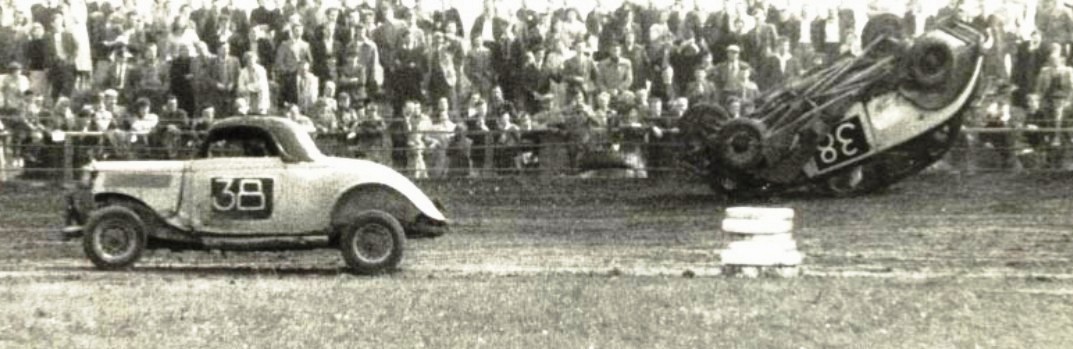
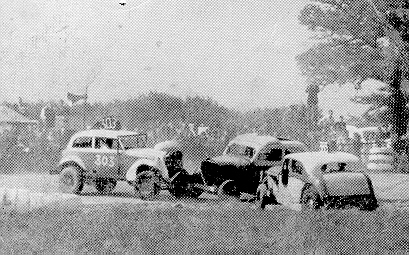
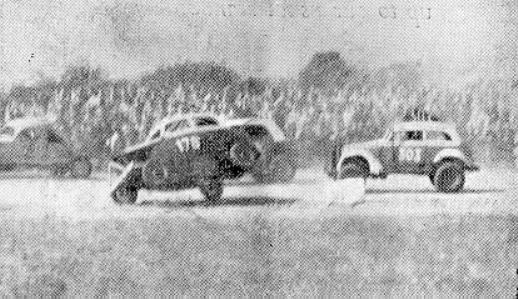
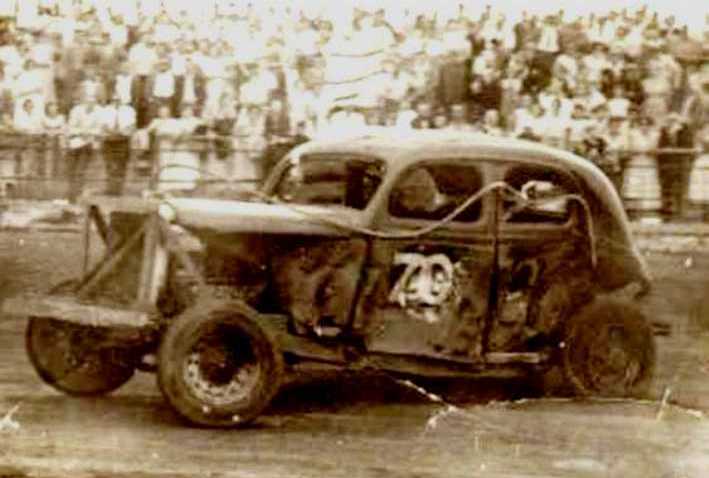
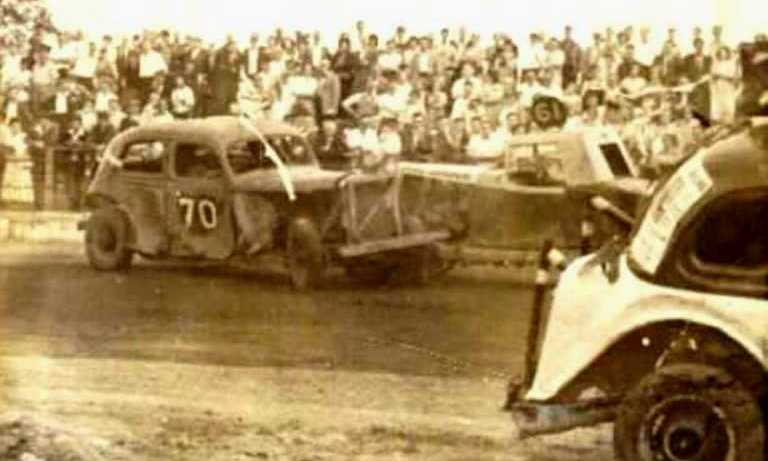
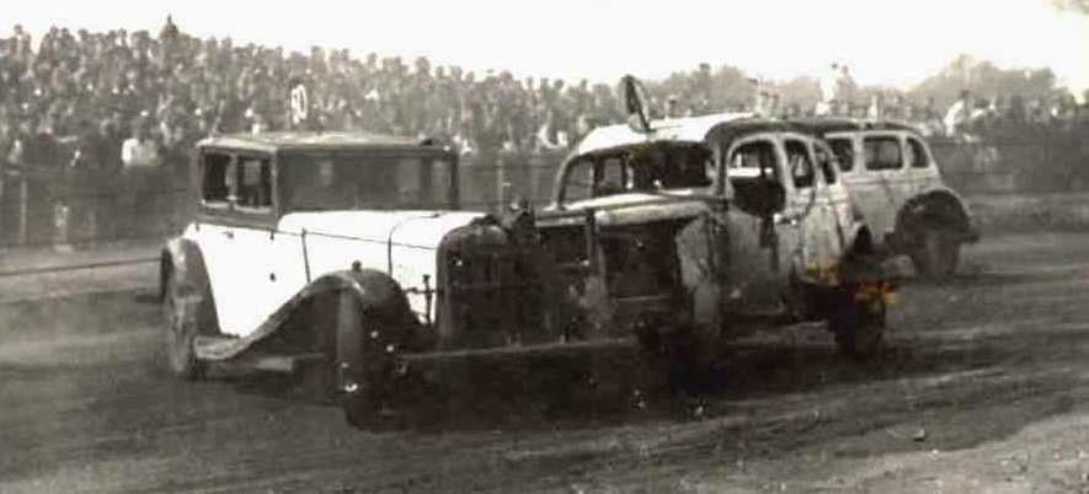
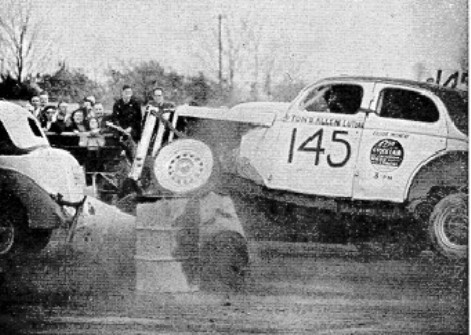
Stock Cars in The Fifties:
*Look
for  labels:
new additions are scattered randomly throughout the page. labels:
new additions are scattered randomly throughout the page. The Men Who Started Stock Car Racing in Britain Thanks to ex-racer Steve Daily, who has published a thoroughly-researched book on the pioneering "USA Visitors" tour of 1955. 
How to book in at Brandon Stadium in 1955:
I cannot remember how I came by these.
Gene Mace was a pioneer racer,
a stunt man with Dick Sheppard's tem, and an artist. Here are the two
official forms he filled in, in order to book in to Brandon Stadium
with Charles Ochiltree.
======================================================= In 1955, St. Austell was running stock cars.
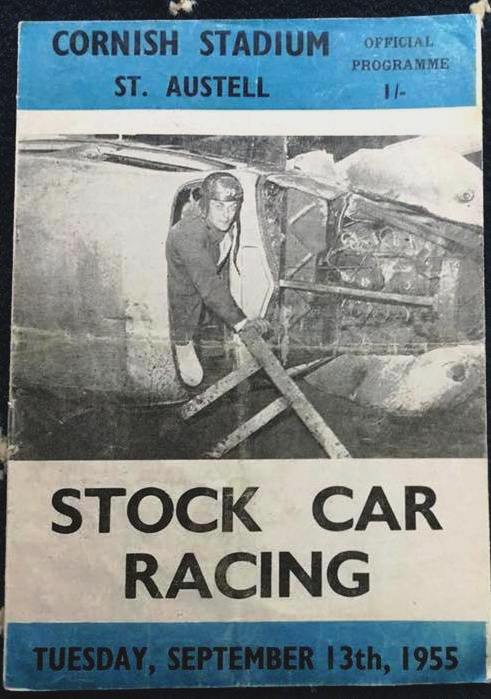
and thanks to Paul Bariball and Steve Palmer, here's a pdf file of that programme.
================================================================= Portsmouth’s
brief history in stock car racing
Stock car historians Graham Brown and Richard Neil and
Steve Daily have traced this brief history.
Steve Daily was a hot rod and banger/grass track driver, and is now busy
researching the history of tracks such as Ringwood, West Ham, Neath Abbey, and
Portsmouth, as well as researching and re-creating early stock cars as models,
when he’s not rallying with a local car club. If you edit-search ‘Daily” around
this website you will find his work.
As early as 1951, Speedway
& Ice News referred to the idea of midget car racing at Tipner Stadium.
The
stadium at Tipner
was opened in 1931 for greyhound racing (the Copnor Stadium
had closed in 1930, where Portsmouth speedway had also run in 1929 and 1930.).
Speedway started
at Tipner in 1935 and only continued until 1937, but nothing on four wheels
happened until 1955. The name Tipner has
been printed as Tipnor from time to
time, and the old RAF base was called Tipnor.
Steve
unearthed this newspaper promotion: 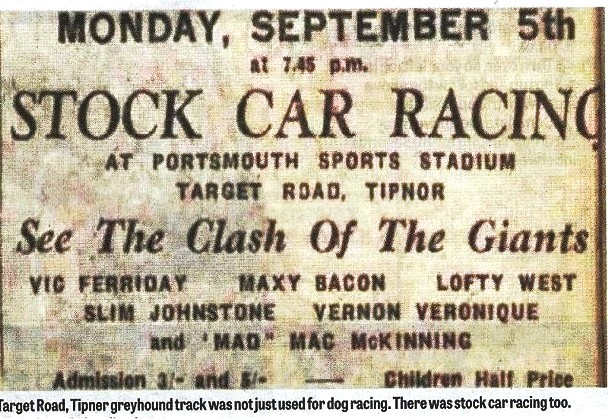
Here's what Steve uncovered:
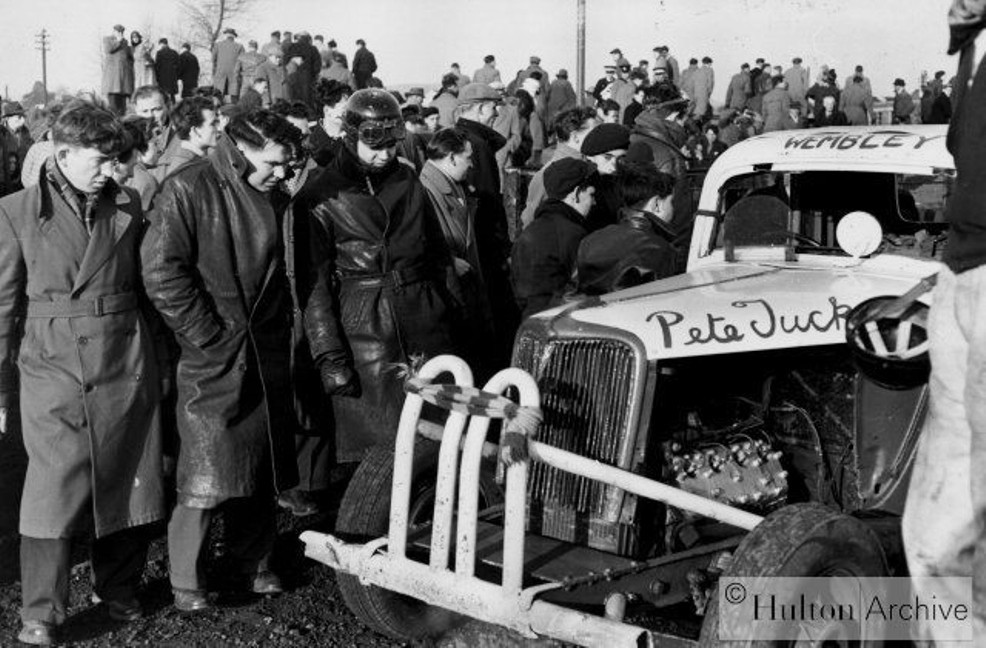
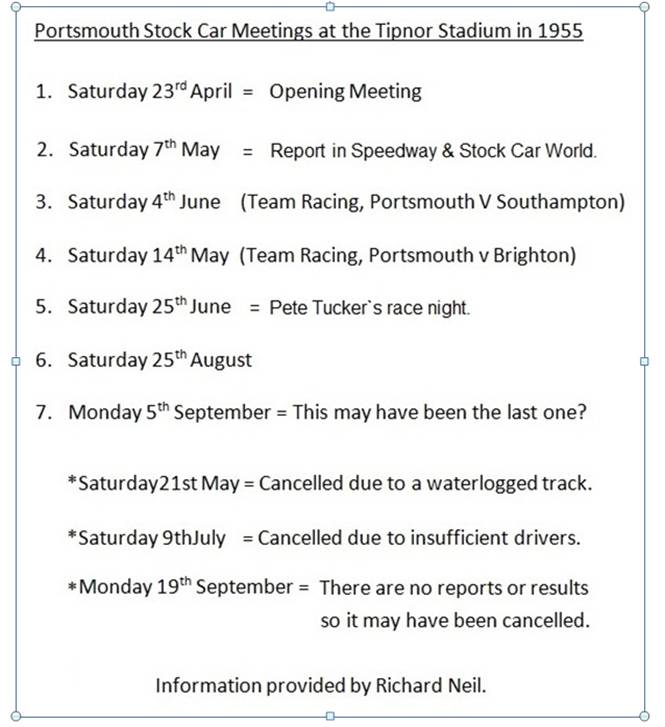 Pete Tucker and his mechanic 'Sprog' Bennett went there and were not impressed! 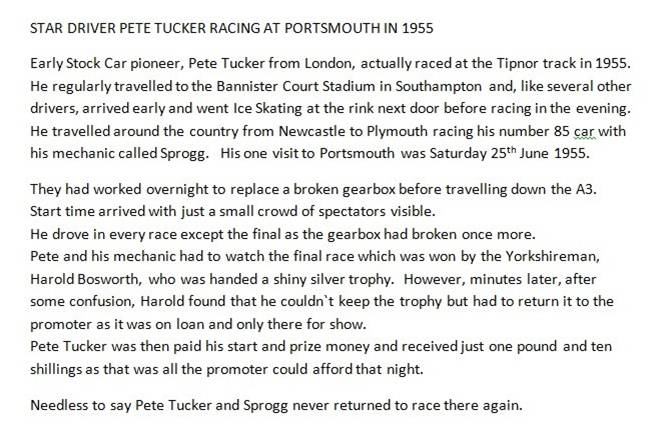
The last greyhound meeting took place on 27 March 2010,
and the stadium was demolished in 2012 with the site awaiting redevelopment.
Steve Daily photographed the old stadium before it was demolished, and today the only memento is the stainless steel greythound state on the M275: 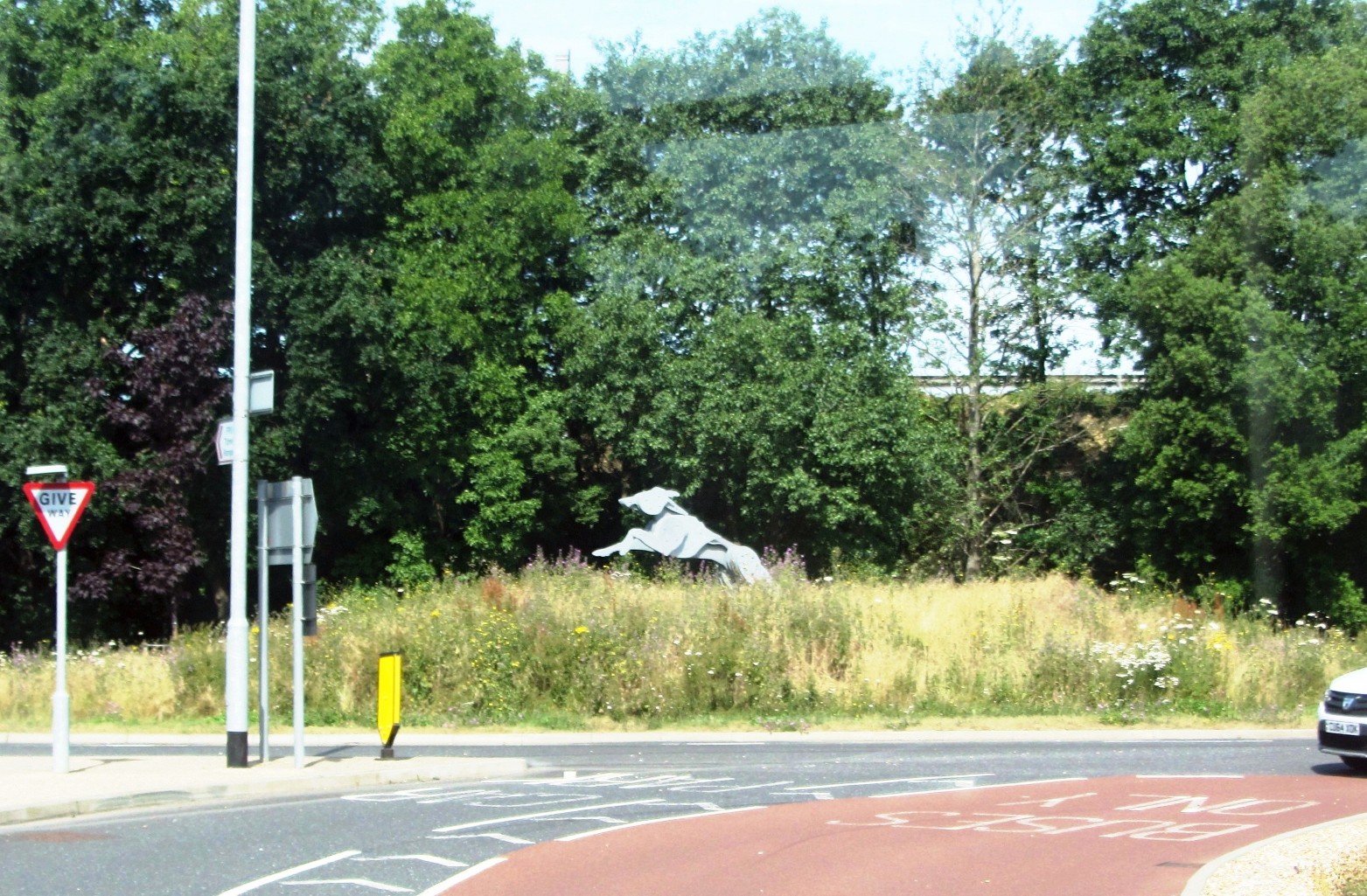
===========================================================
"The Yanks" came over! In
April 1955 Harringay Stadium hosted an international series, and thanks
to Steve Daily we can see the porogrammes for 8th April 1955 and 23rs
April 1955. Nore that Bobby Myers, whose story appears further
down this page, was featured bin both events. pdf files of the
programmes are linked undernearth the twol cover pages. 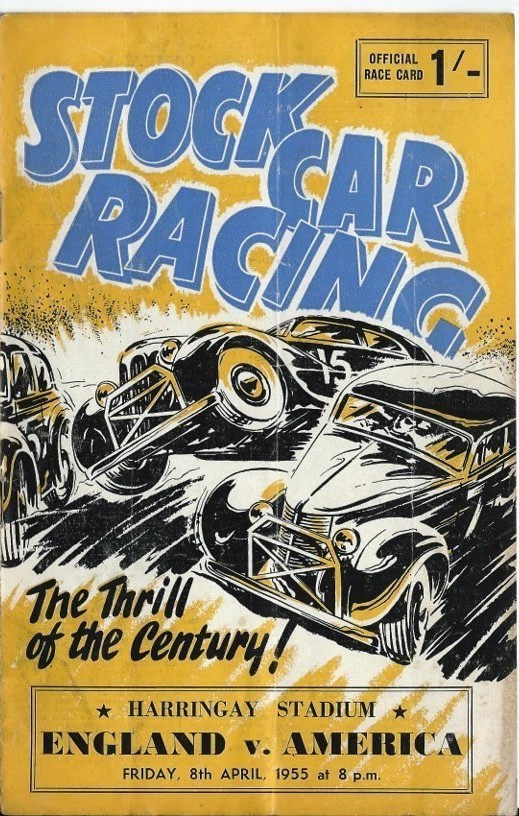 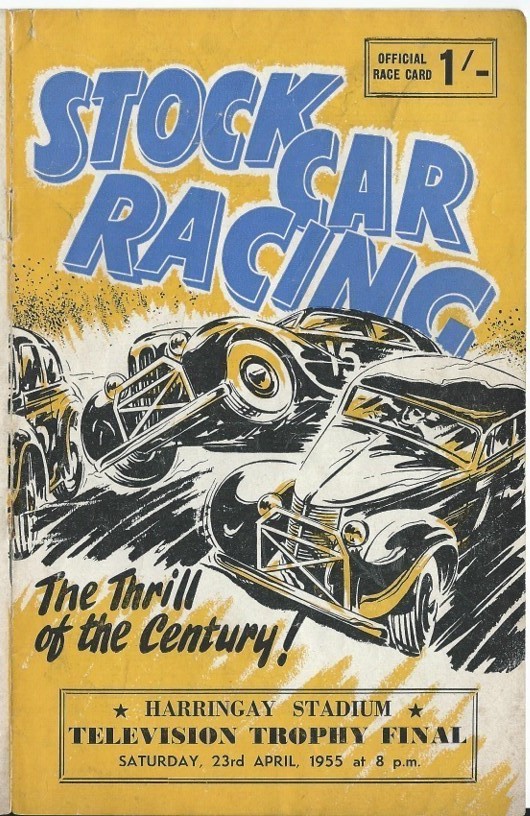
pdf links: 8th April programme 23rd April programme ----------------------------------------------------------------------------------------------------------------------------------- Portsmouth Stadium
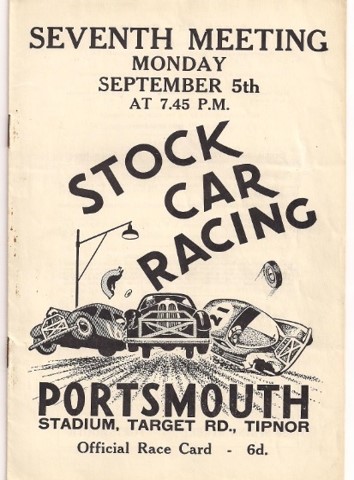
Steve Daily
has found some history of stock car racing at Portsmouth. The
first stock car meet was on 23rd April 1955, and the promotions were
not successful, with 'modest' facilities and few spectators; Pete
Tucker was not complimentary about his races there! 1955 was the stadium's first and only year of stock car racing, but greyhounds continued until the 1980s. It was first opened in 1929 for m'cycle speedway and greyhounds, and the site was finally demolished in 2012. A greyhound statue is all that remains to commemorate it. Alec Le Croisette built a marvellous car that he said was "half a Hudson, half a Ford".
Here is Alec at Brafield with an equally happy Aubrey Leighton:
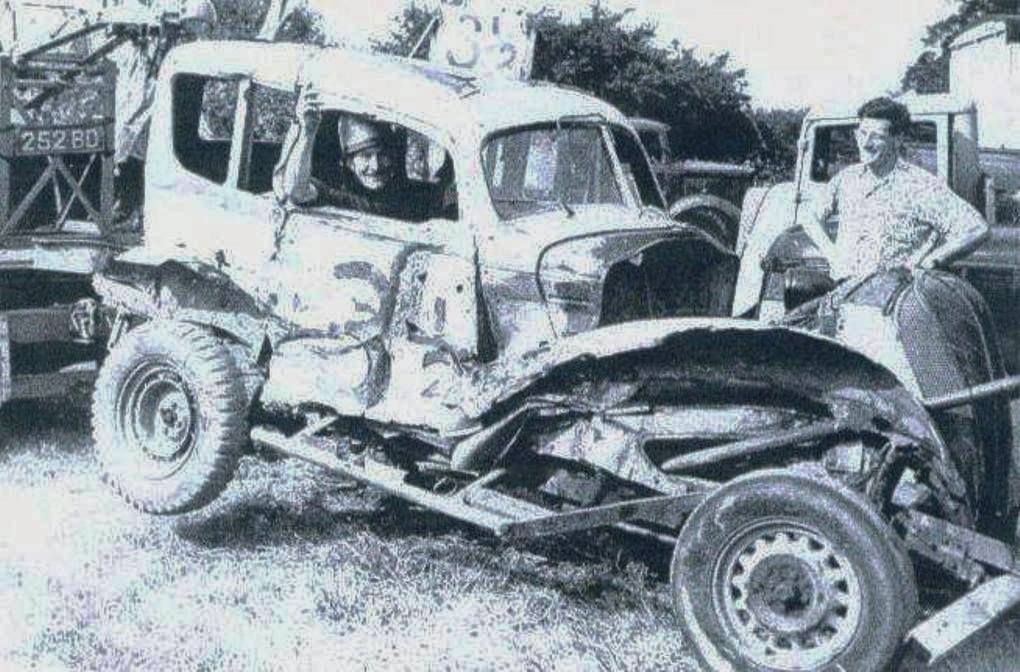 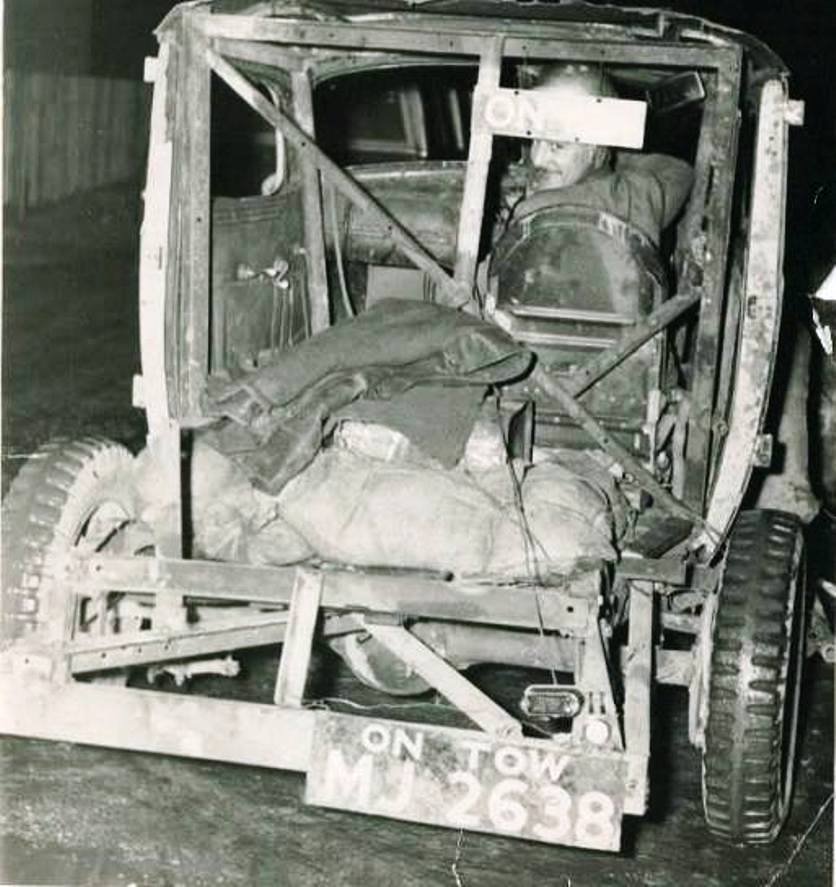 It
was based on a Hudson Terraplane, with a bundle of sandbags to the rear
[visible above and below in the photographs], to improve traction!

In this newspaper photo, Alec Le Croisette is on the far right: 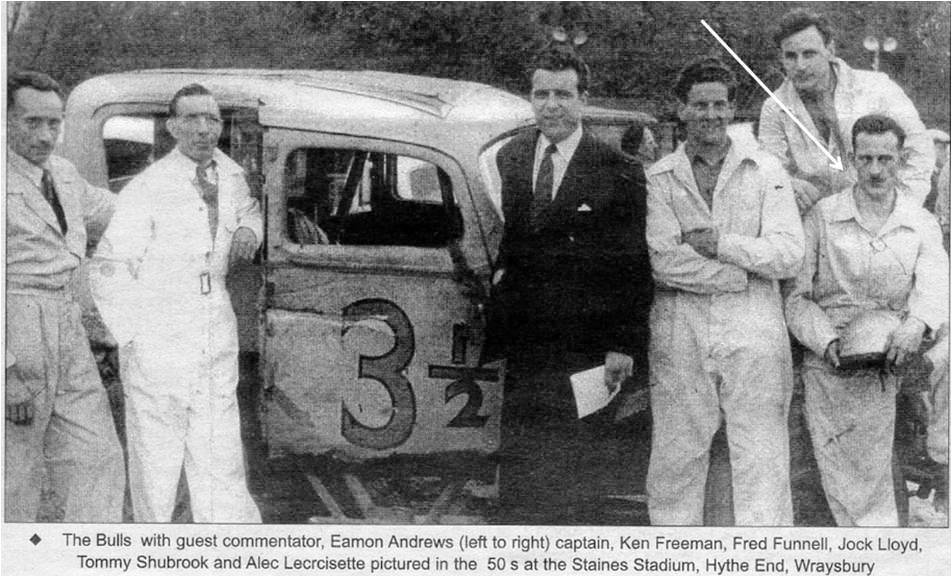 ========================================================================== Here he is, 'the man who started it all': 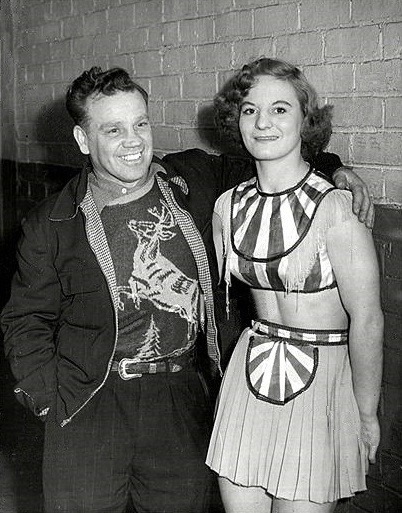
"Digger" Pugh, Northampton-born but nicknamed as an Aussie for showbiz, with his wife Sheila MacMahon, leader of the "Digger Pugh Girls" acrobatic
troupe.Digger's son John Pugh carried on in the circus business.
Pete Tucker admired him and talked about him in the radio programme
linked mon the Home page. The Daily Telegraph commemorated the 50th anniversary of the sport in its April 2004 issue [PDF file] Rayleigh's First Stock Car Meet: "Hextra, Hextra, Read all abaht it!" Described by the local newspaper. -------------------------------------------------------------------------------------------------------------------- I wonder if the 'real, actual first-ever' Brafield race will be identified? Here
is the first of two Brafield PHOTOS that were discovered, by a fan
who dug through the newspaper archives of Northampton's CHRONICLE & ECHO, and kindly passed to me by Keith Barber: 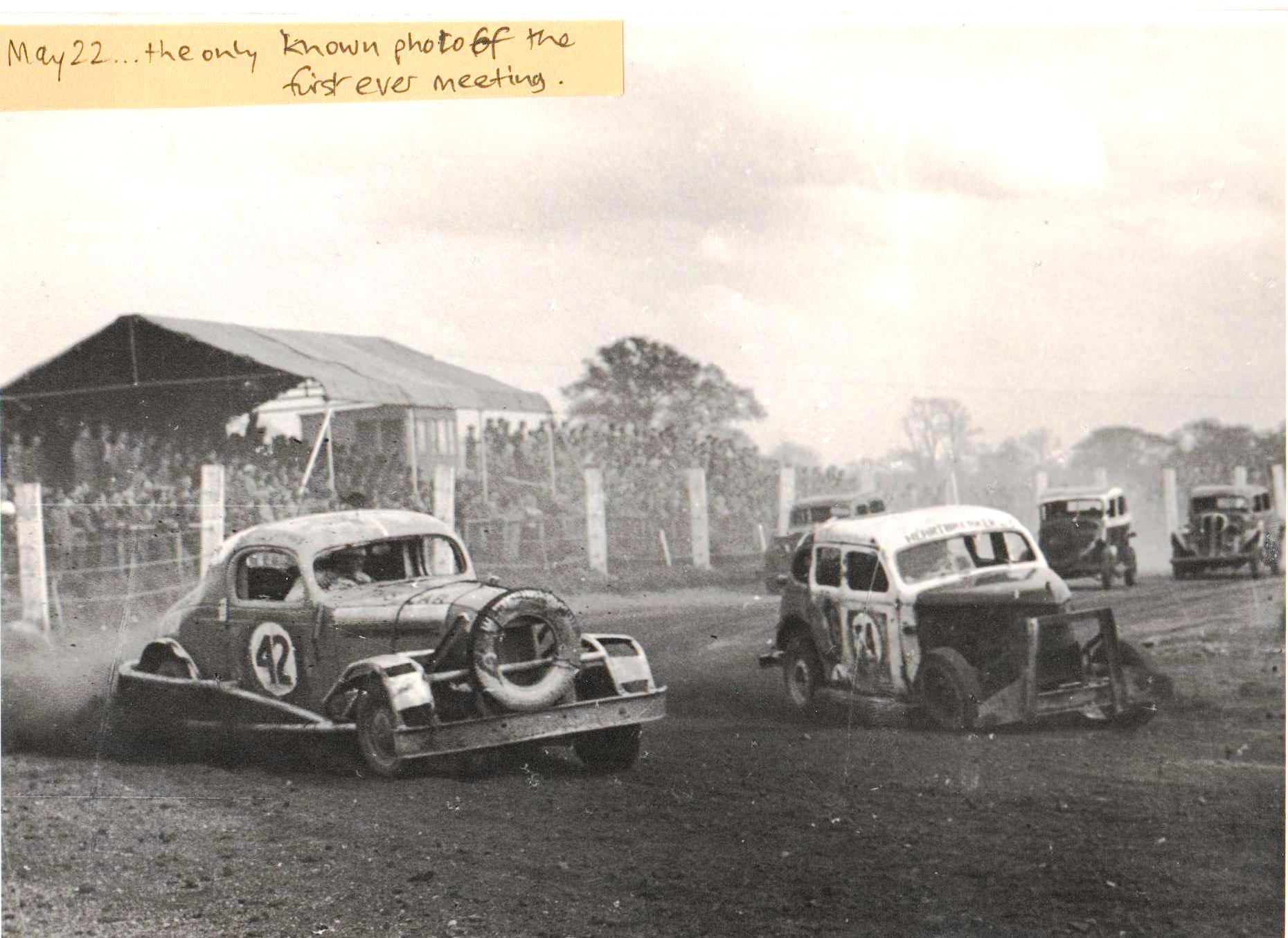
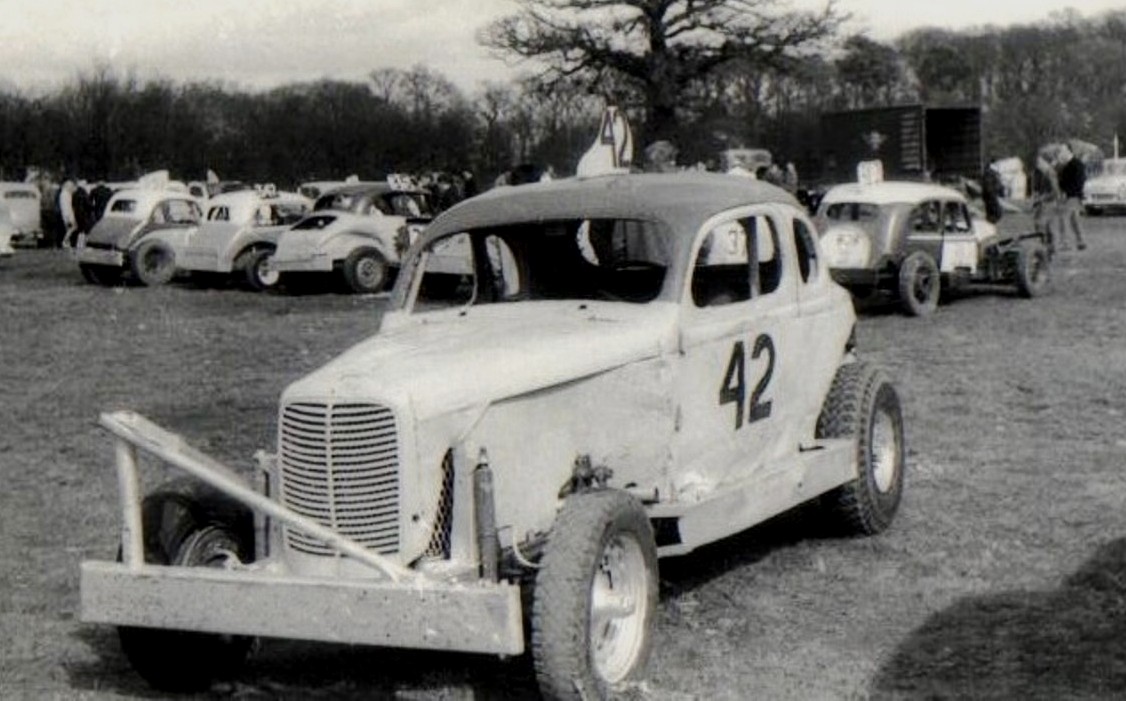
The
photograph --- certainly a professional press shot -- was taken on May
22nd 1955, and at a time when car numbers were not nationally
standardized, and different promoters handed out different numbers at
diferent events. When we see 42, we tend to think 'Aubrey
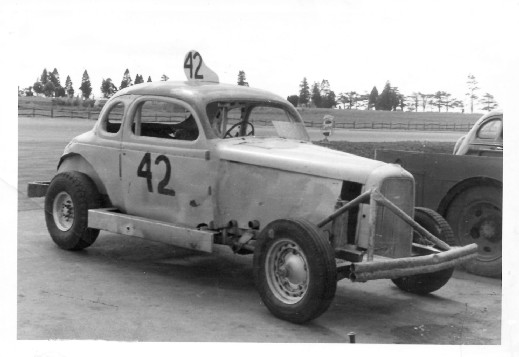
Leighton', but 42 was used in the previous year by Gene Mace "The Red Knight". Aubrey was not listed as racing in Brafield's first three or four meets. The 42 car is a 1936 Studebaker "Dictator" Business Coupe,
evidently R.H.D. so probably assembled in Studebaker's Canadian
factory. Normally fitted with an "L-head" straight-6 motor of 3.6
litres. Was
this photo taken from the entrance to Turn 3? It looks towards the
Brafield oak tree, so the "grandstand" must have been a temporary
structure, and the "shack" could have been a tea shack? -----------------------------------------------------------------
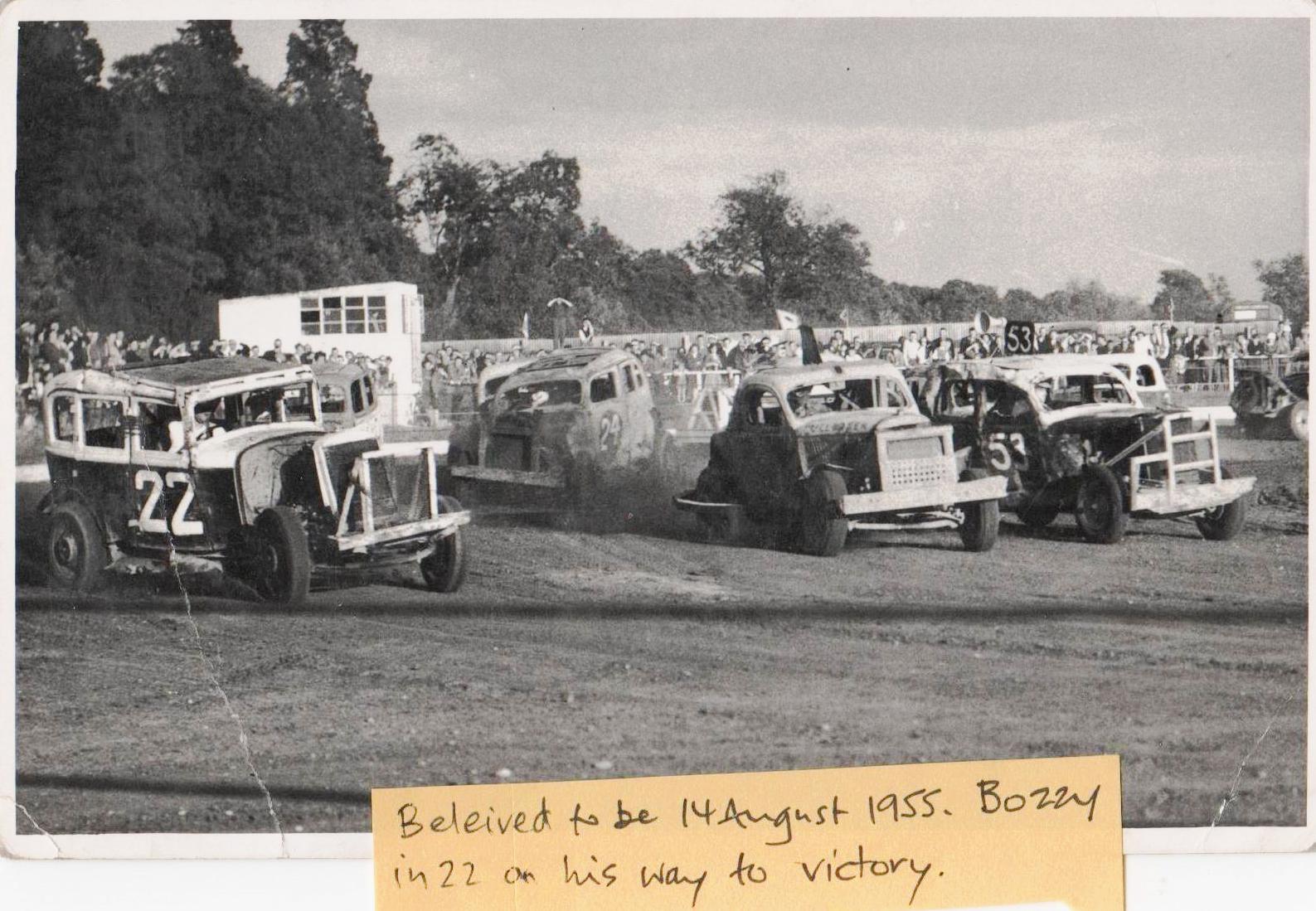
Three months later in 1955:
The
photo below shows the familiar commentary box and the trees along the
Horton road (?), so it was presumably taken from Turn 1.
=================================================================
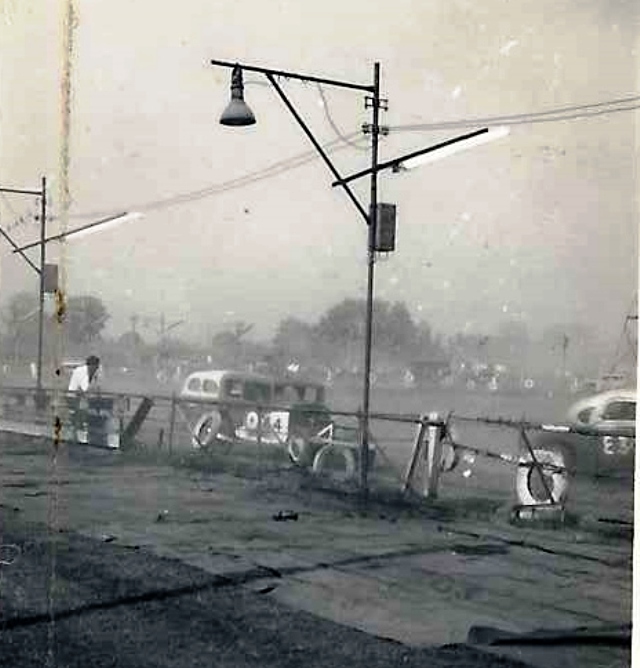
Thanks to Roy Clarke,
who was there and remembers the exploits of "Mac" MacLean 44, one of
the HOUNSLOW HURRICANE team who raced at Staines and elsewhere.
Roy sent these photos. I heard this month that Mac is still
with us at the youthful age of 92 and visited Pat Willis not long ago!
Below, Mac is leading a race:
- Here's the 44 car with the famous bearded sign-writer and Staines starter Frank Howlett.
- Mac's famous fire:
he overturned the car at Staines, right by the pits gate, and today
people have told me they remember it as though it was yesterday.
- Below: 44 up on the lorry and Pat Willis's smart 250 on the tow bar [just corrected the name :-)]:
- The Hounslow Hurricanes all lined up on the green.
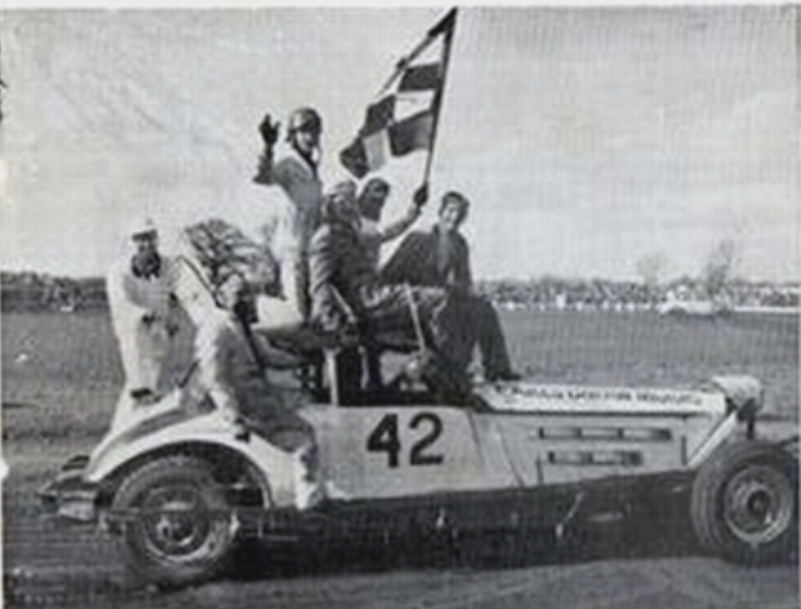
- The Hurricanes with their winning trophy. There are two Austin Atlantics.
Mac [with the flag] and Vic Muggeridge and [either Pat Willis OR Roy Clarke] are on
Frank Howlett's [driving] car; Darkie Wright and 'Unknown" are on the
Atlantic belonging to John Cook.
Big thanks to Roy,
and to Don Roomes and Chris Holmes who added their stories. The two
pits photos were taken by Roy's sister-in-law Molly Willis.================================================================================== June 2015: A big thank-you to the daughter of Dennis W. Burdett-Coutts for
the following photos, and to Keith Barber for some
historical info. Note: I will also add some "Dirt Dennis"
photos and facts to the top of the SENIORS IN THE SIXTIES page.
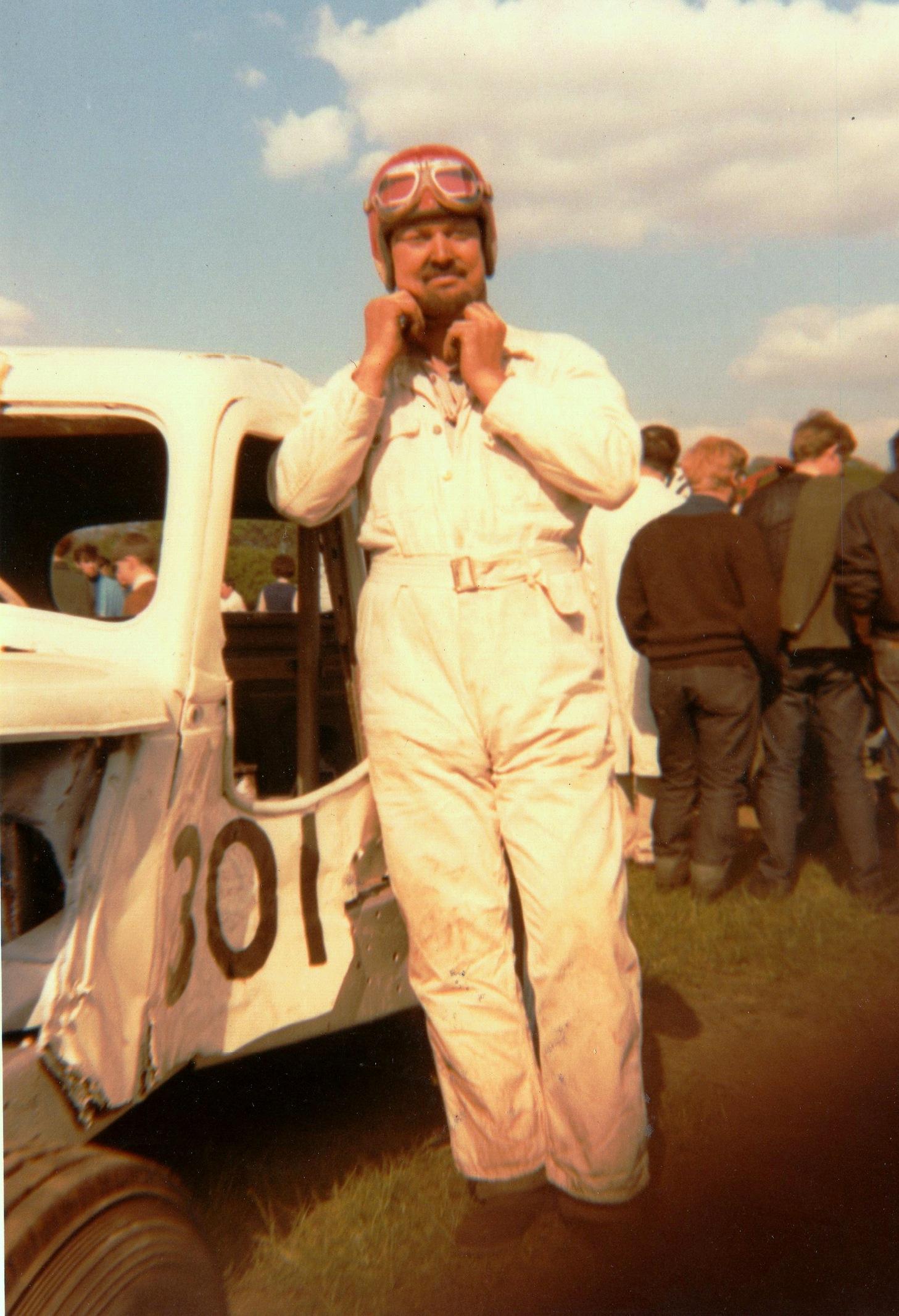
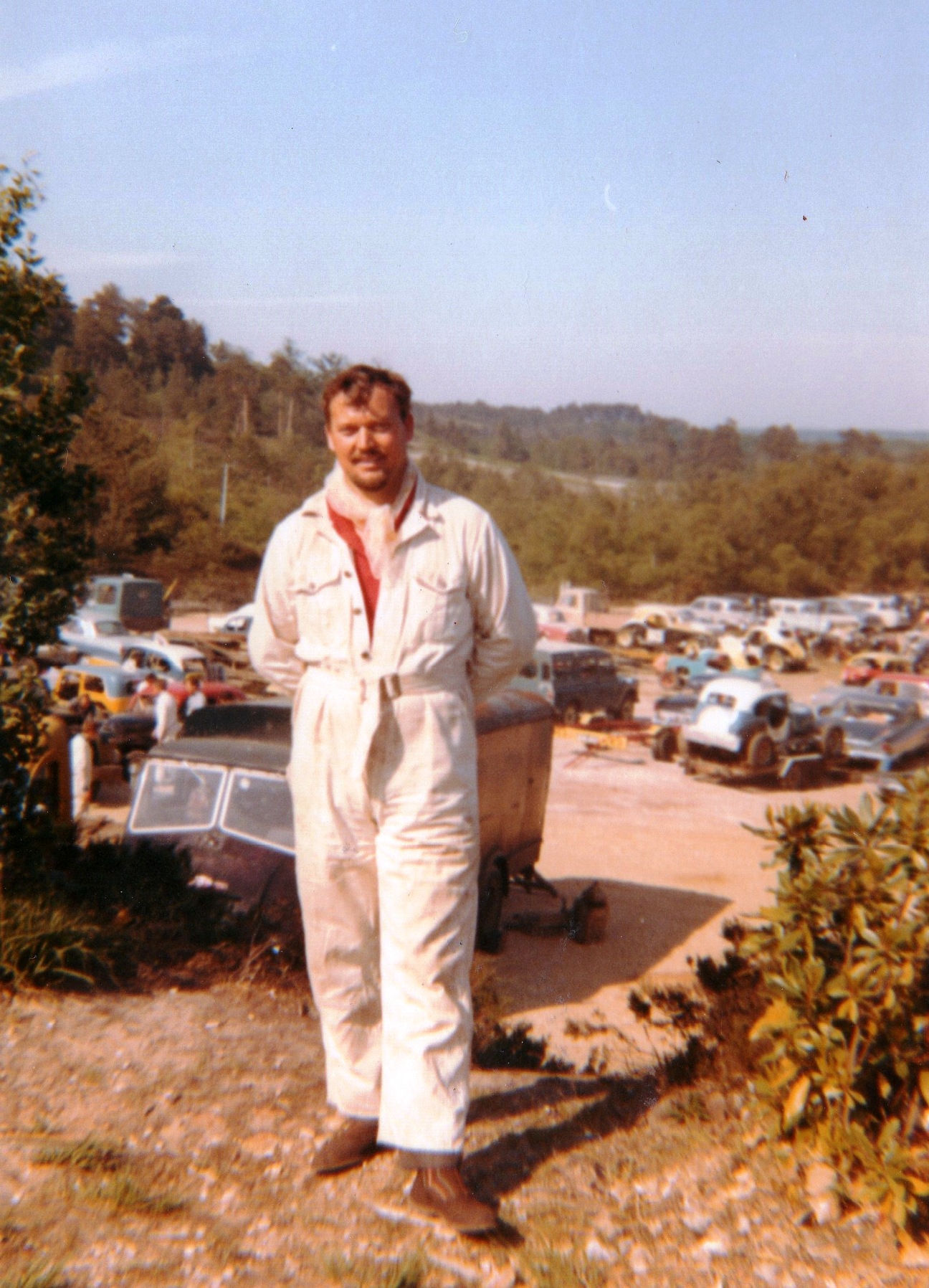
Here we see Dennis as a pioneer racer in the 1950's, but
let's start with this "rogues' gallery" of portraits of a man who was
unique in his devilish smile and his goatee beard. The pits view is at
Matchams Park, Ringwood. 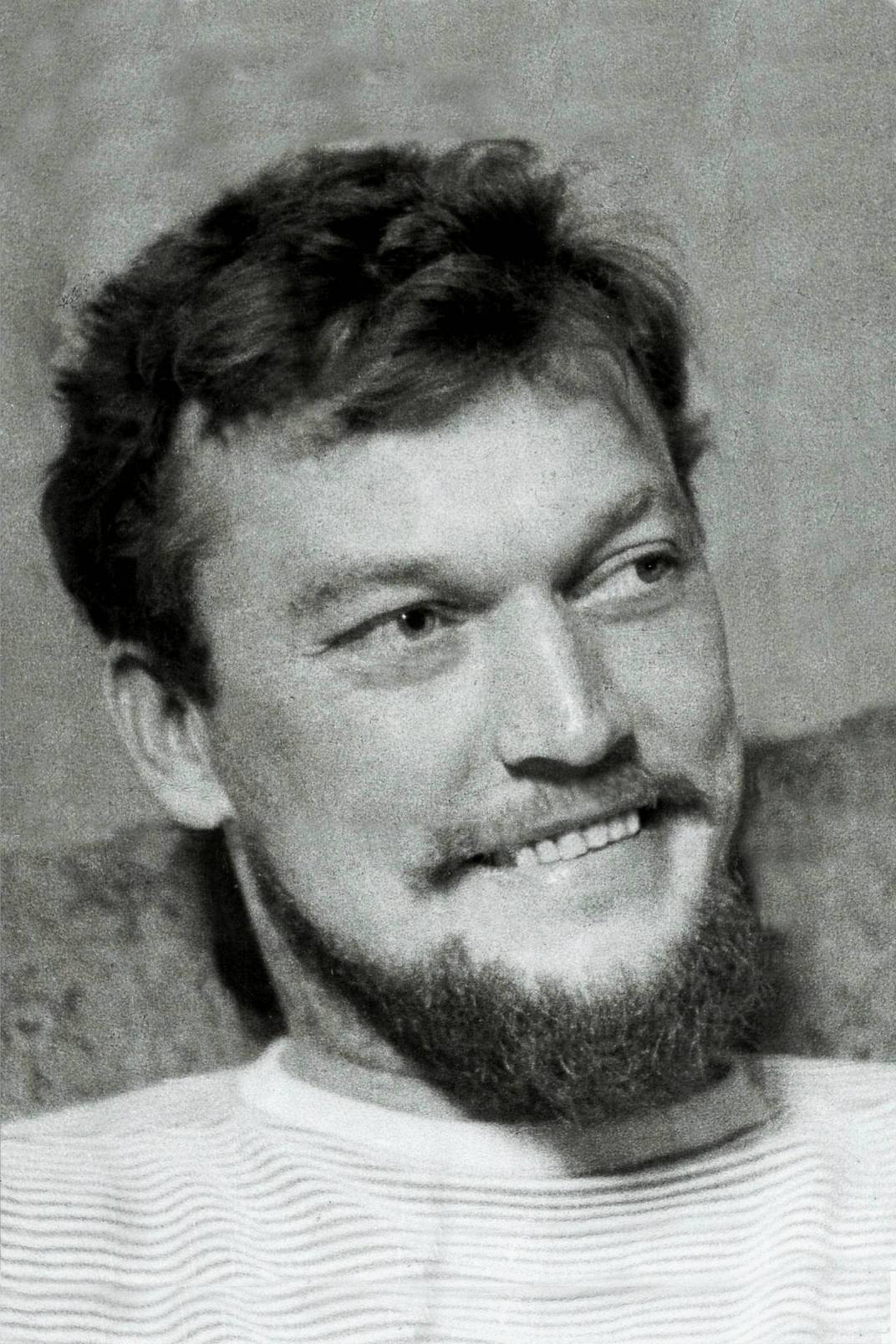 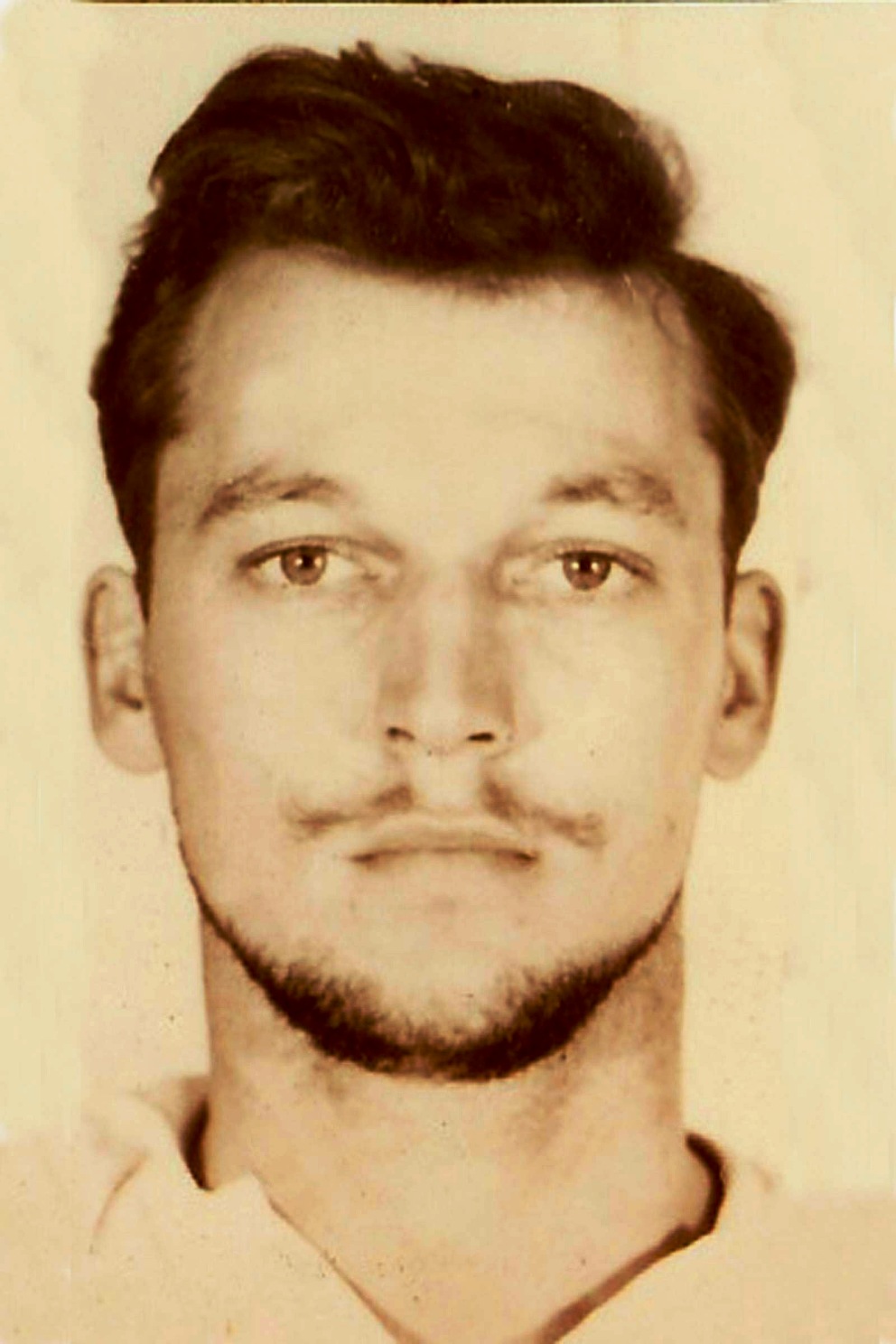 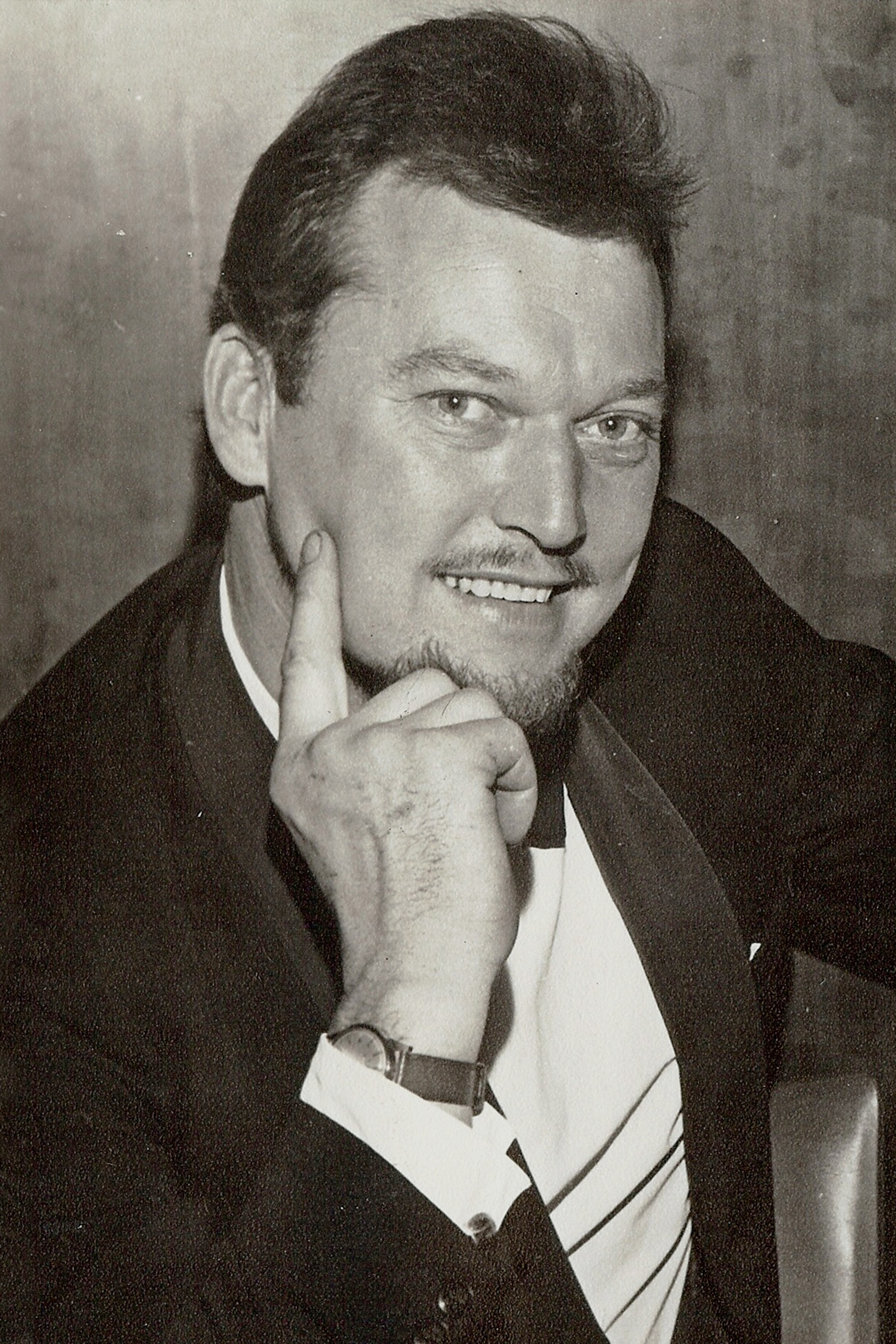
==========================
Behind his mystery stock car is Dennis's 1948 Buick Roadmaster; Here is a jpg of the stock car again, a photo that has ignited debates everywhere. Some have said it's a Ford Model A "doctor's coupe", some have insisted it's a Hudson, a Hupmobile, a Dodge, and a Nash.
Brian Lucas, a Spedeworth fan and hot-rodder first raised the "Nash"
possibility, which was researched by a Nash expert in the US.
The range of makes and models of American coupes in the period
1929-1933 is staggering, and it takes an expert eye to distinguish
among them. Dennis's car is a right-hand drive, and US mfrs built such
cars for export to Australia, South Africa, and the UK.
As of November 11th 2015, a Chrysler collector in Canada argues convincingly that Dennis's car was a 1931 Chrysler CD8 coupe, and these photos back up his conclusion: composite photograph; single coupe; and the characteristic Chrysler straight-8 engine. 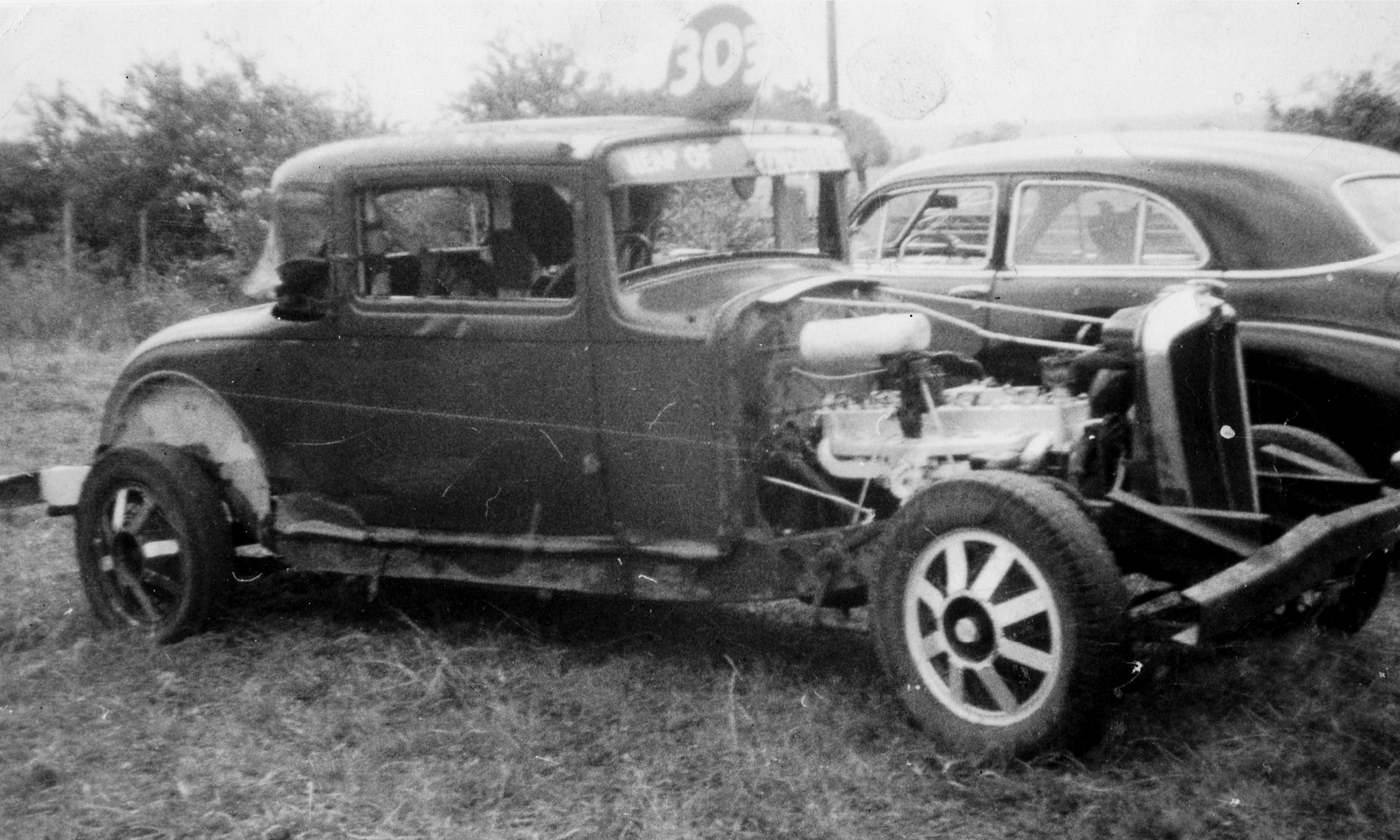
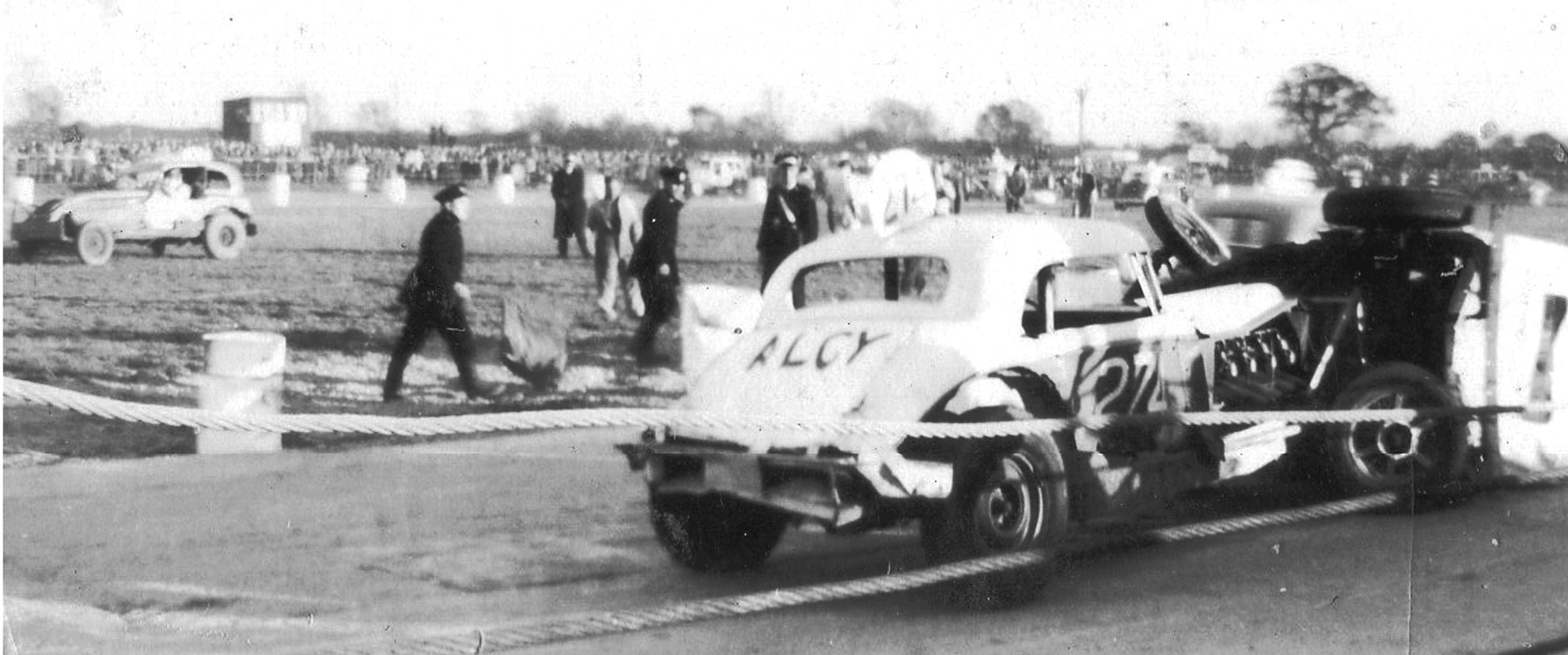
The stock car sunshield says "HEAP OF =========== CENSORED": Not what they are used to seeing at Goodwood and Silverstone! Below: Algy Shergold 272 has Dirty Dennis on his side, so to speak
 October 2015: Grant "Tiny" Tabor recalls the fun of working and travelling with Dirty Dennis: I laughed out loud at your section on Dirty Dennis :) He contributed to one of my scariest moments with a stock car. He used to park
his Austin Sheerline and stock car on trailer in the street in front of
his house and the local council was complaining; so for the off season
he was going to store them at Keysoe [the famous Cunnew settlement].
The last race of the season was in London, so Jayne [Douglas, from the USA] and
myself rode to Dennis's place then I was to drive his outfit home to
Keysoe. Went quite well till coming down the steep hill past the
airship hangers at Cardington :( It was the middle of the night
luckily, and raining and the trailer started to fishtail. I was using
all the road, bouncing off both shoulders :( We must have been doing warp one
when we went thru the village at the bottom because the only way out of
a fishtail is accelerate. After I stopped shaking I pulled over, untied
Dennis's stock car and fired it up (in the middle of the night) to move
it a bit further forward on its trailer to get more weight on the back
of the tow car. Needless to say we never even went close to the speed
limit the rest of the way home.
Dennis and family, probably off to Brafied: 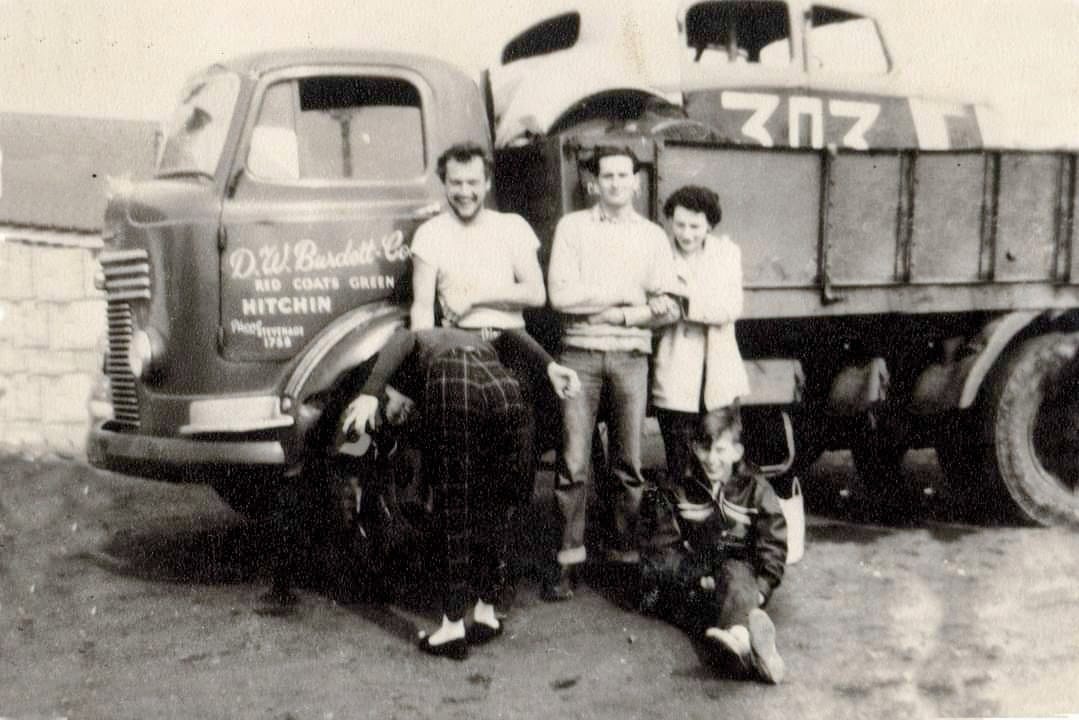
======================================================================================== =========================================================================================== Pals in the 1950's: 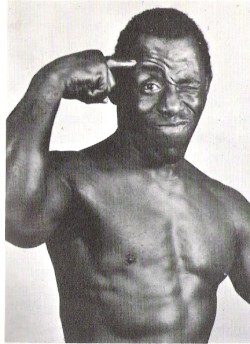 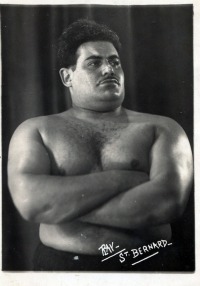
"On my left, Johnny Kwango and Ray St. Bernard!"
Ray was one of Raymond Way's salesmen, and his friend Kwango often visited the showrooms.
Below right: Raymond Way, inspecting one of Hermann Goering's custom armoured cars, which he bought and exhibited. 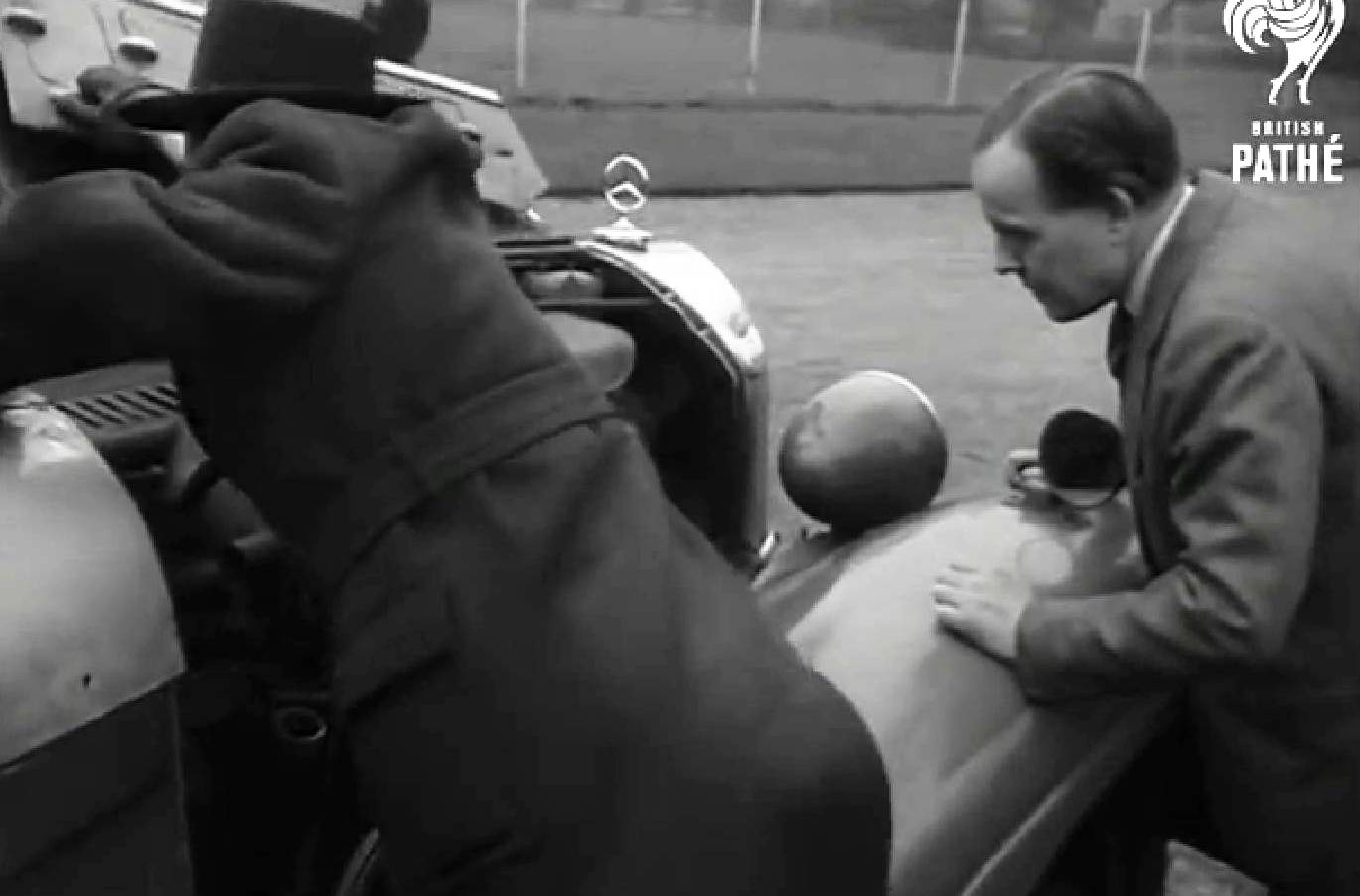
Below: just one of Way's many publicity tactics: sponsoring a stock car. 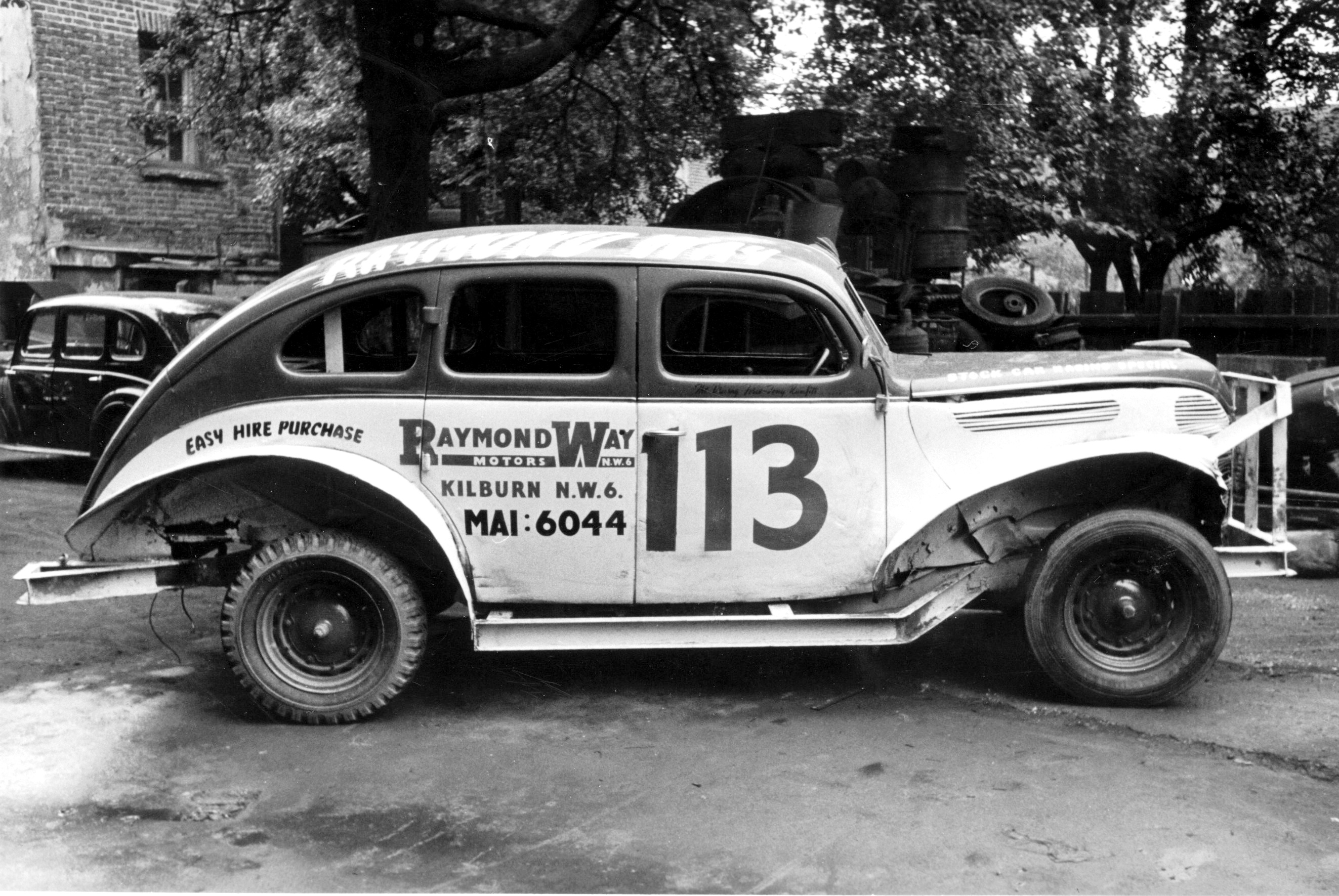
It had once been a 1939 Ford De Luxe: 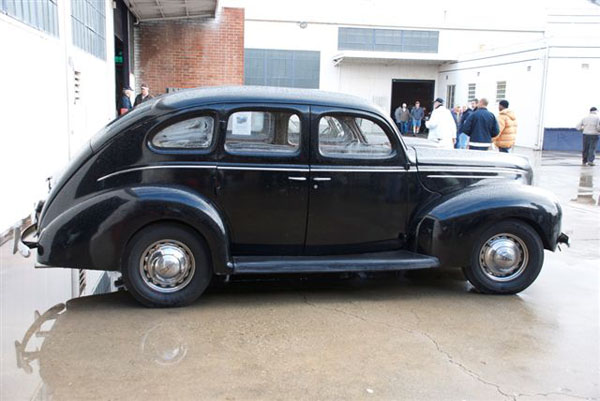
The superb photo of the 113 car was donated by Giles Chapman from his own collection the, Giles Chapman Library of images: http://www.gileschapman.com Giles has published this fascinating "nostalgia" book: 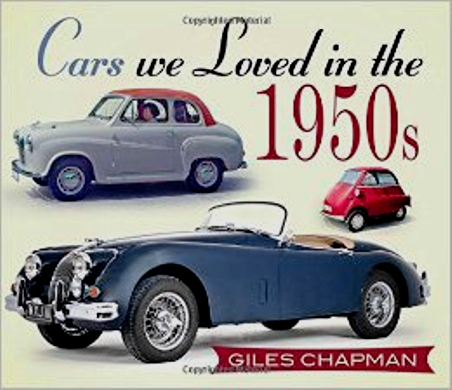 Giles
is currently writing a book on the die-cast rivalry between DINKY,
MATCHBOX and CORGI brands. It examines the HOT WHEELS invasion, which
CORGI fought back with their CORGI ROCKETS cars. When the book is
published you may see CORGI's models of stock cars by Todd Sweeney and Derek Fiske.
One trick Raymond used was to paste a large star on a
windscreen and let customers think it must be a special deal; but
really it was a car he wanted to get rid of quick! He once had a
mechanical elephant installed at his dealership.
Stock cars?
Raymond
flew his own Piper aeroplane over Staines Stadium, trailing a banner
advertising his dealership; where he kept the Piper, by the way!
Raymond hired out cars to TV series such as "Z Cars", and to
movies. RW used to price his cars in guineas,
to reassure working people who were struggling to afford a second-hand car that it
was slightly 'posh': just one of his psychological tricks.Info from Keith Barber: Way sponsored Tony Rumfitt, # 13, and Jack "Creepy" Crawley, # 113. Rumfitt and Crawley were successful motor dealers too, Crawley being a central London Mercedes dealer. Keith Barber designed the signwriting on Mike Shirley's 1947 Ford Coupe Heritage re-creation: These photos were taken by Lee Martin: http://euroclassiccartours.com/profiles/blogs/classic-stock-car-racing. ==================================================================== September 2014
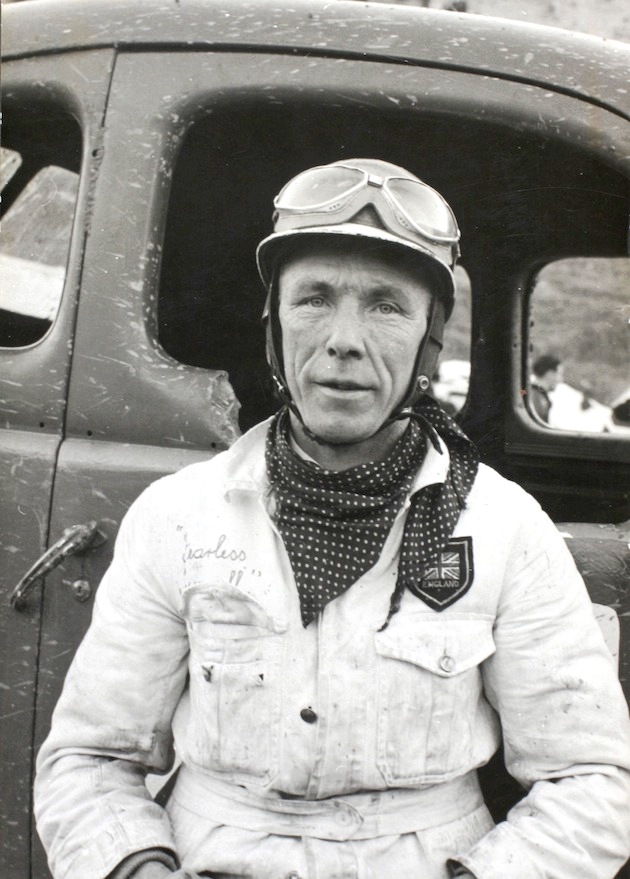
Fearless Fred Funnell
Fred
Funnell from Kent was a pioneer racer, part of the STAINES BULL
TERRIERS stock car team, pal of Jock Lloyd, and famous when the
Junior F2 formula arrived for the lurid "hot rod flames" painted
on one of his #58 cars. He was accidentally involved in a
tragic race accident at Lydden Hill in 1960. More happily, Fred
was one of the English racers who used to race in northern France in
the fifties, a time when stock cars on both sides of the Channel were
still similar. He patriotically painted his helmet "British racing
green" for the occasion. Fred had also raced in speedway and midgets,
and is fondly remembered today by his contemporaries Don Roomes and
Chris Totter Holmes. This terrific portrait shows the kind of
shrewd, "chipper", rough and ready, tough-spirited face we saw
everywhere in the early days of stock cars, but which doesn't seem to
exist any more in today's relatively pampered age.
September 2014 Pat Frost working on a wheel:
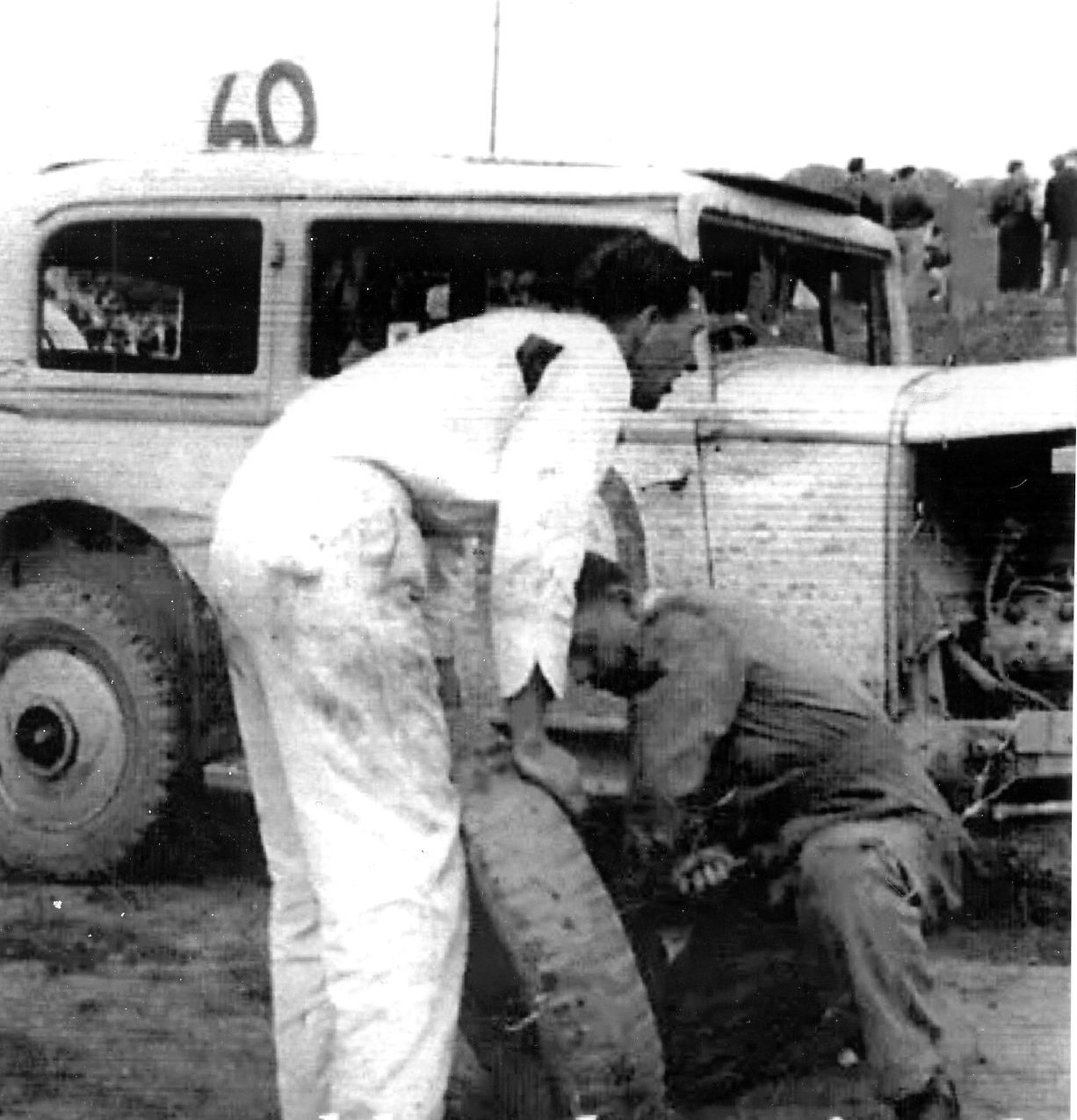
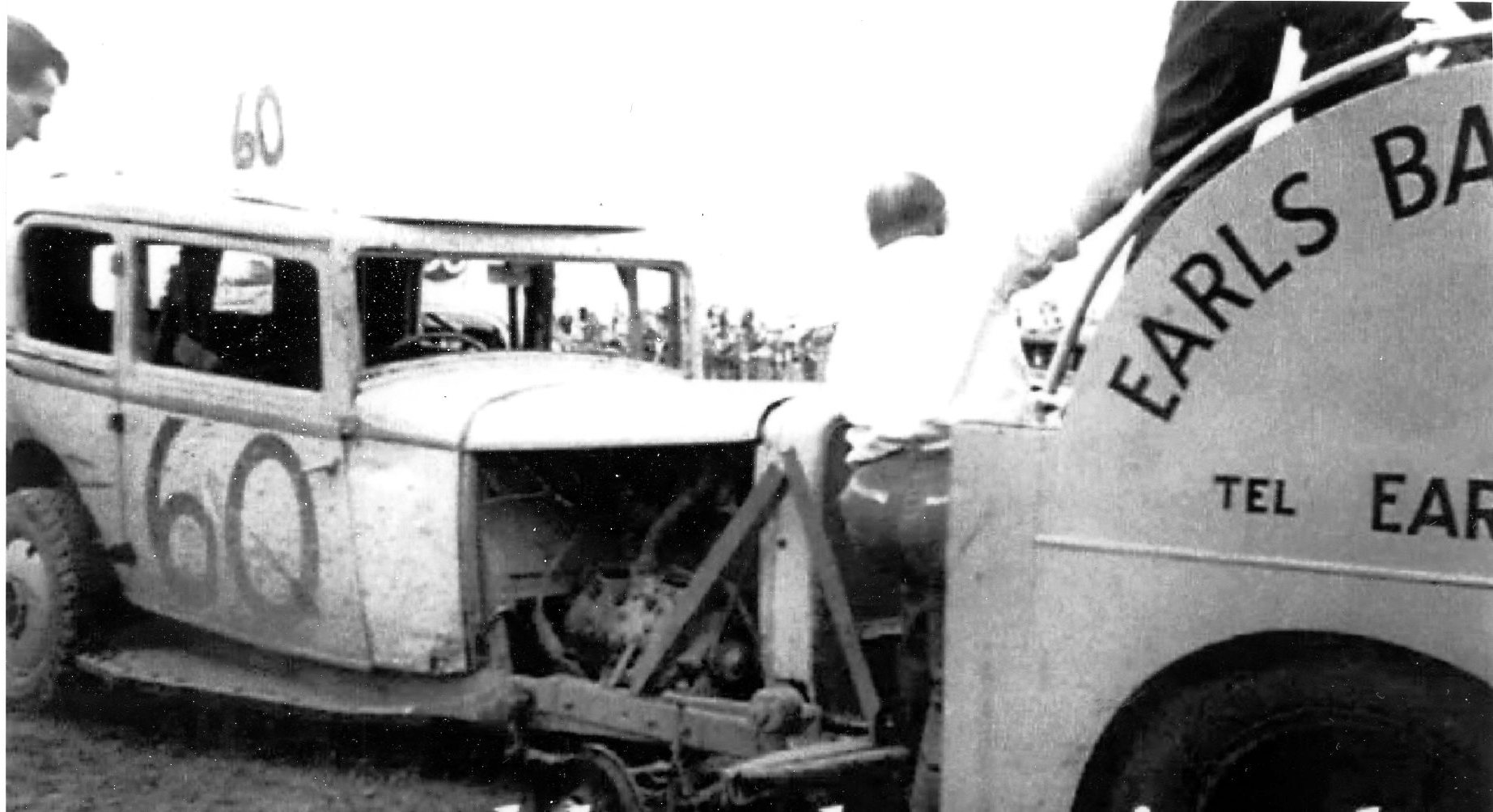
On "Aubrey's Hook" at Brafield:
Pat Frost #60 next to his brother Trevor #68:
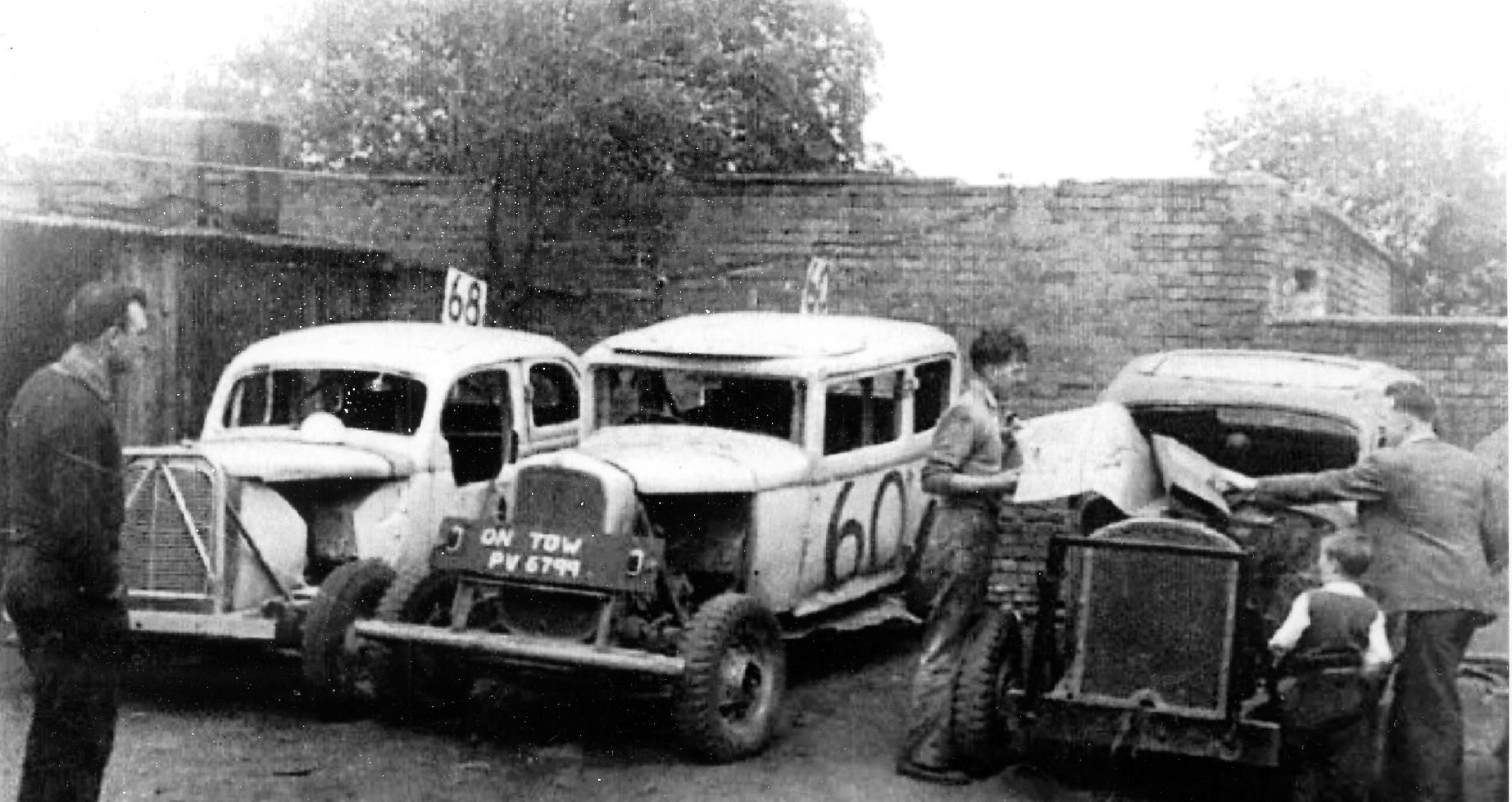
Pat
Frost raced in the fifties and sixties, first in BriSCA, later with
Spedeworth, and was a famous name in the East Midlands and East Anglia. January 2014: Excellent Pathe News feature from 1958 of stock car racing and stunt driving at Matchams Park (Ringwood): http://www.britishpathe.com/video/girl-stunt-driver-aka-stock-car-race/query/matchams+park January 2014:
Rough-n-ready was the spirit in the early days, and racers like
Pete Tucker and Dick Sheppard insist that real fun ended when the
1950's drew to a close.
I urge fans to get hold of Dick Sheppard's
marvellous book of memoirs, CLOSE TO THE EDGE,
to enjoy the
full-blooded larks and scrapes and busted knuckles that went with early
stock car racing and stunt driving.
Dick raced with Jumbo
Tustin
and with Geoff Harrison, and their cars can be seen here:
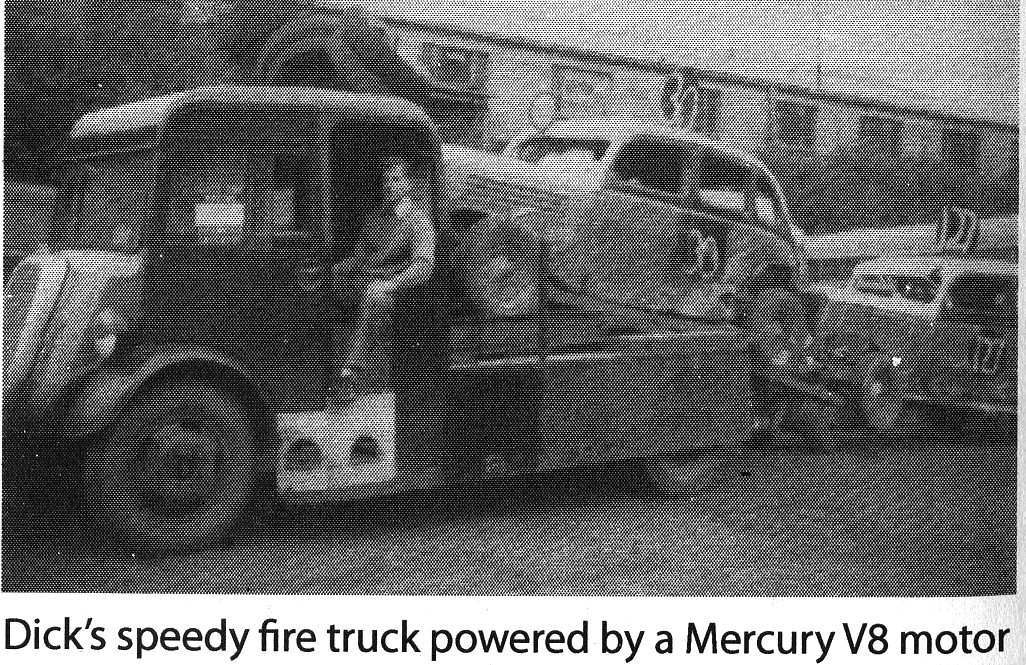
Dick
asked specifically for number 30 to be his registered racing number as
soon as roof fins were mandated; he found that standard 30mph
speed limit road signs were just the job! Dick Sheppard also managed to
drive one of his stock cars on the road, in the face of much police
interest.
- At one point he built his front and rear bumpers from massive semi-circular crane "slew bearings" and counterweights.
- On this car, the railway-sleeper bumpers and steel visor make it look like an early Star Wars weapon.
- Dick poses while climbing into his car.
- Dick receiving a points trophy at Brafield after an intense rivalry with Aubrey Leighton. The presenter, Rochelle
Lofting worked as a vaudeville / B film / glamour model in the
fifties and sixties. Her first husband was stunt man / muscle poser
Gerry Lofting who banged the gong in Rank films credits.
- Ian Melton identified Dick Sheppard's
car,in the Brafield pits, 1957-ish.
Dick had been driving a 1937 Chevrolet, but this car is a 1935 Ford 48 five-window coupe, with the 3.6 litre V-8
flathead.
Dick Sheppard also spent a lot of time putting on stunt
performances at showgrounds. During his long stunt career in
world tours and in movies he wrecked 2,003 cars, and at the ripe old age
of 80, Dick made that 2,004 wrecks when a careless driver sideswiped him on a Gloucester street, fortunately without causing injury. Dick had earlier ridden speedway
bikes for the Brandon Bees and Swindon Robins, and as late as 2004,
along with Jumbo Tustin, he attended Geoff Harrison's funeral and
memorial buffet; "One of the originals" said Roger Harris. In 2010 Dick Sheppard published a brief autobiography called MY WILD YOUTH IN GLOUCESTERSHIRE
through Waterstones bookshops. Dick is still alive and kicking in his
eighties today, as competitive in skittles as he was on the cinder
tracks and fairgounds. http://www.dicksheppard.co.uk/?p=107. Check it out.
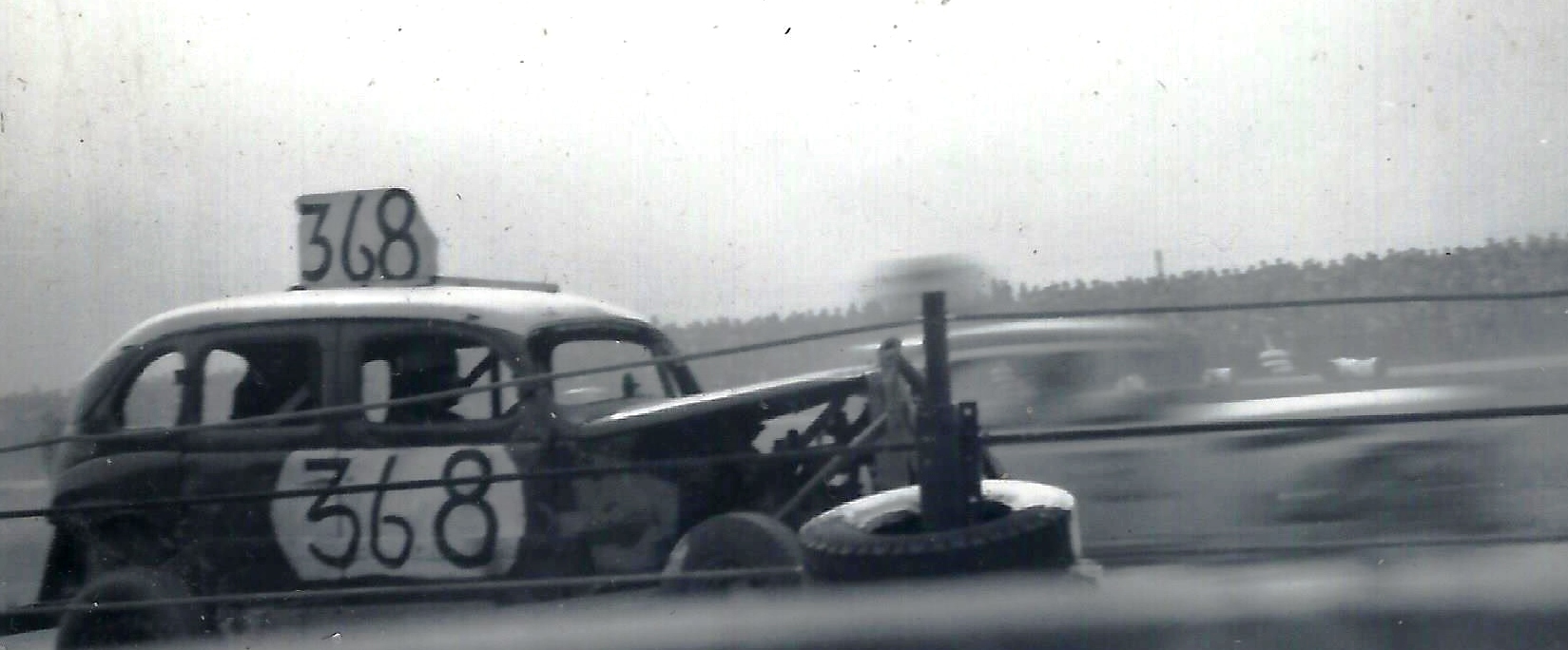
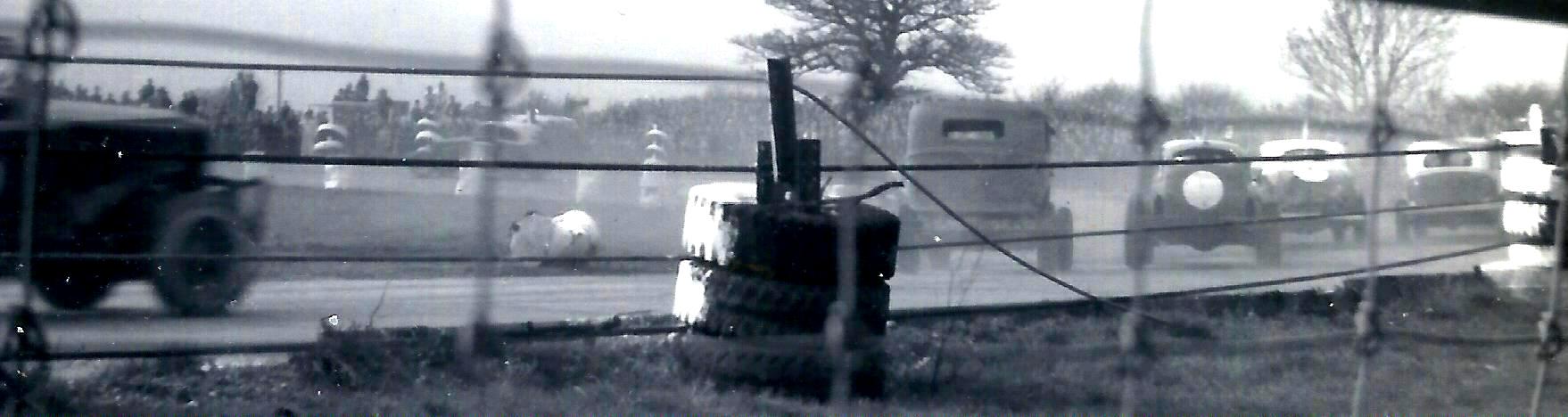
Russ's second photo below shows a crowd**
enjoying three-wide racing. Russ suspects George Foulger (another
farmer, but from Norfolk) is driving the "bulbous rear end" car, which
George lettered "EAT MY DUST".
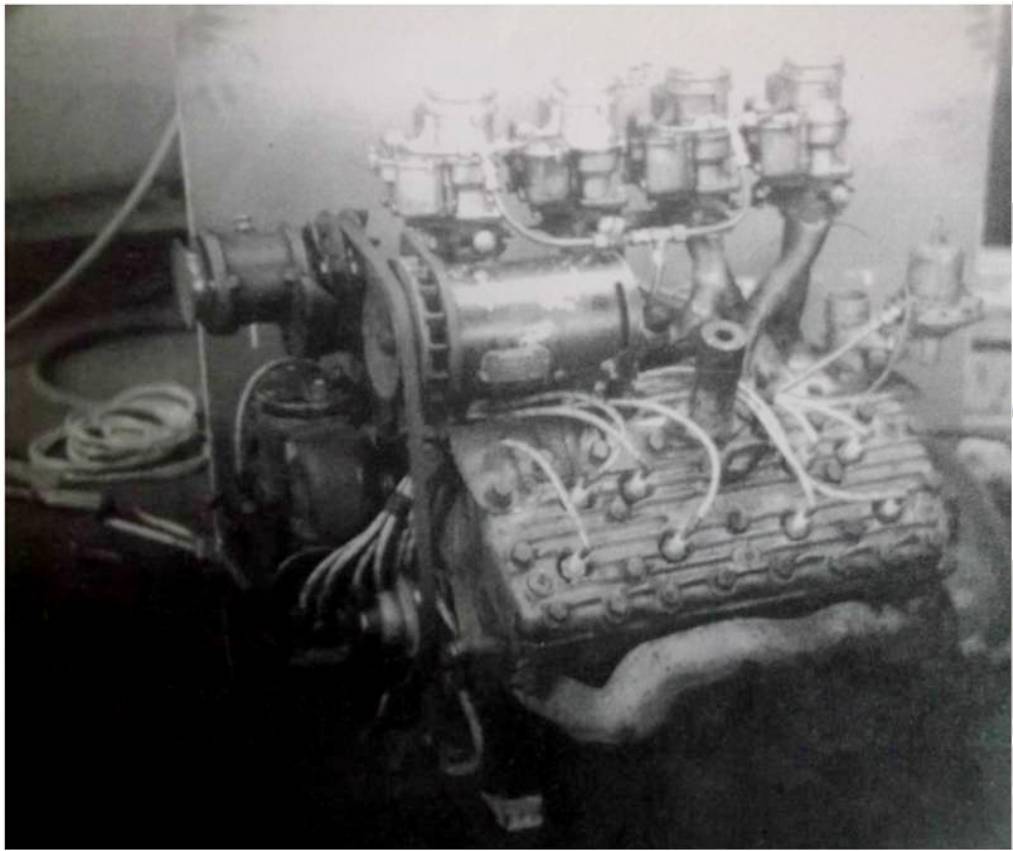
September 2013: New Zealand stock car racer Gary Wike
used this very special Ford sidevalve V-8 in 1960. The photo is
in the NZ HISTORIC STOCK CAR CLUB's newslatter. The engine is
described as having "Hogan" cylinder heads fitted with twin plugs per
cylinder, fired by twin ignition systems, and fuelled by four
carbureters standing on "twisted-leg" intake runners. The distributor
was "probably" a Nash, as Nash used twin-plug heads on their straight-8-cylinder
engines in the 1930's. The Hogans, father and son, were NZ engineers who made their own custom finned alloy cylinder heads. Hot stuff!
January 2013: Courtesy of Datchet racer Roy Clarke, here are two photos of his bro-in-law Pat Willis at Brafield in 1957 in his Packard: 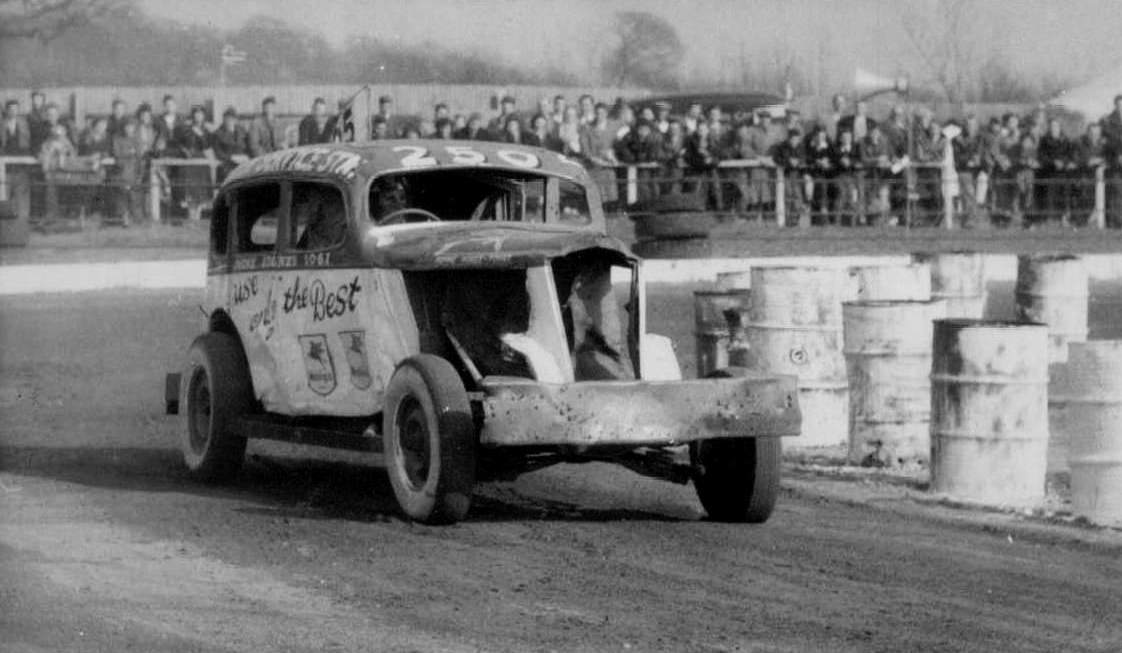 The
engine is invisible, even with the open hood, but at about this time
Pat installed an enormous GMC straight-six out of a WW2 "Boarhound T18"
armoured car (an eight-wheeled 20-ton beast) of which only 30 were ever
built.
--- and here Pat enjoys an argy-bargy at Brafield with Nottingham's Reg Saul #10.
January 2013: They were a special breed, the men who pioneered the sport of stock car racing in England. One of these was George Teece,
whose son John has sent these historic photos. Sponsored by Bray
Motors, below he is on the way to a 1954 Harringay meeting (both cars are 1936 Ford coupes): 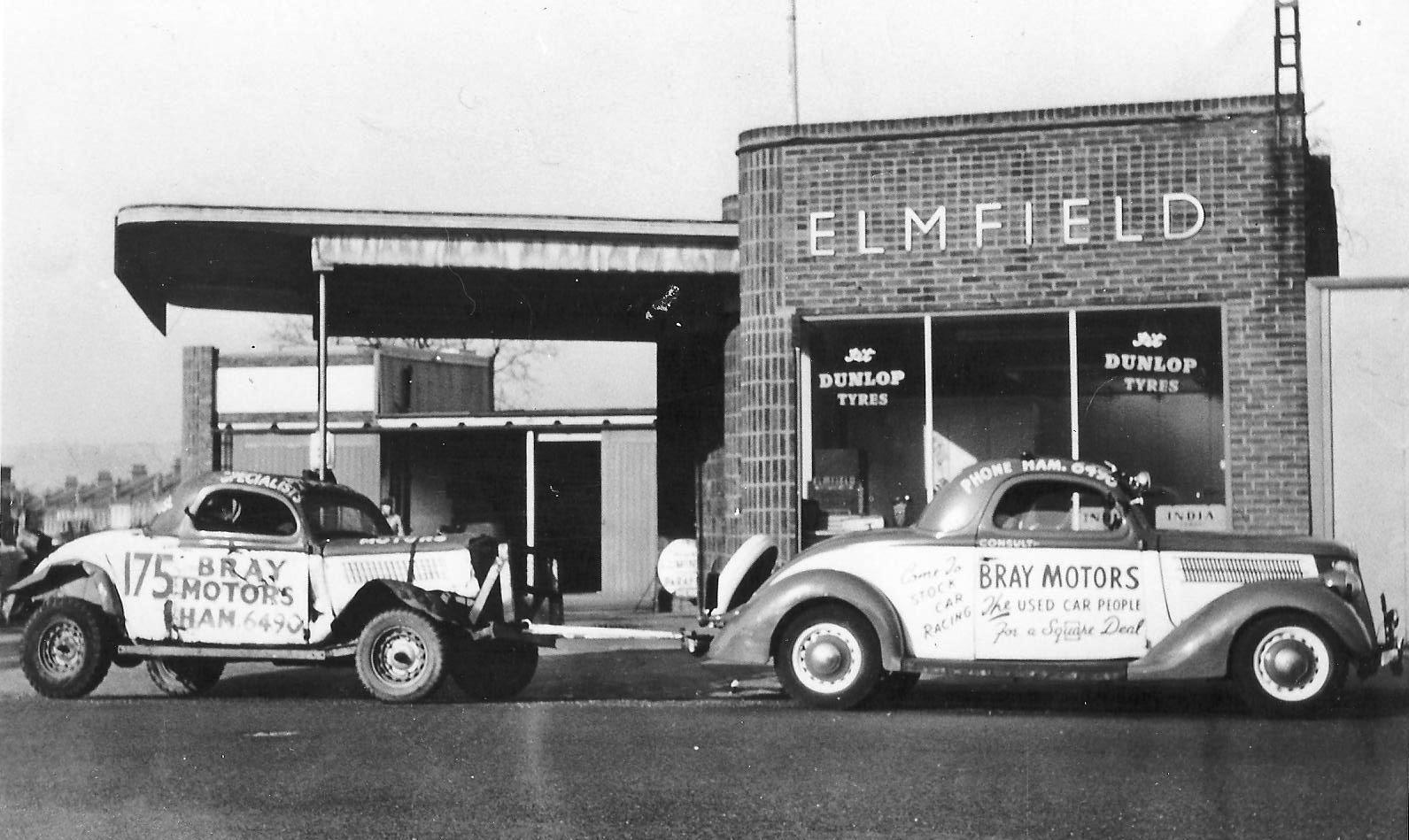
At one of the April 1955 meetings, George Teece went neck-and-neck with "Crawfish" Cryder of the USA. Here's the programme for that meeting with some names out of history. In 1954 at [possibly] Rayleigh, cars are still wearing their window glass; George is #175. At West Ham George met the fence hard;
John points out that this car was originally a convertible but had a
hard top welded on; see the odd curves and seams. George favoured 1936 Ford coupes, of which he
had several. In 1956 at Rye House, George (in overalls and tie) presented the trophy to Pete Tucker. Note:
Although George hung up his helmet in 1960, the racing bug bit again
in 1965, and you can see George Teece's later exploits on the JUNIOR F2
page.
==============================================
May 2012: Sheffield's Owlerton Stadium opened in 1954, and a wise father took his son, then 10-year Neill Crookes, who sent the following historic photos. Neill comments "I just had to take up racing at some stage after watching these pioneers ." Neill's later career in F1's in the sixties and seventies can be seen elsewhere on this site. - Mind the wood! Ivor Roddis of Sheffield drives a "woodie" station wagon.
- In street-ready condition, a black Hudson Terraplane driven by Ginger David of Manchester.
- Last but not at all least: Who but a Sheffield garage man would race a 1925 40/50-hp ROLLS ROYCE
on a stock car oval? Joe Proudfoot of the Niagara Service Station is
the adventurer. According to Rolls experts, this car is probably a
Silver Ghost Landaulette, or a newer Phantom 1, with bodywork by
Hooper, and a six-cylinder engine [two banks of three] of
7 litres capacity. Today, if it survived in one piece, worth maybe
£160,000. It surprised me to learn that Rolls-Royces were
not particularly valuable,
and in 1954 ones like this were selling for as little as £100, because they were
already 25+ years old and in postwar Britain simply too expensive (petrol) to own.
These photos are from the archives of Sheffield's TELEGRAPH & STAR, part of SHEFFIELD NEWSPAPERS.
April 2012: Long Eaton:
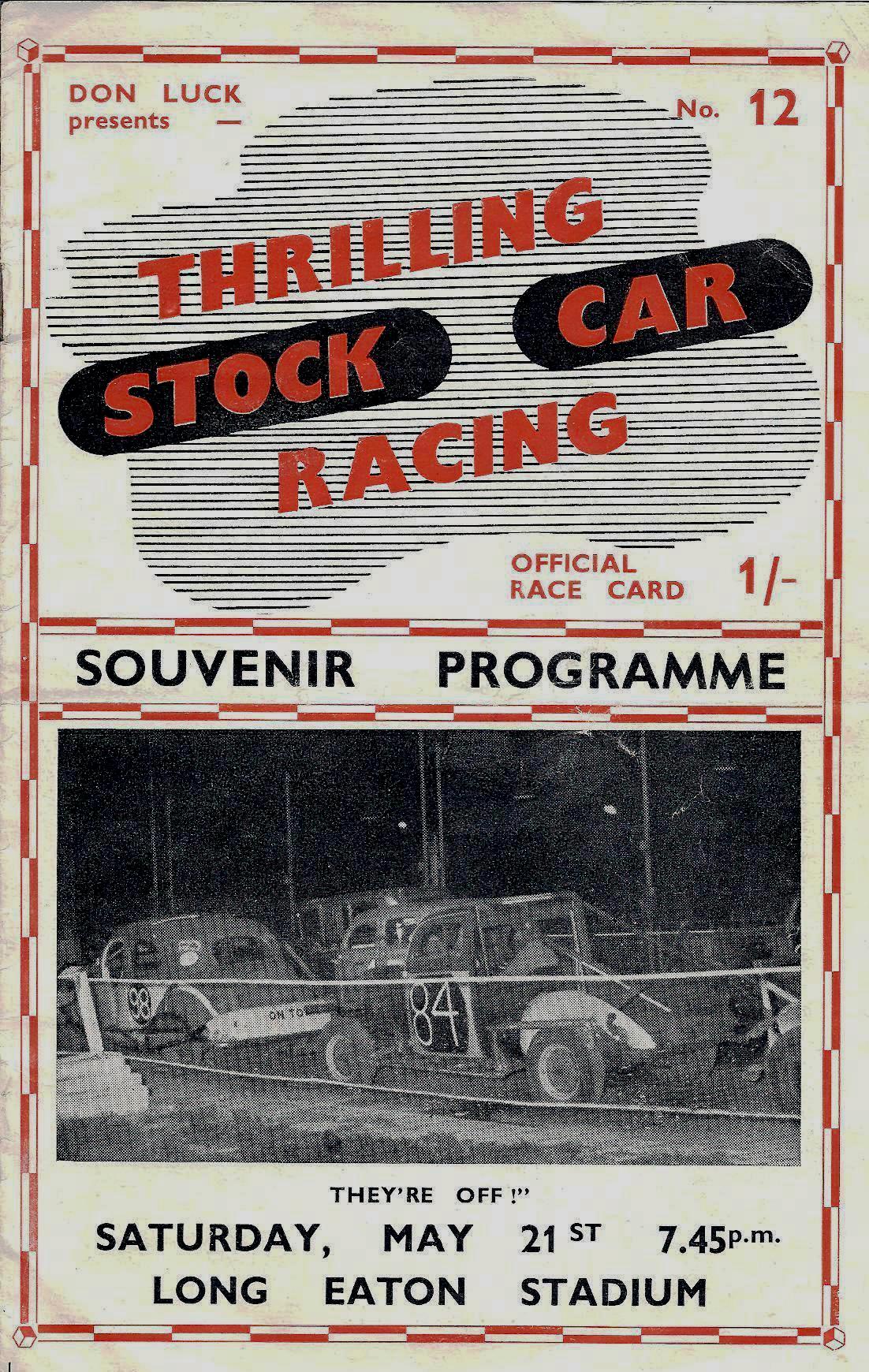
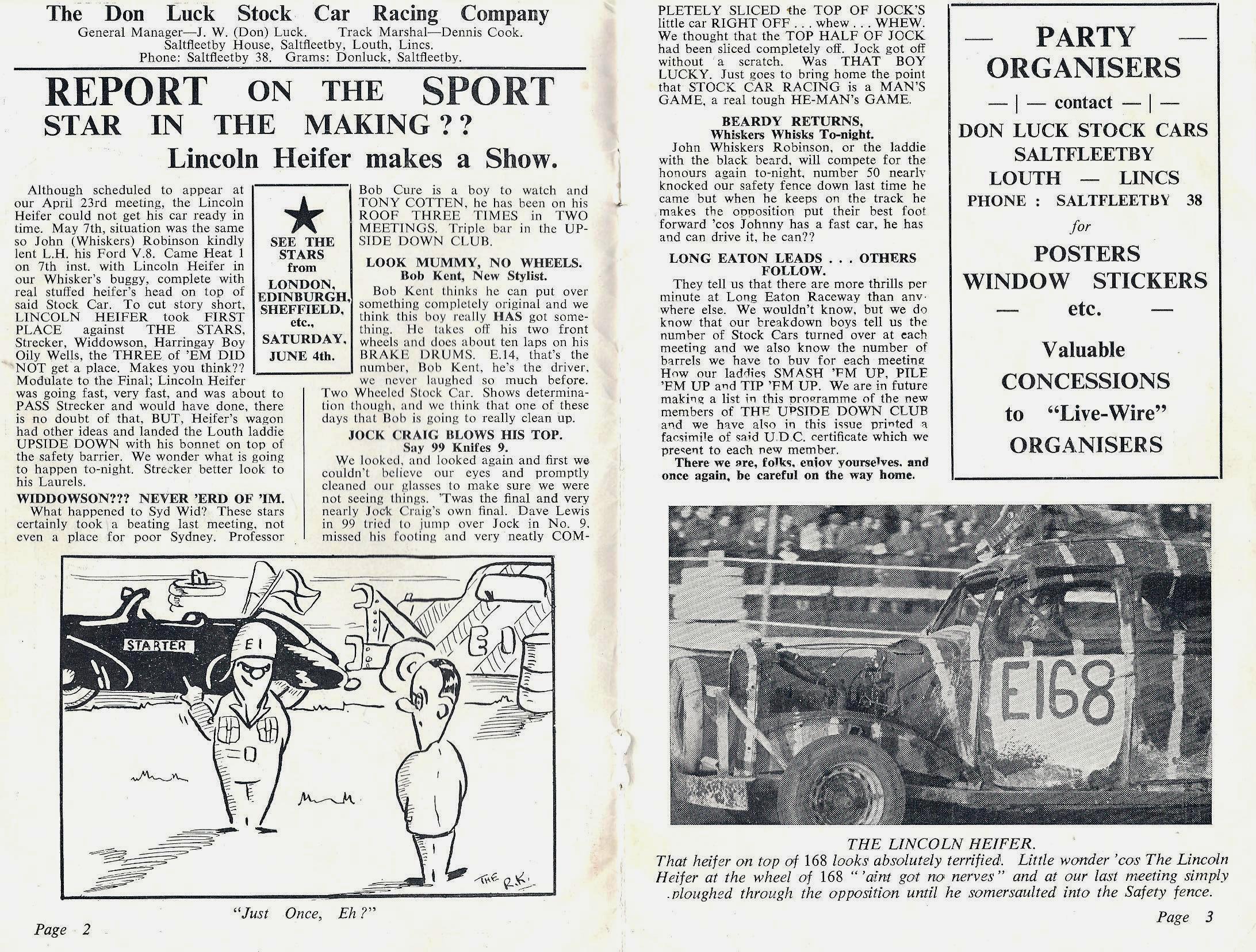
Thanks to Jim Luck, we have a unique glimpse of the birth of stock car racing at Long Eaton. Jim's father Don Luck
was a pioneer in the sport who deserves credit for starting things off
at Long Eaton in 1954, though he also promoted at Scunthorpe that year. Don Luck was
a theatrical agent, promoter and impresario. In his short career
he made a mark with several artists before they were really
established, including Jamaican trumpet king Leslie 'Jiver' Hutchinson; black singer/percussionist Frank Holder; Cleo
Laine and John Dankworth; Joe Daniels and his Hotshots, and many others
both during the Second World War and just after.
Don was also a deputy
stage manager at Butlins Skegness pre-war.
On Saturday 17th July 1954 year, the Don Luck Stock
Car Racing Company
opened the gates to a huge crowd who saw Grimsby farmer John
Robinson win the final. Thanks to Don's
initial enterprise, the sport continued at LE until the stadium closed
in 1997. Sadly Don Luck --- just visible between the Red Knight
car and the safety tyres --- passed away too early in 1963, but this
oil-on-board
painting celebrates that lively first year; the only car I can identify
for sure is the 42 of "The Red Knight" who was Gene Mace. Early car
numbering systems were unpredictable!
Note: please respect the copyright of this painting, which belongs to Jim Luck. Higher-res. image link here.
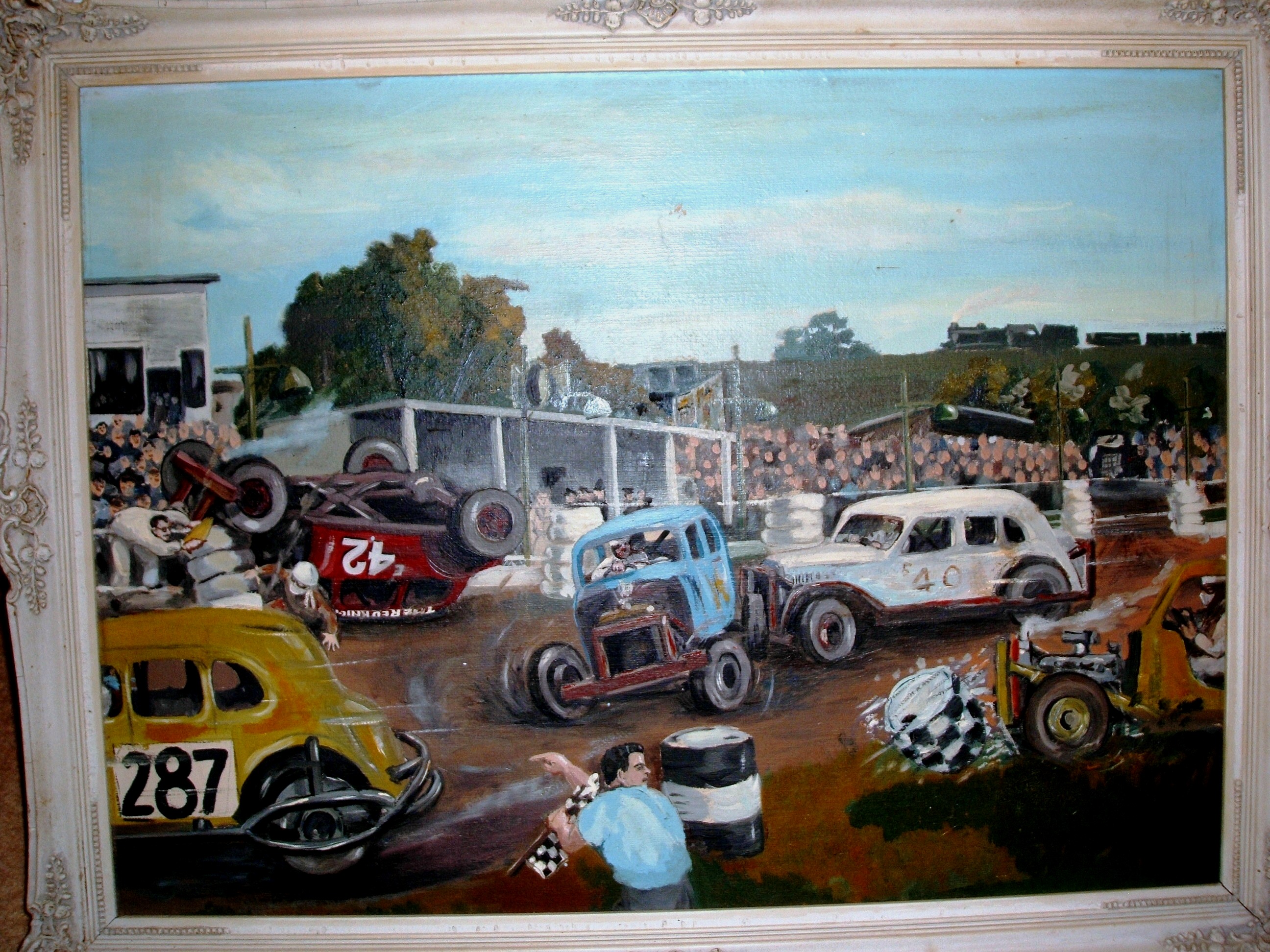 You'll notice that the bright red 42 car, "The Red Knight" is especially
well-detailed; that's because the oil painting was done by its
driver, Gene Mace. He used artistic licence in omitting the "A"
prefix used by Northern Stock Car Association drivers, (287 of
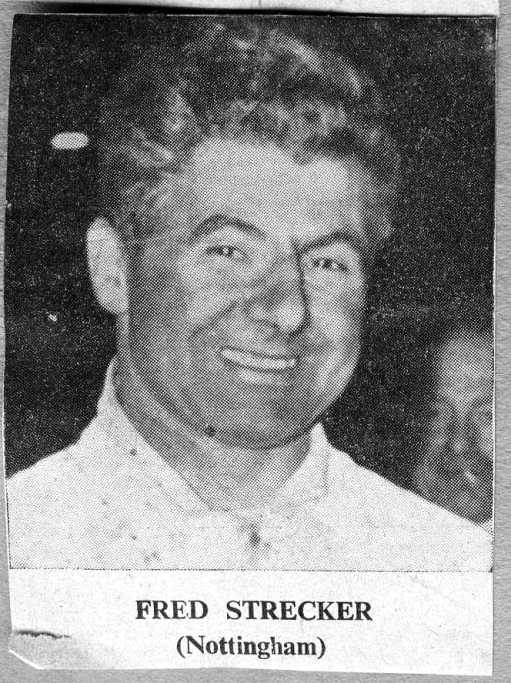
Fred Strecker and the 40 of Norm Crane) [thanks to Ken Mason for pointing it out]. Keith Barber reports that Mace was an accomplished signwriter as well as a stunt driver.
[The person on the far right --- is that a man or a woman? --- Jean Forrest was one of LE's early racers.]What the Press said about Long Eaton's first season; jpg files can be enlarged for easier reading:
January 2012: IMPORTANT HISTORY:
In
1955 Digger Pugh stage-managed the American tour, bringing over some
hot US cars and drivers to promote the new sport at tracks around the
country. Much has been written about the tour, especially well
researched by Keith Barber, in his Stock Car Magazine and books.
I will leave the detailed and fascinating story to Keith's publications
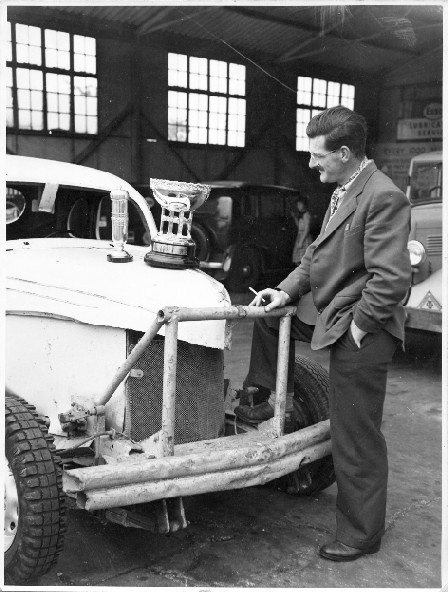
past and future, but here I will show the Harringay Television Trophy that was presented to Bobby Myers by 'Sabrina' after he won Britain's very first televised stock car race.
This trophy resides today in North Carolina, in the care of the late Bobby Myers' son, Danny. Danny 'Chocolate' Myers
is a NASCAR legend in his own right, having worked for Dale Earnhardt
and the Richard Childress team for many years, as well as hosting a
NASCAR radio show nationwide; his wife Caron is a NASCAR journalist and
TV reporter. Here is a large high-res image of the trophy seen below, and here a close-up of the engraving. 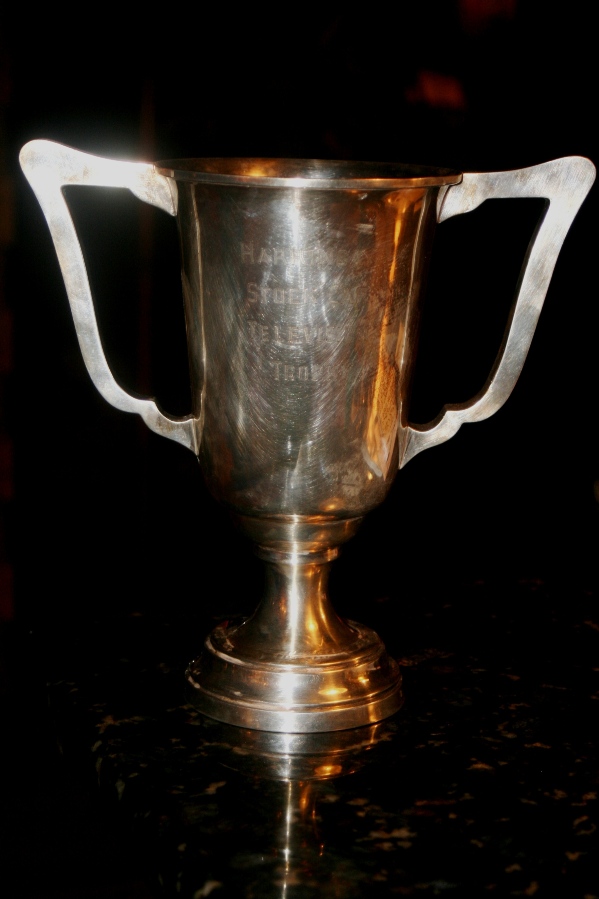 Bobby Myers received not just the trophy but this autographed photo of Sabrina, dedicated "All the best, Yank". Bobby Myers received not just the trophy but this autographed photo of Sabrina, dedicated "All the best, Yank".
The
trophy remained in England with a garage-dealership that Myers had been
associated with during his tour, but they kindly returned the trophy, with this letter, to Bobby's widow when Bobby lost his life in the 1957 Darlington 500.
Final
piece of trivia is this letter of agreement from Digger Pugh's
company to Myers, giving the guidelines for his important appearance in
the Harringay televised race. I would like to heartily thank Caron and Danny Myers for contributing this information and the unique photos.
January 2012: From a 1959 West Ham programme [possibly not taken in 1959 ---]:
- Dave Isaacs from Ilford had the honour of wearing #1 from 1957 to 1963.
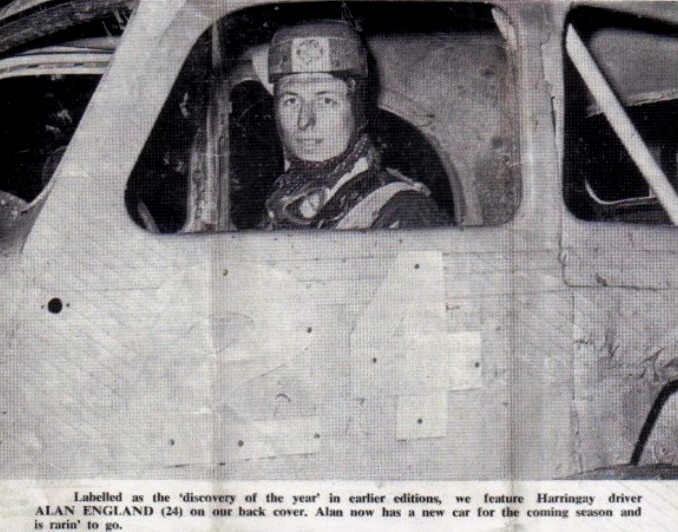
- Mystery man --- the #24
belonged to Lincoln's Ron Grantham in 1957 and to Long Eaton's Alf
Giles in 1958. But the name seems to be Thorne or Horne [which
don't appear in the Greenwood book at all) and "Killer", but Killer
Sayers was 81 and 98 in that era.
- Steve "Perce" Lovegrove #190 was from Tooting, and he isn't 'tooting' here.
November 2011: A legend reborn in three stages
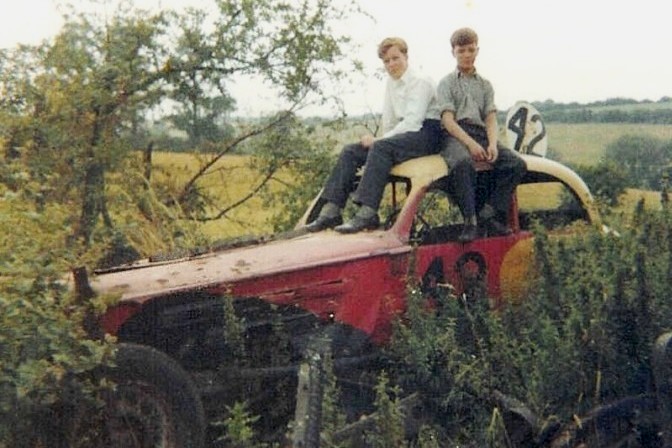
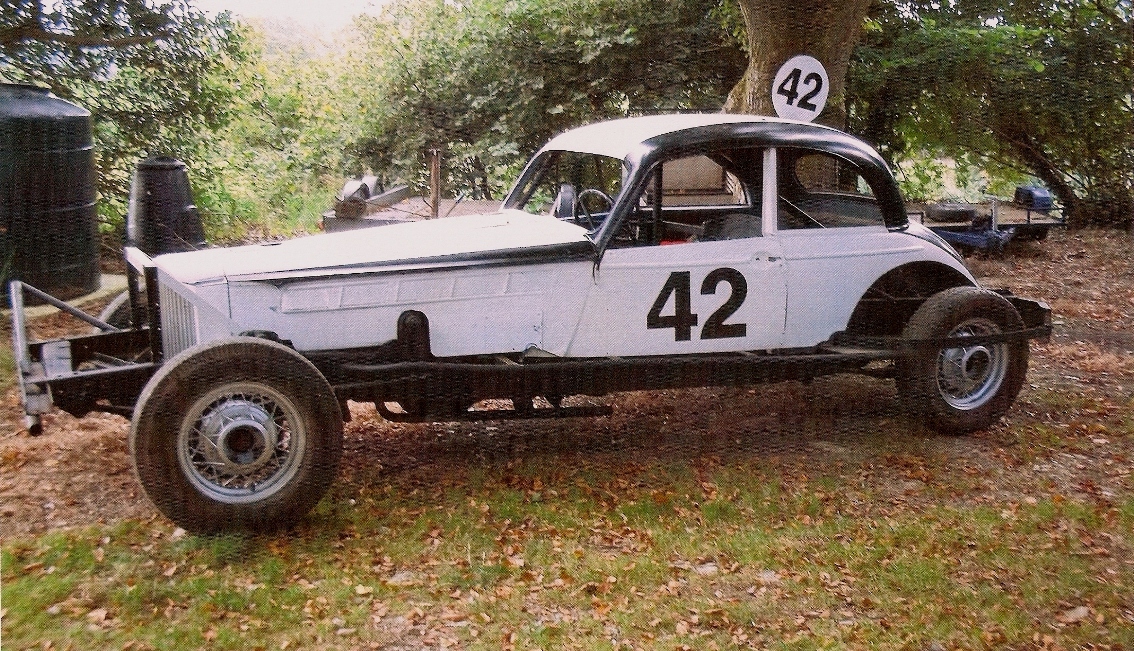
Top: Aubrey victorious at Brafield in the notorious Packard
Centre: Aubrey's son Keith and friend Steve Gateley with the Packard 'retired' in the weeds at Earls Barton Motors
Bottom: In 2011, the superb Keith Barber recreation of Aubrey's famous car, photo courtesy of Keith.
November 2011: Thanks to Dick Sheppard for this historic photo of Jumbo Tustin's "Ice Cream Cart" , date and track unknown, with a mysterious face in the background.
September 2011: Future champion --- thanks to Don Roomes, Jock's one-time mechanic:
- 1957 photo of Jock Lloyd, probably taken at Lydden Hill. The car was a circa 1936
Hudson Terraplane, of which several were raced as stock cars in the
fifties, as it had a torquey straight-8 engine of 4 litres.
- Here is Jock team-racing at Staines with the "Bull Terriers" team, in a Ford coupe.
- Jock at Brafield, advertizing his White House Garage.
- The paired cars of Jock and his good buddy Ken Freeman #61; their flathead V-8 coupes lookightly different --- is one not a Ford? Jock
raced under #13 only in 1957.
July 2011: Thanks
to John Jones for some memories of his father, the late John "Ginge" Jones from Maidstone, who made his living in the tipper business, and who raced under #144 and #146. Here is John heading into battle at Lydden against stars like Johnny Brise at
Lydden in 1957. John junior was a youngster
and somewhere in the background is his father's special 3-ton
"enforcer" with which he kept the enemy off Freddie Funnel's
back; there was some notorious unofficial team racing which saw a
few 'blocking' cars destroyed, and new upstarts given a sharp lesson!
Young John was watching on that fateful
day when Freddie Funnel's ramp stunt went wrong. John Jones also used the old
methods: a club hammer
for repairs and mustard for sealing a leaking radiator. His son
John reckons today's "pretty" racing can't compare with those good old
days. Like Aubrey
Leighton, Ken Freeman and a few others, "Ginge" Jones didn't get
through WW2
unscathed, but its effects didn't slow him down.
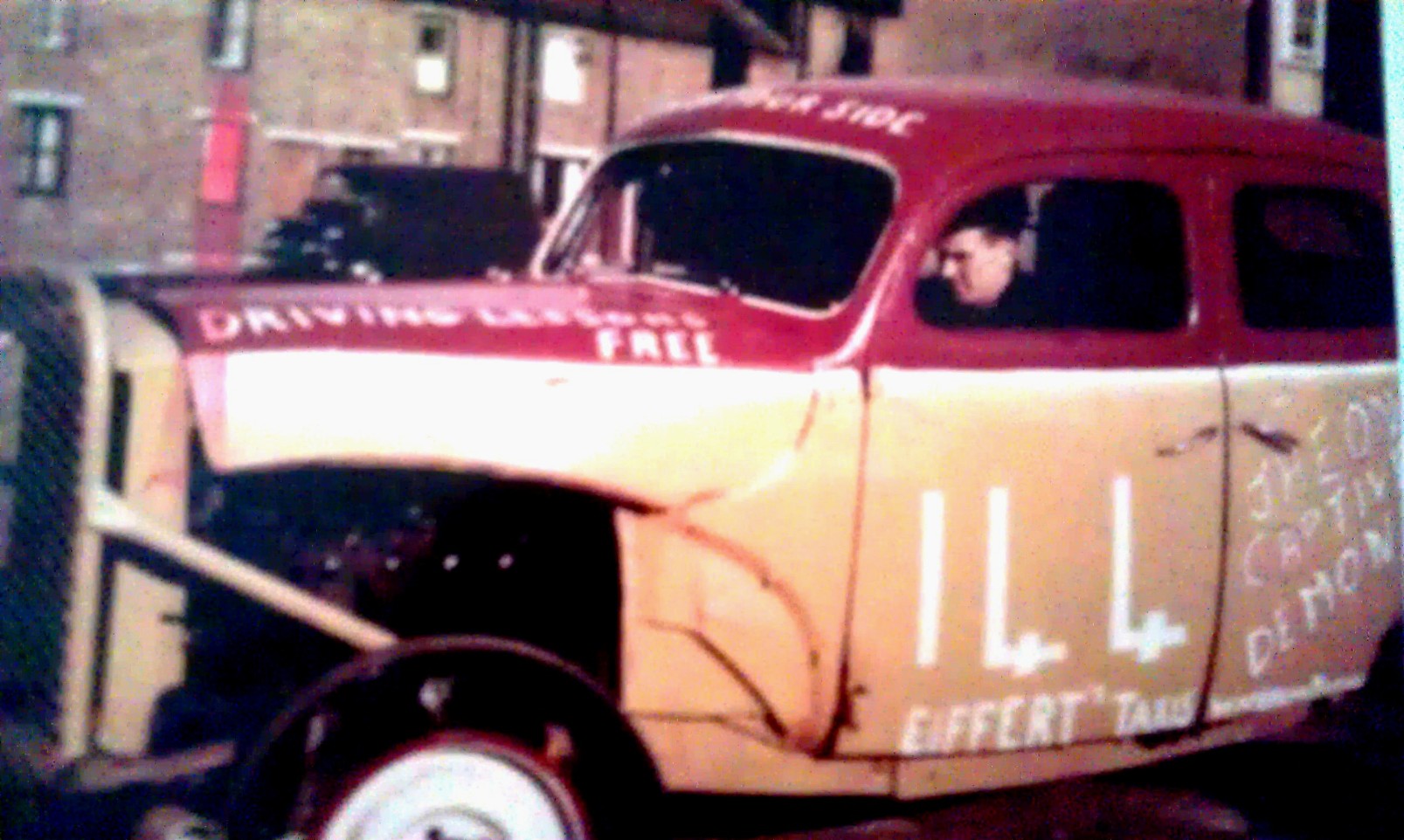
John and his Maidstone mate Bobby James sometimes shared cars. Below
is a 1957 photo of "Ginge" Jones, with some imaginative signwriting:
--- like "The Only Captive
Demon".
Here's a question: "What are stock car people like?"
Here's your answer:
John Jones had the stock car on his truck, not far from Lydden on
the Dover Road when he spotted an accident with an overturned van off
the road. Without a second's hesitation he stopped his truck, jumped
out, got people to lift the van up a bit, while he crawled
under the van to get out an injured young woman, ignoring dripping battery acid and the likelihood of fire. That's what stock car people are like --- okay?
May 2011: Don Roomes kindly scanned this recent newspaper clipping, which included a 1950's photograph from Staines. Note: --- the current researcher on Staines history is listed as a sidebar above the photo. Caution: the journalist got something wrong: no "Bona Callino"
acted in STOCK CAR, though the other actors are correctly named.
However, there was an American stage and film actor named Bonar Colleano,
who died in a car crash in Birkenhead in 1958 ---- and the Jaguar XK140
he was driving became the basis for Jock Lloyd's 1961 World
Championship stock car! Eerie coincidence -------. The
newspaper also misspelled the name of Alec Le Croisette (#283, 1957-59). January 2011: John
Dyson sent a Leicester programe from 1955, but since it was for the first
meeting of the year, its photographs were necessarily from the 1954
season. Here are four photos of the wild men who pioneered stock
car racing there:
- Car 218A is Edinburgh driver Alan Roberts
- This driver cannily installed a spare wheel as side protection!
- It says 46 on the back, but 56 on the roof ---- so it's either T.J. Rowe from Hillingdon or less likely T. Addis from Cornwall. When this 1955 programme was printed, Ron Cerrone from B'ham had #46.
- Jack Tipping (that surname doomed him to race stock cars) had a TV aerial on his car "Gravel Gertie".
- Len Ogbourne from Northampton raced under 51 and 76, and others; this "pdf" file is from 19 April 1955. --- the item on page 2 will be separately shown as a jpg below.
- Poignant bit of history: From the same Leicester Illustrated Chronicle in 1954.
This young lad drove a demonstration lap at Leicester's track at age 6 in his lawnmower-engined jalopy. His name was Roger Williamson [1948-1973].
He became a successful kart racer at age 14, moved to saloons and
Formula 3, and eventually into top flight Grand Prix racing. Is the
name familiar? He was to die in the most appalling incident in GP
history, in 1973 at the Dutch GP. The crash and aftermath are
viewable, if you have the stomach for it, on various video clips. His
March 731 crashed and overturned in flames, and his racing friend David
Purley attempted frantically, without any help from,
and even with obstruction by, the race marshals, to upturn the blazing car and
pull Roger out, catching fire himself in his attempts, but in vain. It was a shock to
realize, when first assembling these old Leicester reports, that "this
was the lad".
More from Leicester history: 14 October 1954, and the Leicester Mercury carried these two columns:
Off-topic, but --- fans of the "goggle box" in 1958 could feast their eyes on this television listing
for the weekend, printed in Leicester's Illustrated Chronicle for
23 April 1958. On Saturday nights you could stay up late, till 10:45pm
to listen (sound only) to the news! Although the Midlands
started to get ITV in 1956, this schedule refers only to the BBC. Some of us remember with pleasure the good old
Range Rider on Children's Television --- bang bang.
My thanks to John Dyson for scanning these bits of history from his collection.
Aren't we posh?
DID YOU KNOW? The chairman of the Northern Stock Car Company in 1954 and 1955 was
Sir Henry Shiffner, 8th Baronet of Combe Park,
an ennobled family, (vice-admirals, MP's etc) one of whom
rescued the fleeing Charles II, by boat to France, after the Battle of
Worcester in 1651.
DID YOU KNOW? The first New Cross 1954 meeting, among its French contestants, included a horse-riding nobleman, Jean-Francois de Thonel, Chevalier and 5th Marquis d'Orgeix, seen here in his #11 car; he was author of Horse in the Blood: a Showjumper's Notebook. Racing too at New Cross was his wife, a famous French horsewoman Michele Cancre d'Orgeix.
DID YOU KNOW? At Belle Vue's meeting on September 1st 1954, the person chosen to present the prizes was Derek Charles Moore-Brabazon, 2nd Baron Brabazon of Tara, CBE, [Eton and Trinity College] otherwise known as Lord Brabazon of Tara, descendant of the Earl of Meath (peerage
created 1627). He was an aviation pioneer, and held the very first British
pilot's licence.
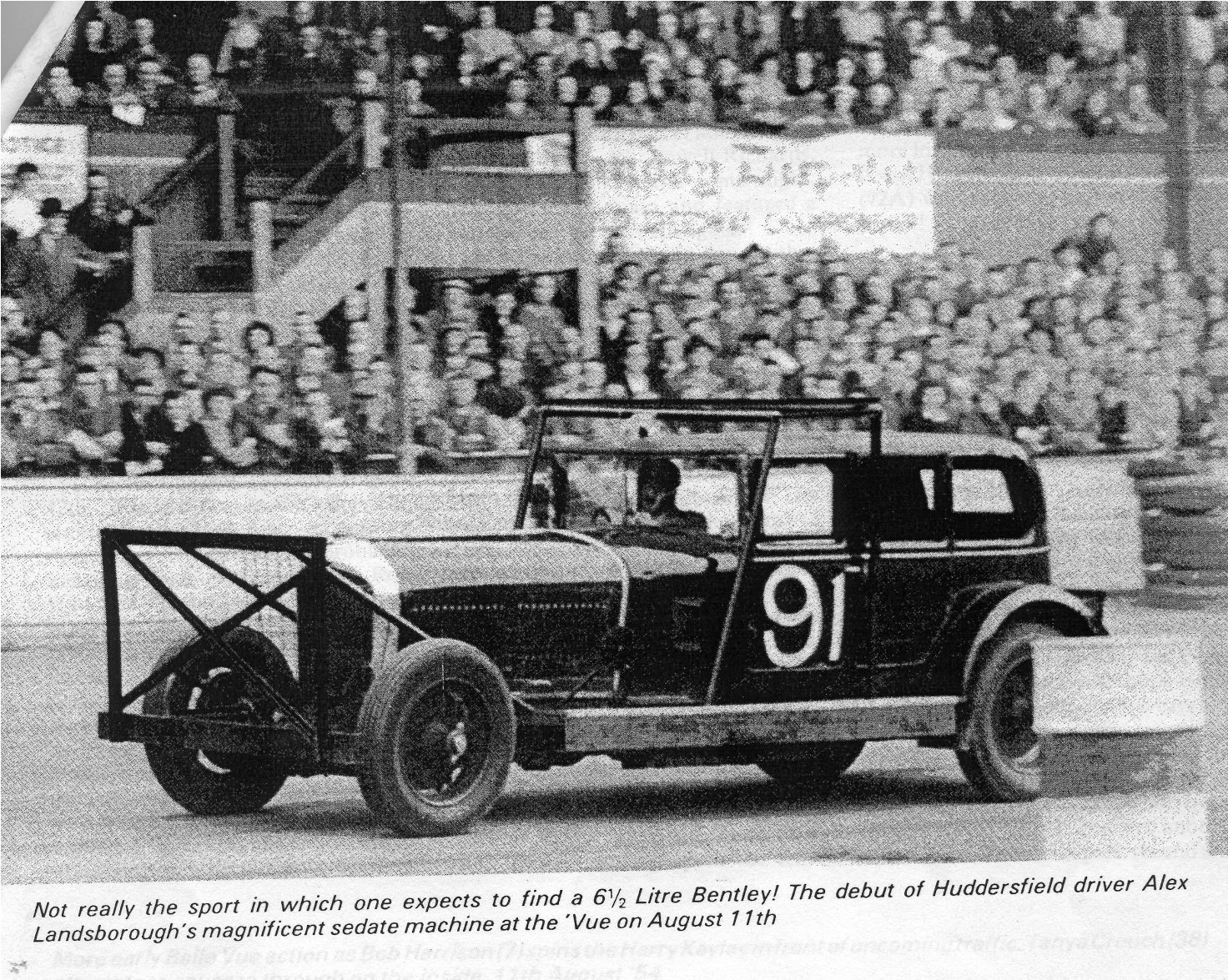
What
draws upper-class people to our sport? Likewise, cars like this 1928 Bentley 6.5 litre limousine ---
Another driver, Ken Smith, raced a Rolls-Royce to destruction at Belle Vue in that year.
With the 1954 New Cross French team came William Camus,
who was born a "Metis" in 1923 in the Yukon territory to an Iroquois
trapper and a Frenchwoman, and grew up among Canada's First Nations. His
mother took him to France when he was 12. As with other early characters like Spike Rhiando and Digger Pugh,
most people decided to believe, perhaps, 90% of his entertaining stories ----. He
looks a smooth charmer. https://fr-m-wikipedia-org.translate.goog/wiki/William_Camus?_x_tr_sl=fr&_x_tr_tl=en&_x_tr_hl=en&_x_tr_pto=sc
High-class
French car in a stock-car race about 1958: it could be either
a Talbot Lago T150, or
a Delahaye 135? And this similar car,
in 1956 at the same French track, at Montreuil. Take them to the USA's
Pebble Beach concours nowadays and you'd get around a million dollars each. More French stock cars in action at the quarry (from Robin Izzaard), and a contemporary poster (via Darren Smith) of sponsor "Pastis 51" (Ricard or Pernod are equivalent anise-flavoured drinks).
Montreuil's
quarries were just some of the massive gypsum industry in France, and
Paris had dozens of mines and quarries for extracting gypsum, which was
roasted and turned into plaster --- the finest quality, and most famous, is "Plaster-of-Paris".
If you've been to Montmartre in Paris, the whole hill underneath
is honeycombed with mine tunnels for gypsum. Today the Montreuil
quarry is now PARC DE BEAUMONTS, a 22-hectare green park.
2019 addition:
Two more classic French luxury cars in battle.
Can anyone identify the make/model of this one? Or this one?
=========================================================
January 2011: Three heroes at Brafield:
this programme photo was printed for May 1960, but I'm putting it
here, as it may well have been taken in 1959. Behind the fuzzy
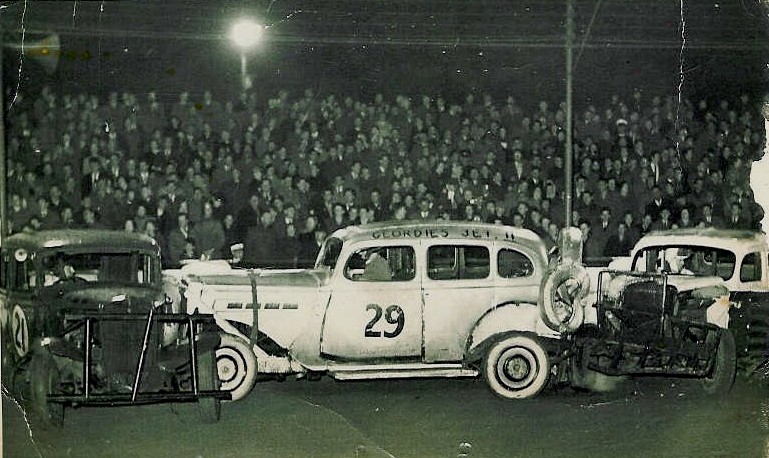
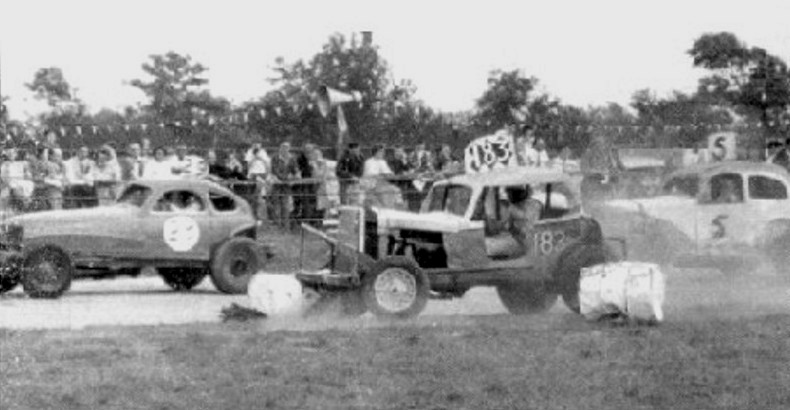
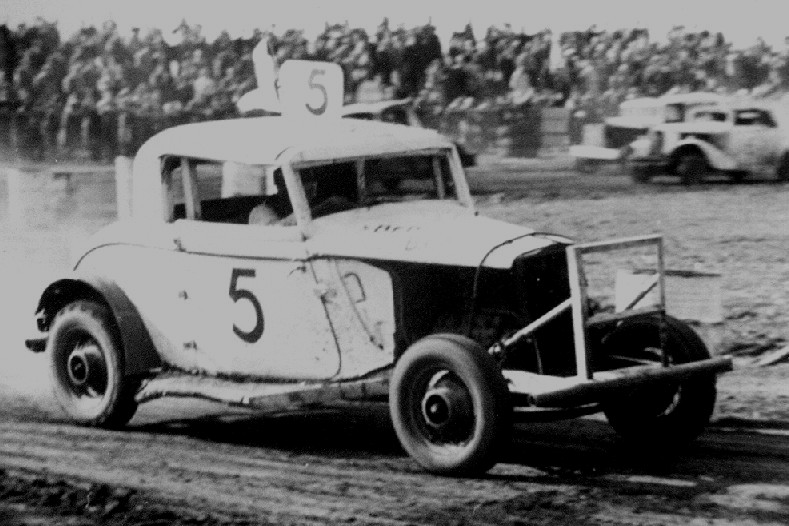
half-tone printing we see #183 Ellis Ford, #29 farmer George Foulger from Norwich, and #5 Dougie Wardropper.
November 2010: From that first dizzy barn-storming season, Russ Thomas sends this photo from the Leicester track's programme for Wednesday 13th September 1954. In the first couple of years, cars licensed by The Northern Stock Car Company had an "A" with their number, and number-only cars were Digger Pugh's Stock Car Racing Company
(Belle Vue drivers had a "B" prefix). There's no guarantee this
photo was actually taken at a Leicester, because the three
different companies were opening and closing tracks willy-nilly that
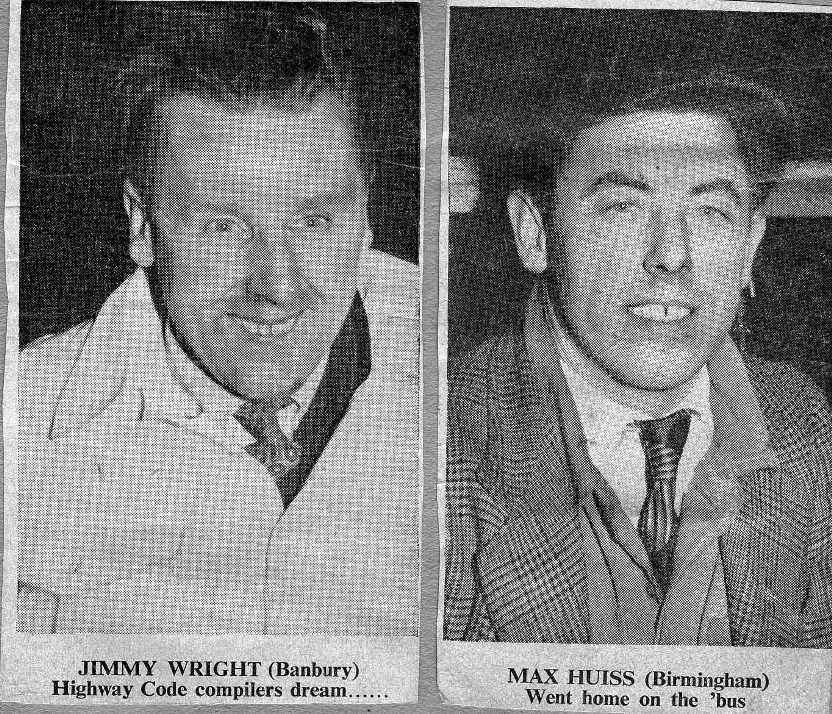
year, but three drivers can be identified: 81A is Ginger Davies from Manchester (the "Silver Knight"). Number 6 had the wonderful nickname of "Satan", D.W. Powell-Richards from Bromley. 100A
is Jimmy Wright from Banbury (a speedway rider), who did race on that
September night, in a huge 28-a-side team event. September 2010: Several early drivers used straight-8 cylinder engines, and in 1954/55 a few English "Railton"
cars were raced by Gil Cox, Vic Tordoff, and Alan Hughes.
Railtons were in the same league as Bentleys and had a limited production
(only 1500 built between 1939 and 1940) and high performance. The Railton was
actually a British body mounted on on the American Hudson Terraplane chassis and big 4-litre engine. Here's a big straight-eight "L-head" Hudson engine. No doubt some U.S. Terraplanes came over with servicemen during and just after WW2. November 2013: A veteran Perry Bar fan, George Renshaw,
saw a Railton being stuck in the fence on the first lap, and after
that the field took a delight in "chipping" bits off every time round
until it was a "bag of parts". If you look at auction
records you'll see that good Railtons fetch £50,000 and up. Here is a 1955 Harringay race, professionally filmed: http://www.youtube.com/watch?v=poBuLV_5s3Y&feature=player_embedded
August 2010: Tanya
Crouch and her partner John Goody were a godsend for publicity in the
first years of stock car racing. The Press followed them
everywhere,
as Tanya was from a posh background, being the well-spoken
daughter of a surgeon from Heathfield Sussex, and who drove her own Bentley on the
road:
Tanya is helped out of her car by John in 1954Tanya at Neath Abbey, pushing the 38 car in 1955Tanya and John at Neath prepping the tow rope; Goody's plush corduroy outfit is distinctive.
The
stadium was just across the road from the old monastery ruins, and also
featured speedway motorcycle racing --- Kiwi rider Trevor Redmond rode
there before turning promoter.
Tanya Crouch was still alive in retirement in 2010, though commentators like Brian Sewell had implied she died years ago.
July 2010: In
1955 Pathe News (for us old 'uns Pathe was a regular feature that accompanied the
movie at the local fleapit) showed a 2-minute clip in 1955 of
stock car racing in Australia. Here's the url.
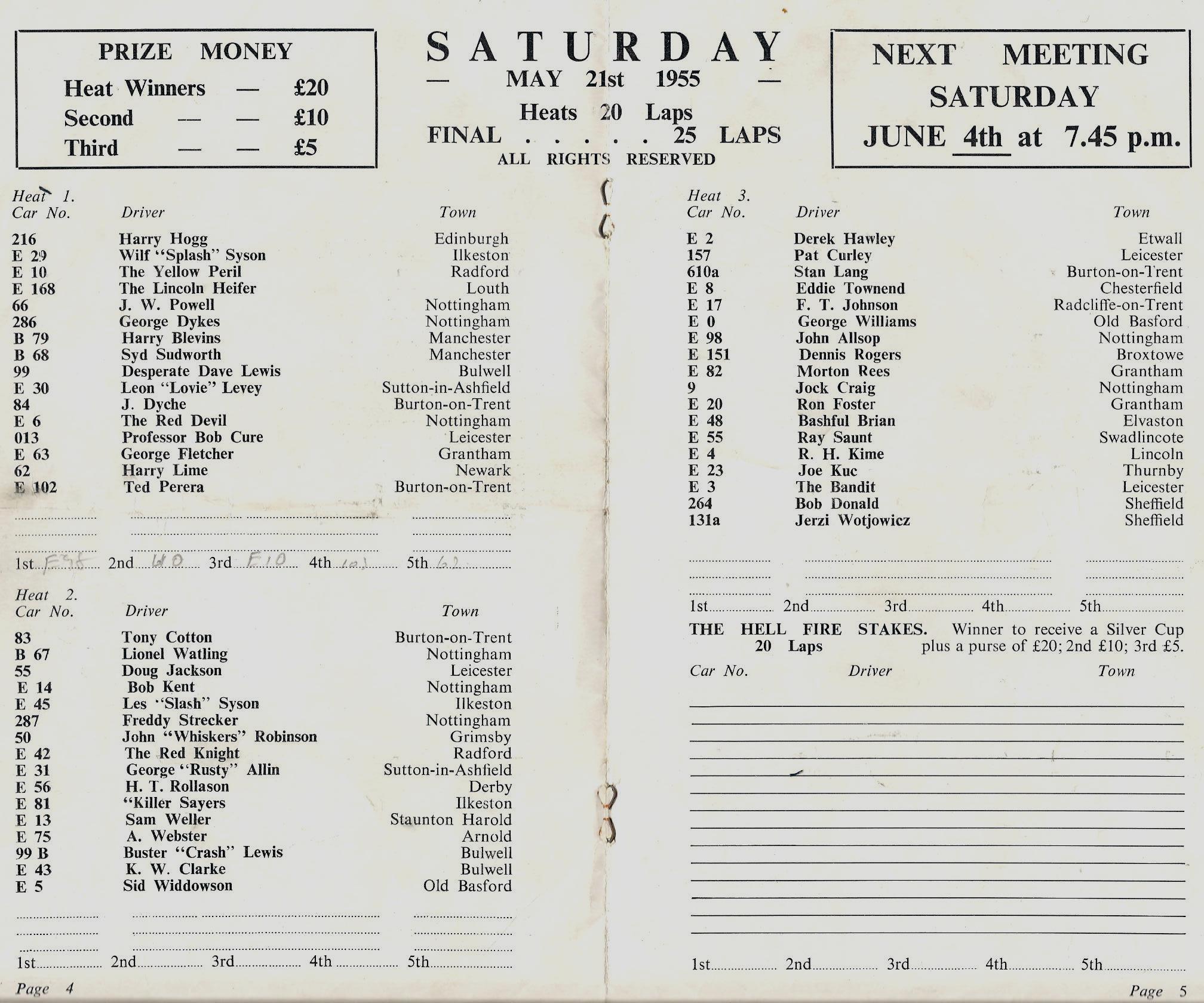
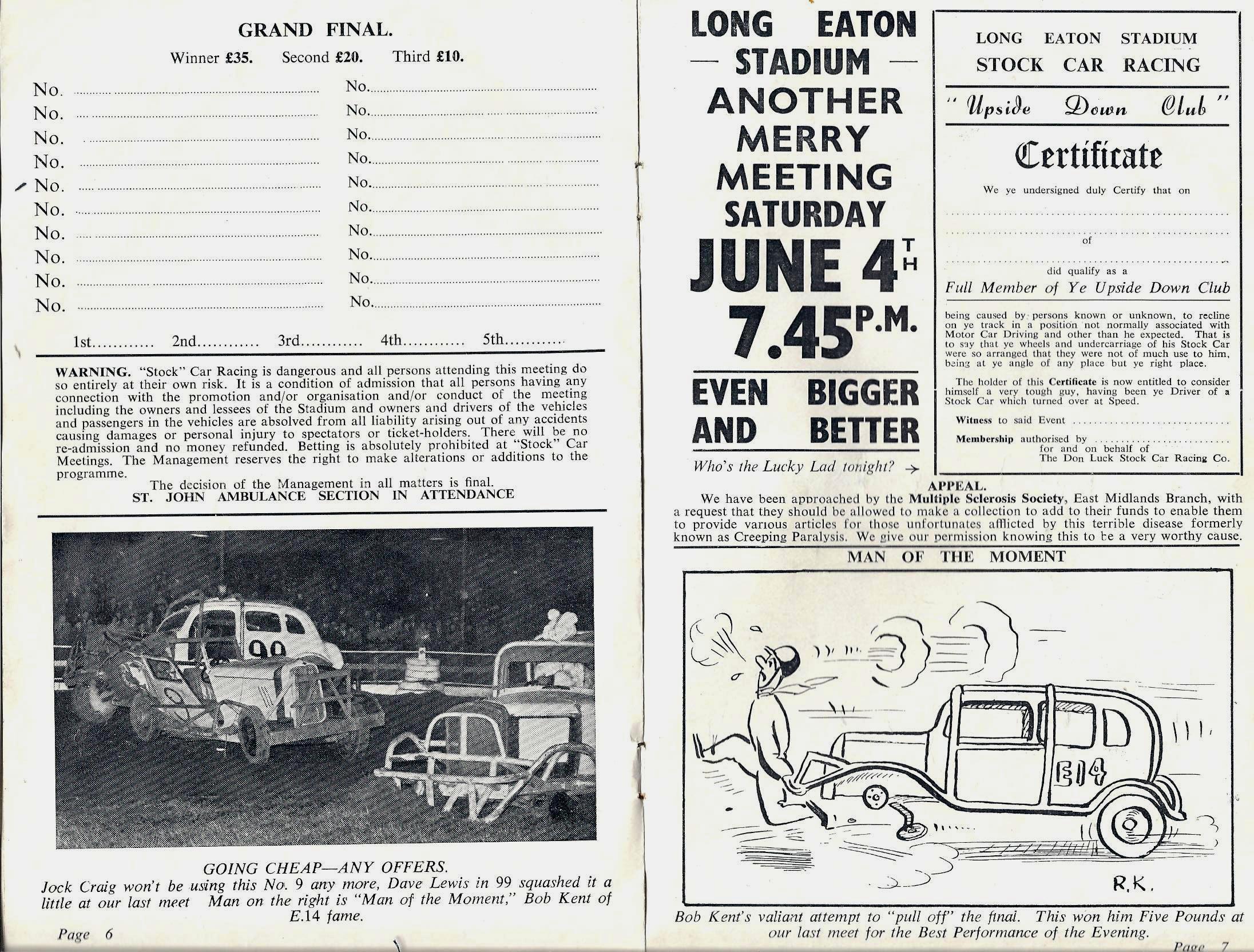
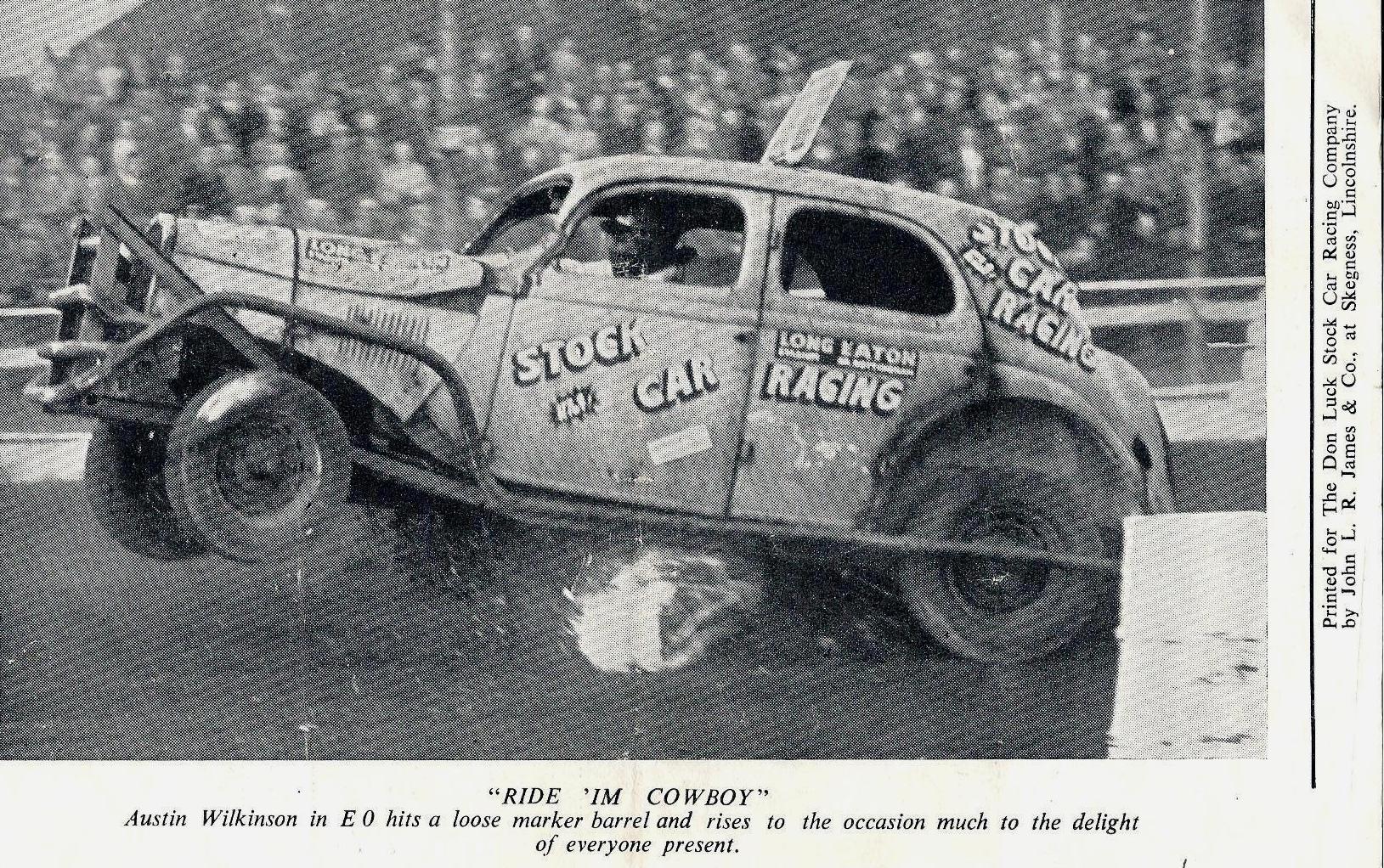
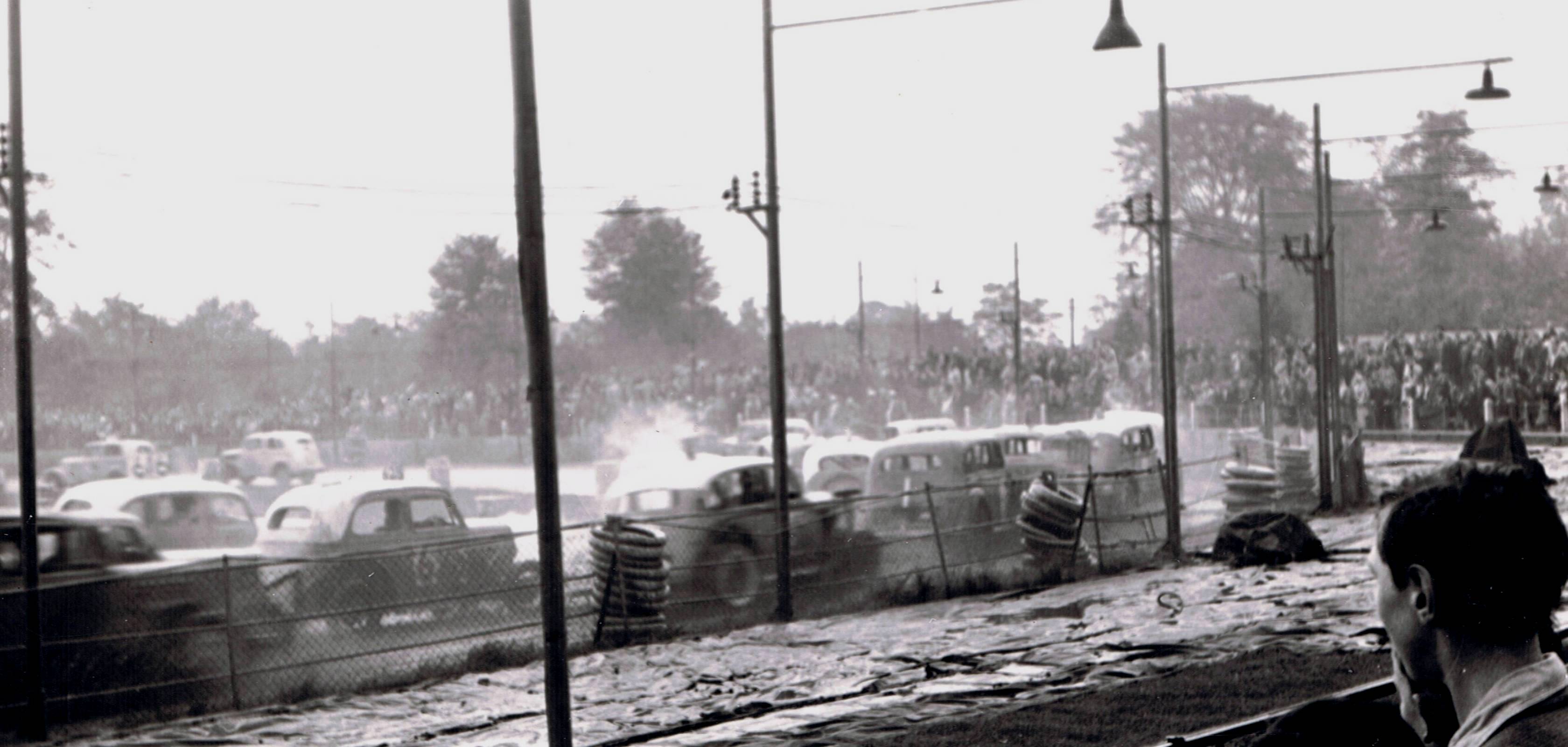
May 2010: A big thanks to Graham Cox for his generosity in scanning at top quality this rare gem: Long Eaton's May 1955 programme.
the impressive back cover photo. Two enlargements from Graham's vintage programme, below:
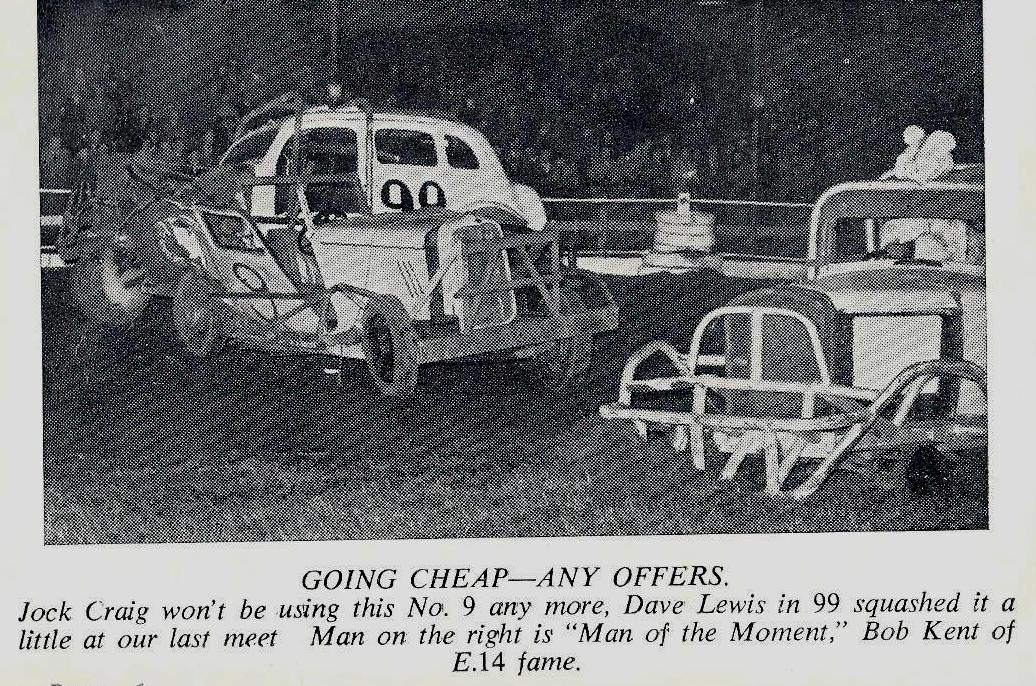
Look closely at what's on the roof of the car below: Mooo!
March 2010: Three
remarkable photographs from Tamworth, and I am putting them here
because "the sixties" are getting full, and Tamworth opened in 1960;
one shows one of Sid Farndon's first Junior 10 races. The photos were taken by a then-young lad with
his
father's camera, and he has kindly sent the scans to me; I am crossing
my fingers that there may be more ---. The car numbers are hard
to read but I can make out a few if I enlarge the views. I have
deliberately left them at high resolution and not cropped. In all
cases you can see the greyhound track and floodlights of Tamworth.
Thanks to Trevor Chater for establishing the decade. First photo; second photo showing 616 R. Clark from Datchet, and 625 John Gray from Corby. The #10 number in the third photo was assigned to THREE drivers over 1960-61: Tony Flower (Derby), Reg Saul (Nottingham) and Geoff Hunt from Melton Mowbray.
Thanks to David Hughes, who has also donated some Hednesford pics in the SENIORS IN THE SIXTIES section. David
also corroborates 1960 or 1961 because the track Tannoy continually
played "Tell Laura I Love Her" by Ricky Valance, which made #1 on the
hit parade in England in 1960. The lyrics!
February 2010: Early Brafield photo featuring numbers 43 and 51.
Four different drivers registered under #43 during the fifties,
one of which was Danny Bassett. The number 51 was either Willie
Watts from Essex or Sam Stewart from Norfolk.
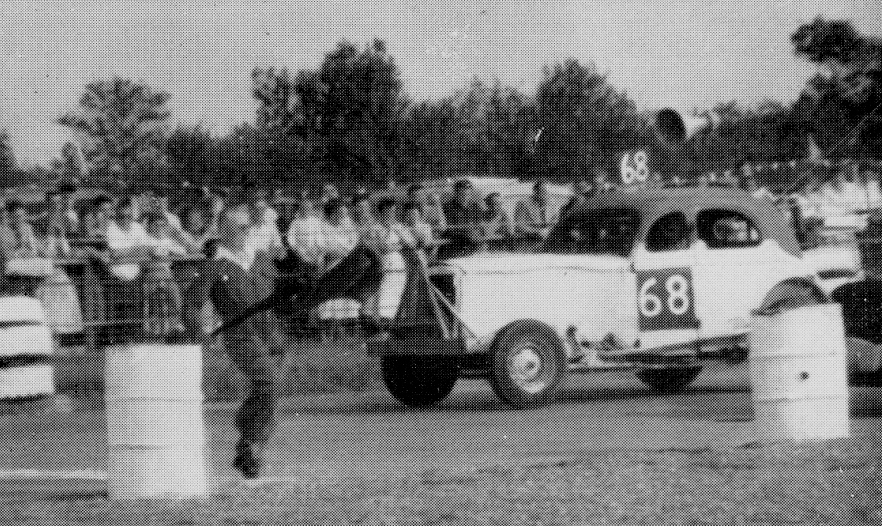
Run for it --- Starter Jack Barrick uses his soccer referee skills to escape from the path of Trevor Frost's 68 car as it zooms over the start-finish line at Brafield in 1959.
February 2010: Sleek coupe with a flathead motor, shown here rather damaged, is at West Ham in 1959, driven by Vic Webb #33 from Bristol.
Where is this? --- the photo
was printed in a Brandon programme in 1959, but the open countryside suggests it
is one of the other tracks owned by Midlands Sports Stadiums
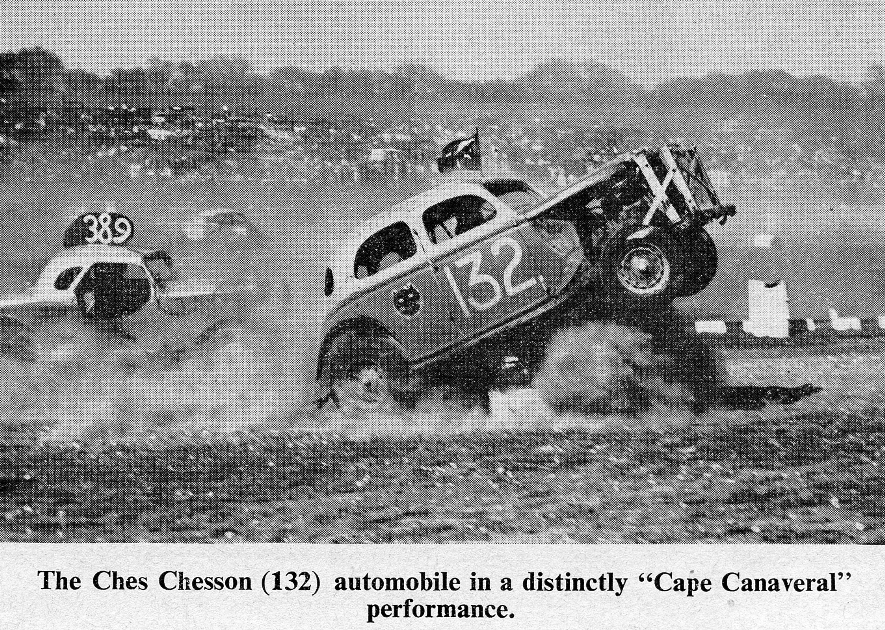
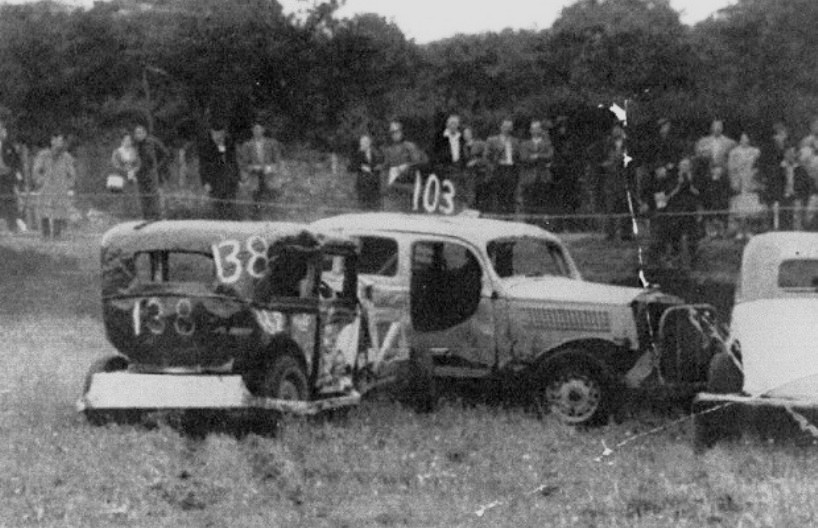
Ltd, or that the photo was simply "kidnapped" which was quite common among promoters. March 2010: Trevor Chater bids for Ringwood or more likely Lydden, and Alan Humphrey also reckons Lydden's old field circuit. Trevor identifies the driver as Cliff Sisley from Wilmington in Kent. Since the 132 car is Chez Chesson also from
Kent, that settles the argument in favour of Lydden.
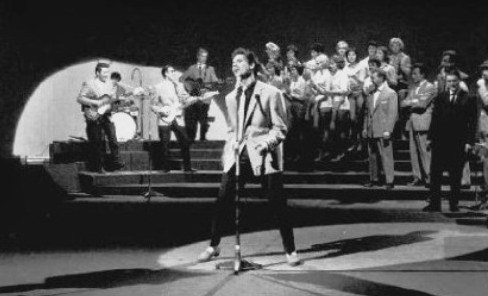
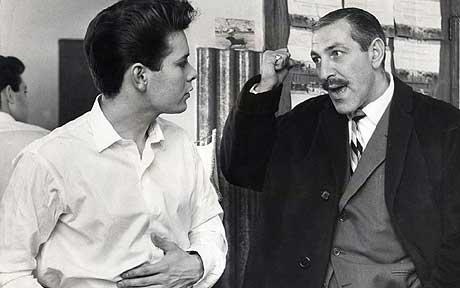
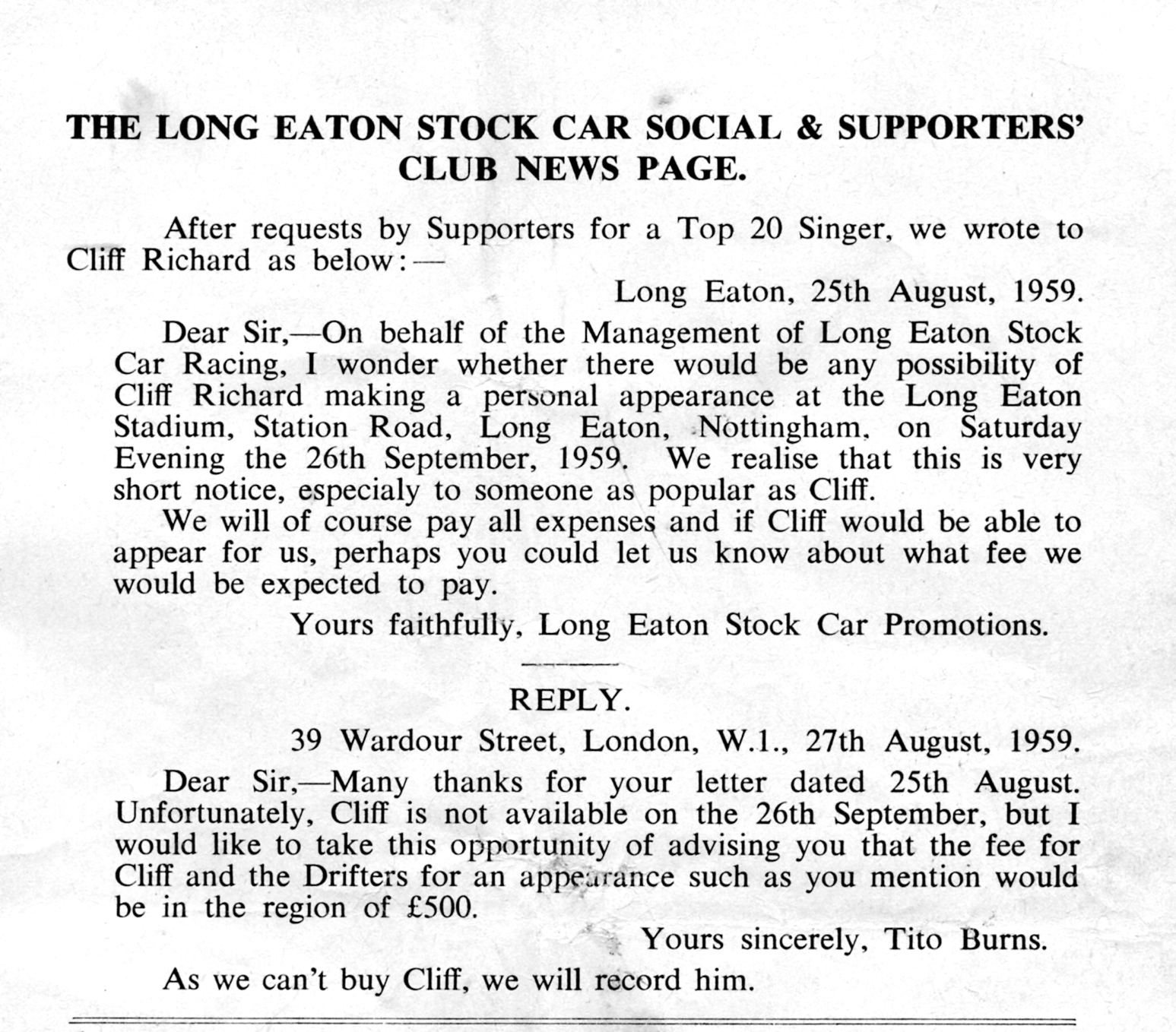
January 2010: Cliff Richard and The Drifters, on a stock car site?
In August 1959, Long Eaton thought it would be a great
thing to invite Cliff Richard to make an appearance at their September
race meet. (Staines had Diana Dors appear at their world qualifying round). At the time Cliff was touring with The Drifters (pre-Shadows). Here is Long Eaton's invitation,
and the bad-news reply from Cliff's manager. As far as I can see,
Long Eaton just wanted Cliff to turn up and say 'hi' and present trophies.
Tito Burns, the London impresario [also manager of the Searchers
and Dusty Springfield, Tony Bennett, The Zombies, the
Stones, and Cat Stevens] wanted big money.
In any case, 1959 was a tough year for Cliff, who was being
overworked and had laryngitis. How big a
fee was £500 in 1959? The flamboyant Tito Burns (Nathan Bernstein,
1921-2010) had been a cabinet maker and an RAF air-gunner before going
into showbiz.
Two tough guys battle it out: from a 1956 Lydden Hill programme, courtesy of ex-racer Barry Redman, here are Pat Willis and Ken Freeman going at it.
Behind the Slough garage of Bill Webb (#162 in the early numbering system) we see Ted Pankhurst's 102 car,
and the dark-shirted "cool dude" is Bill's son Ron, later to race under
56 and 481. The photo is approx. 1956. Ron's
brother Pete Webb became famous under #8, and their older brother Eric was
a non-racing member of the pack. My thanks to Barry Redman for the photo.
Britain's Daily Telegraph in April 2004 did a very
good job of researching the early history of stock-car racing, and
their journalist was able to find and interview some of the surviving movers and shakers. The article,
entitled The Trail Blazers, is a 'must' to read.
In my home page section, Terry Dickinson provided scans of a rare 1954 Belle Vue programme;
they are such high resolution that I have cropped and extracted
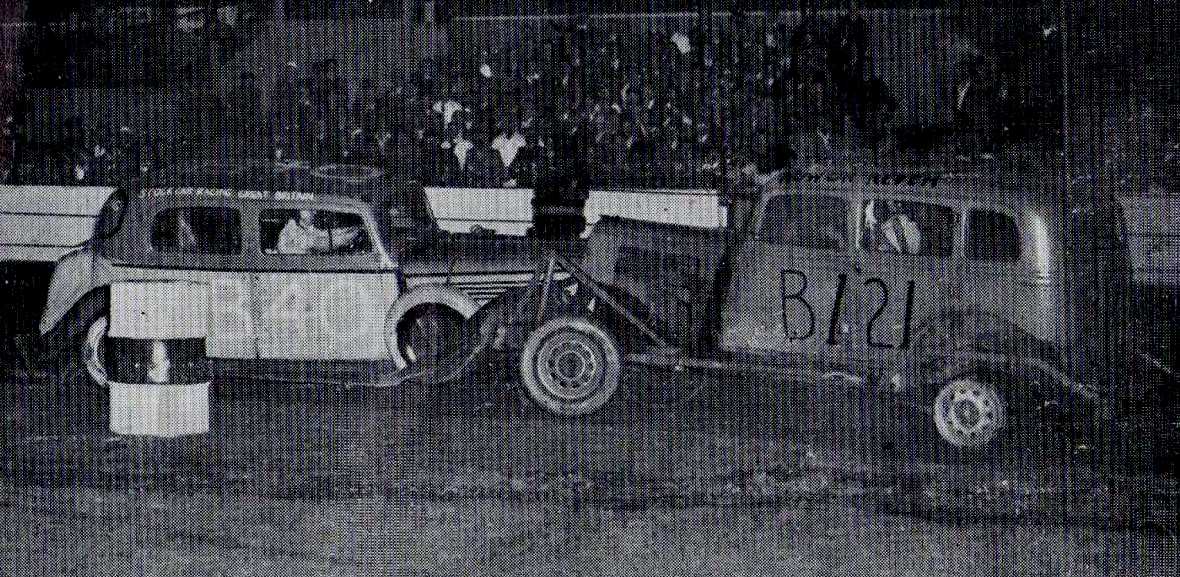
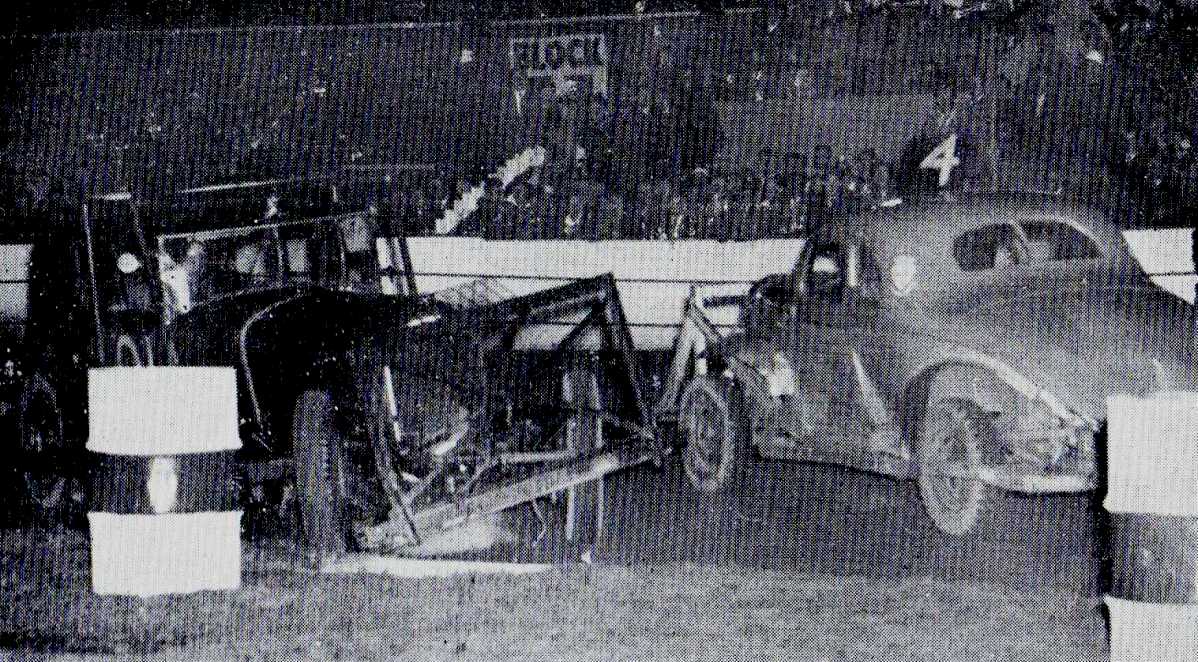
five excellent photos of cars and drivers from that meeting:
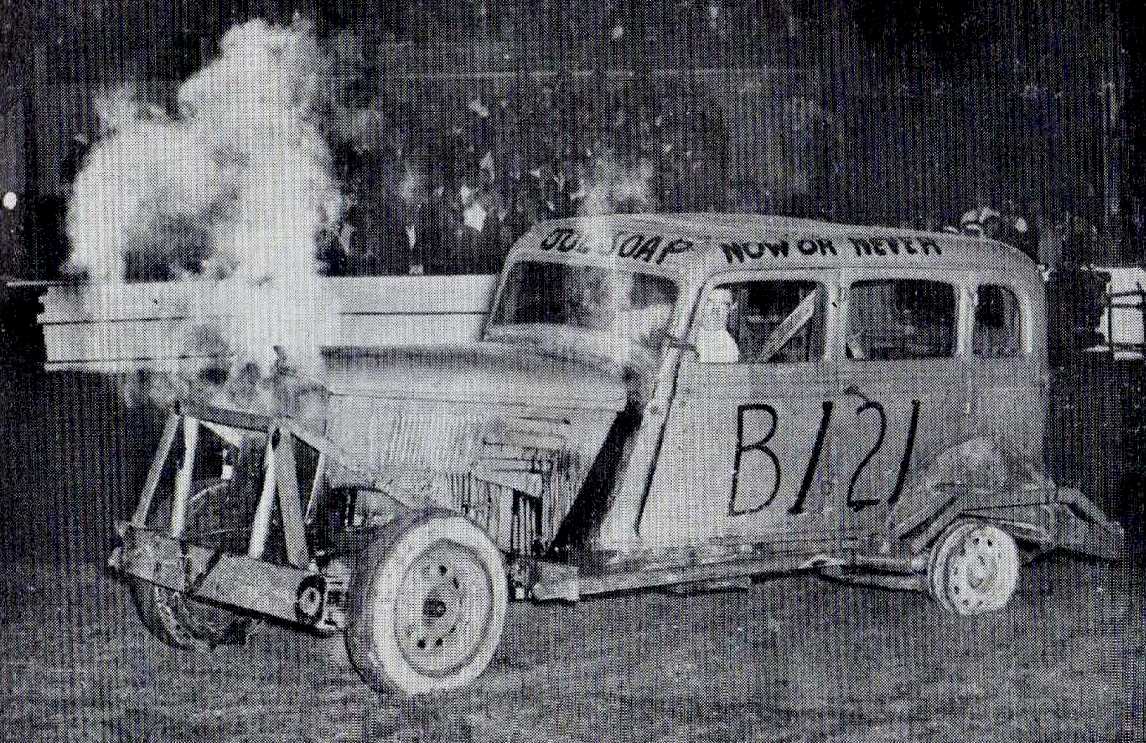
- Nose-to-nose; car B40 is Ginger Davis from Manchester; B121 is Noel Evans from Urmston, Manchester, under the nom de guerre "Joe Soap".
- A Bentley (yes, one of those) gets pushed around by car 4, George McInnes from Edgware.
- Frank Haft from Manchester carries a newspaper poster. Car #35 on his back is Mac McDonnell from Dartford
- Joe Soap again.
- Tanya Crouch and John Goody chat.
I cannot recall where and how I got this photo scan, of the pioneer racer Jack Tipping, with pre-1957 BriSCA numbering. Whoever sent it, let me know. From
Ian Melton, five photos of cars that bridged the end of the fifties and
the start of the sixties: original snapshots, not programme
reprints. That's Graham Hill in #73,
Vic Ferriday's car! While racing in Formula One grand prix for
Lotus, Hill took part in a West Ham special event, against a Michael
(or Dennis) Taylor, a Lotus engineer who borrowed Vic Muggeridge's
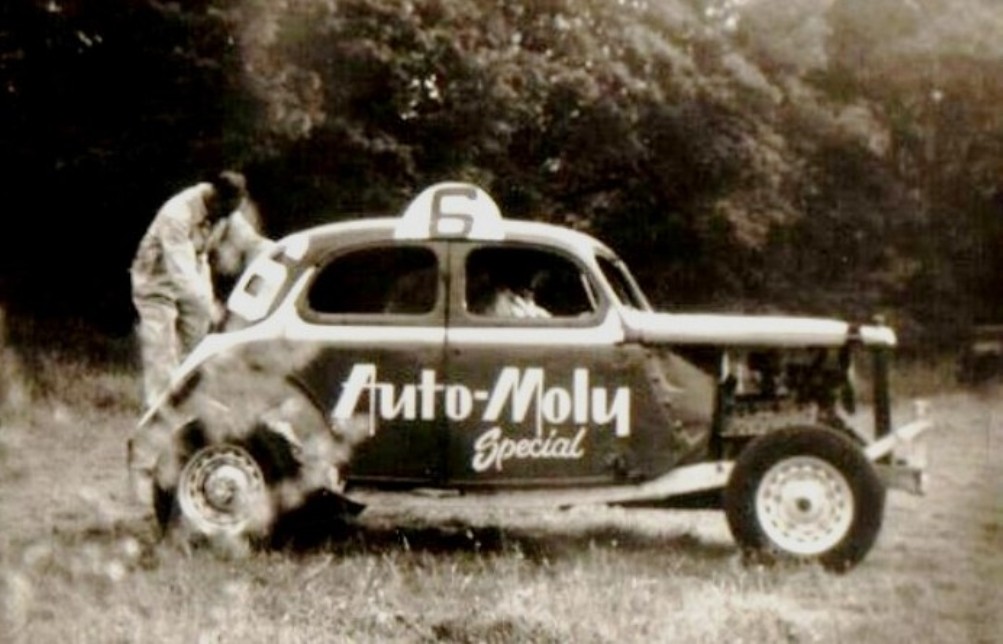
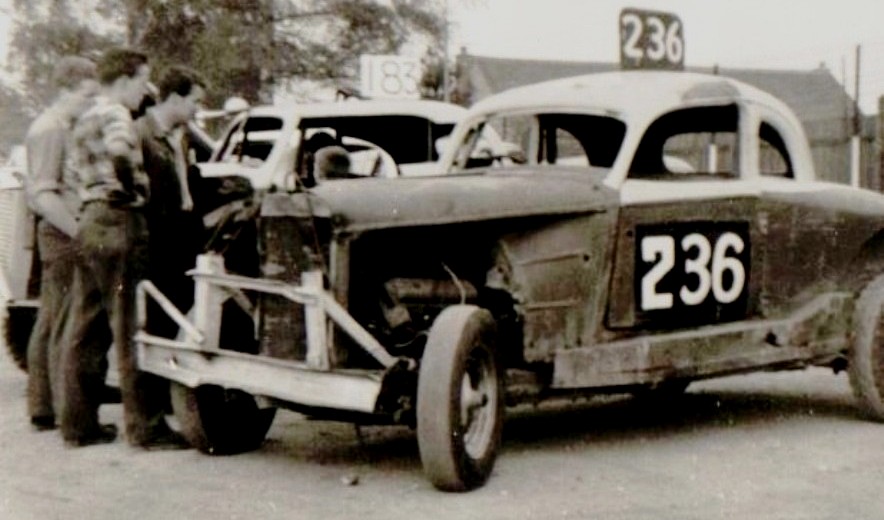
stock car #255, which was a supercharged 1935 Auburn! Then Cyril Ainsworth [from Newbury] #106. Next, the flathead-engined car of Johnny King, probably 1958 / 1959. Johnny King's Auto Moly Special #6. Johnny's son Chris King corrected my earlier "ex-Brise" label. Then ex-speedway rider Jimmy Wright's 236 car
parked in front of Ellis Ford's 183, and I have a feeling that those
young chaps appear in another Ellis Ford photo elsewhere on this site.
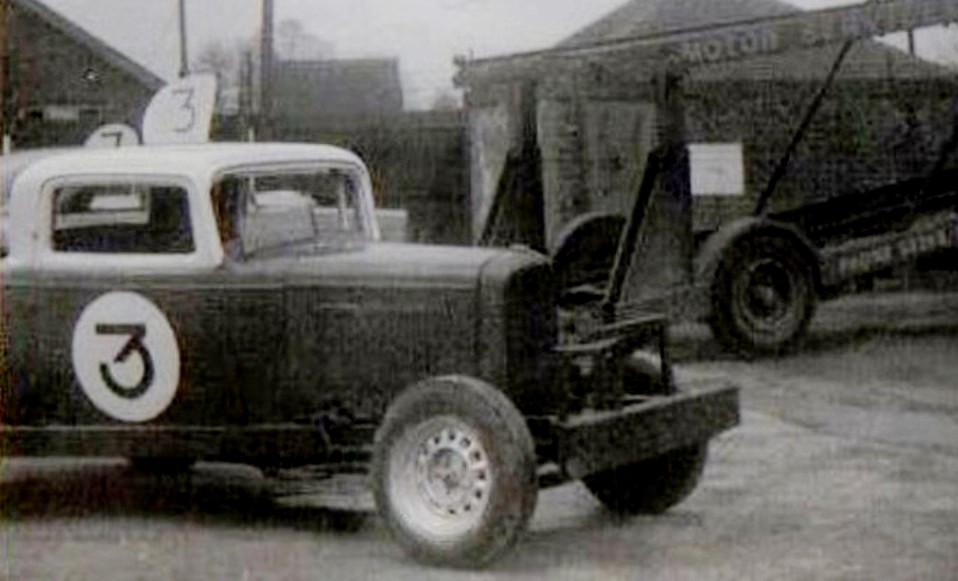
Another 'mystery': this neat and smart "hot rod" coupe, #3
(before Ellis used #3) could be that of American Melvin Linville if the
photo is 1961 or 1962. If it's 1957 to 1960, then it's Graham
Warner from Bury St. Edmunds. [Though the coupe looks much like Pete Tucker's cars.)
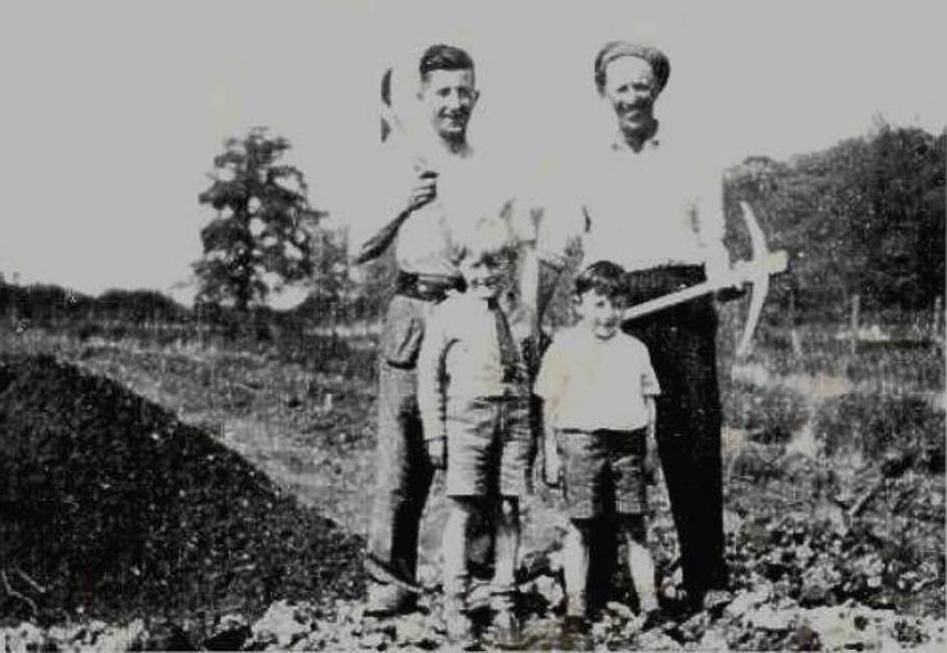
Treasure Trove! Probably the earliest photo in existence of the dawn of Brafield Stadium, 1948.
A big thank-you to Russ Thomas, the long-time Brafield announcer
/ deejay, and driver # 286 for the following: here are Russ's words:.
It is a photo of Dave Hughes' Irish brother-in-law, who with a friend have dug
out the start straight at Brafield Stadium in 1948. One of the two young lads is
the son of midget racer Arch Hanscombe.
Dave Hughes was a baker at
Cogenhoe. [ If you go to Northants, say "COOK-KNOW" ] He was mad keen on speedway and pre-war would organize coach trips
(via Yorks coaches no doubt) to major events. In doing so he got a lot of local
people interested in the sport.
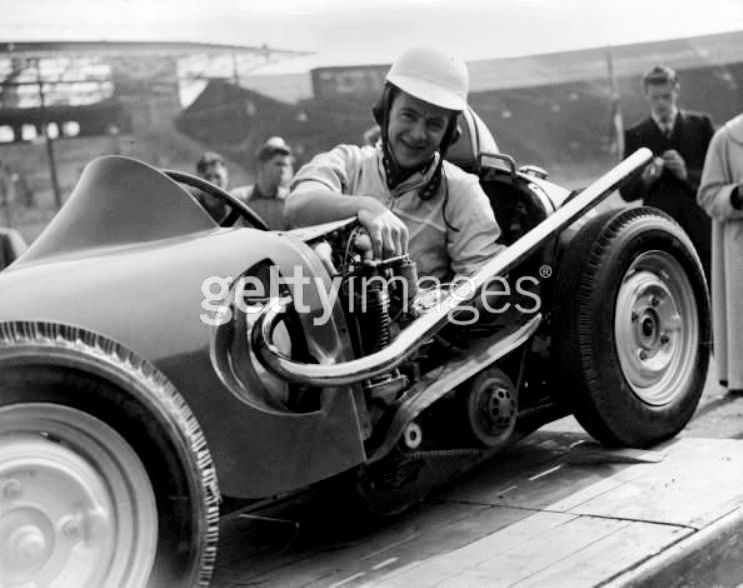
After the war he saw the midget
racing cars, thought they had potential and bought a 'set' of Skirrows to race
as a team. They started practicing and holding their own very unofficial
meetings in a field near the village of Whiston. This wasn't very successful as
the field was only accessible across other fields, so they started
looking for something better. A local character was running dogs on the field
that is now Brafield stadium/NIR and they approached him to try and run the cars
there. He was reluctant and thought they needed planning permission. They
applied for this and were turned down at first, but eventually were given permission and,
I believe they then bought the field from the "dog man". This is where the
photo comes in. They dug the first layouts by hand, then their star driver,
American ex GP driver Spike Rhiando was given the job of commissioning and
overseeing work with mechanical plant. I think the track was first up and
running properly in 1949. The midgets never attained the success that was hoped
for and I think Dave had to organize a lot of the team events and then try and
sell them to promoters as a 'package'. They did race all over the country,
however, through until stock cars took over.
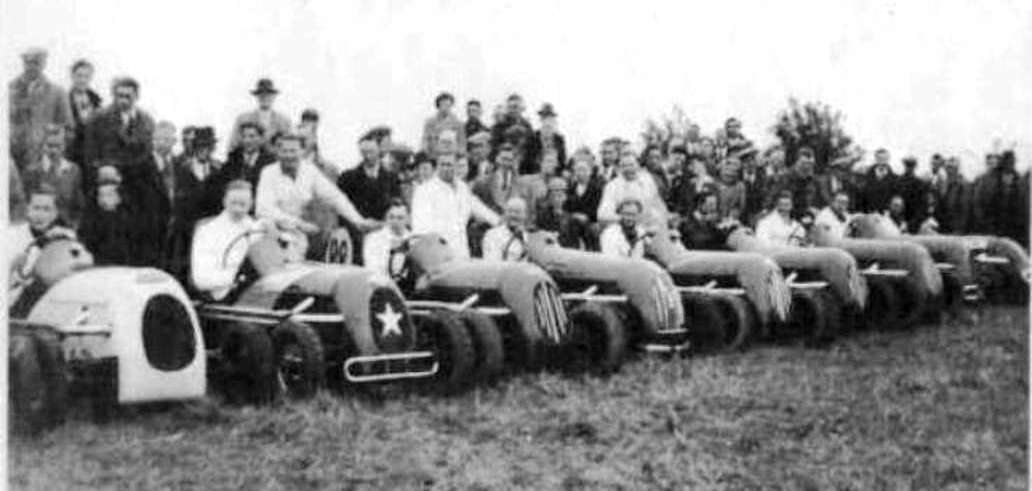
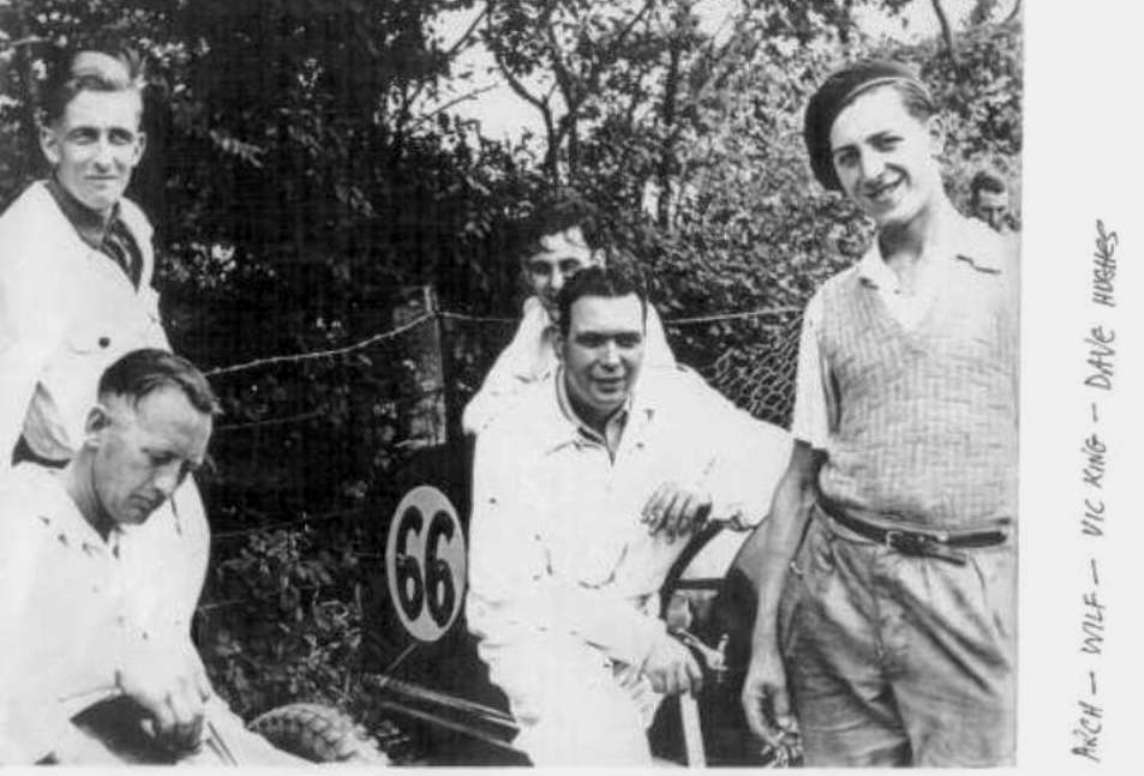
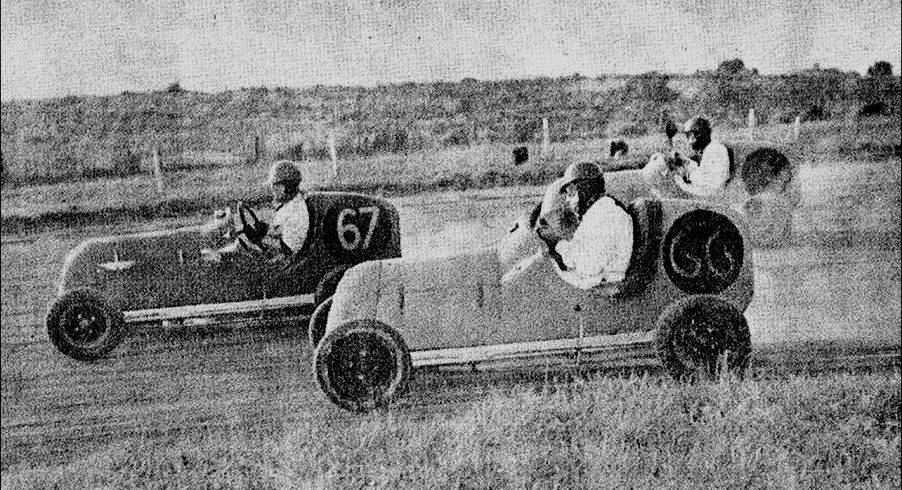
Two early pictures of the Brafield Midget Racing team. In the closer-up photo, the driver
standing on the left is Aubrey Leighton's old 'partner in crime', Wilf Davis (whose
ruthless team tactics got Aubrey's cars banned, and led to one of the
sport's most infamous on-and-off track skirmishes at Brafield,
involving drivers, mechanics, and spectators ----). The fella that started it all, Dave
Hughes, is in the car. Unnamed on the snapshot, Ron Ball is the chap on the far right.
Two of the drivers around 1958 were Harry Law and Bud Buswell; they helped ready the cars when David
Hughes had garage space at Cogenhoe, and even traveled to Holland to race. (Diana
Brewer)
More "March Midget" info from Russ Thomas, found from elsewhere on the 'Net:
"Old-time
midget car driver Dave Hughes, who pioneered the British revival when
he built the original Bradfield track in 1949, helped by American
driver Spike Rhiando, blames the early post-war attitude of speedway
promoters for the sport's decline. He bought his first Skirrow midget
car during the 1939-45 war, thinking that the pre-war build up of the
sport would continue when hostilities ceased. But the speedway bosses
effectively blocked midget car racing's come-back in Britain, including
warding off an American attempt in 1948 to establish the cars. In
1948, Hughes met pre-war driver Gene Crowley who hoped to re-establish
the sport, but then lost interest. Hughes then bought a dozen Skirrow
midgets, and besides running the company also drove in meetings. As
late as 1982 Hughes was intending to revive his interest in midget car
promotion."
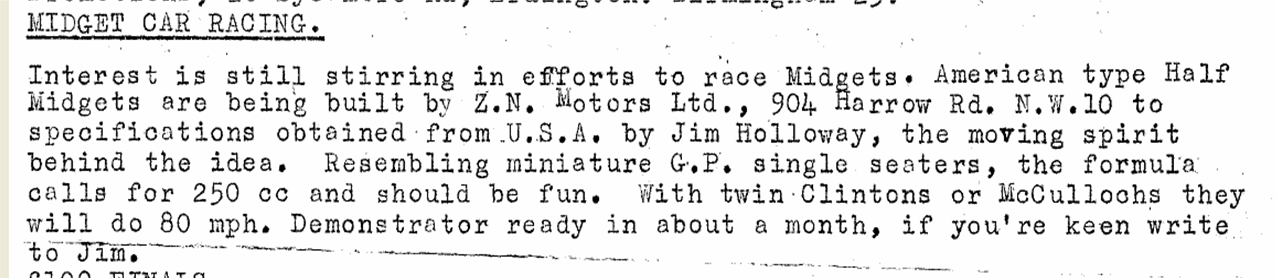
March 2010: Did
these midgets get built and raced? Steve Farndon sent some scans of the
July1960 BSCDA newsletter, and among its news items was this:
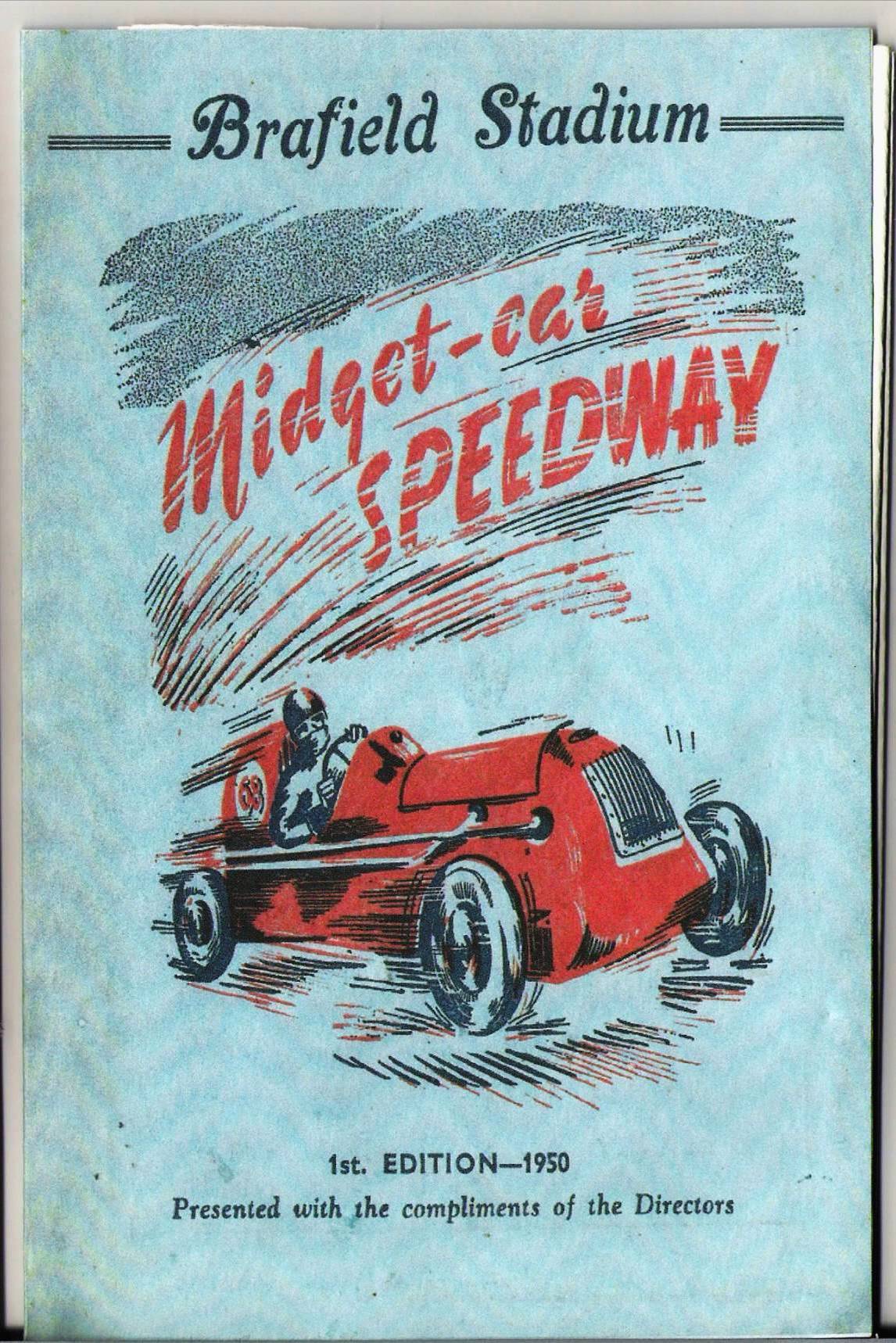
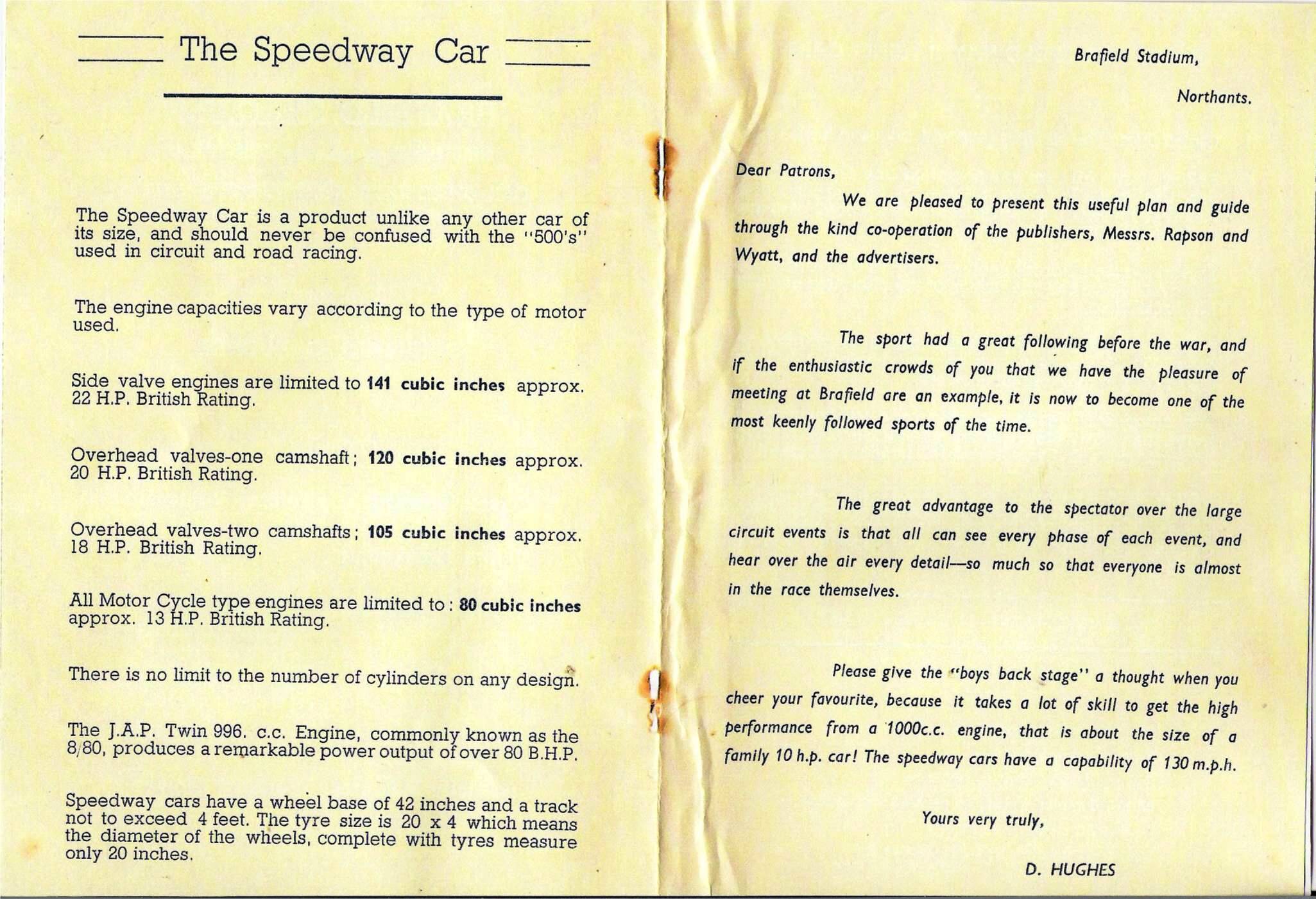
January 2010: Russ Thomas brings more treasure from the chest: here is a promotional booklet distributed by the Hughes brothers in 1950 to publicize midget racing. More below:
February 2010: More
midget magic, thanks to James Gould, the grandson of the famous racer
Wilf Davis, and James's information connects with Russ Thomas's
Brafield bits. The struggle to bump-start midget as a sustainable
sport took Dave Hughes and his companions all over. Here is
a pdf file of a 1952 programme from Brough Park (Byker, Newcastle-upon-Tyne).
Here below is Wilf Davis, all 6ft 4in of him to fit in the tiny
car. Like his friend Aubrey Leighton, and unusually in stock car
racing, Wilf was a well-spoken public-school educated chap, and it
shows in his demeanour and expression here:
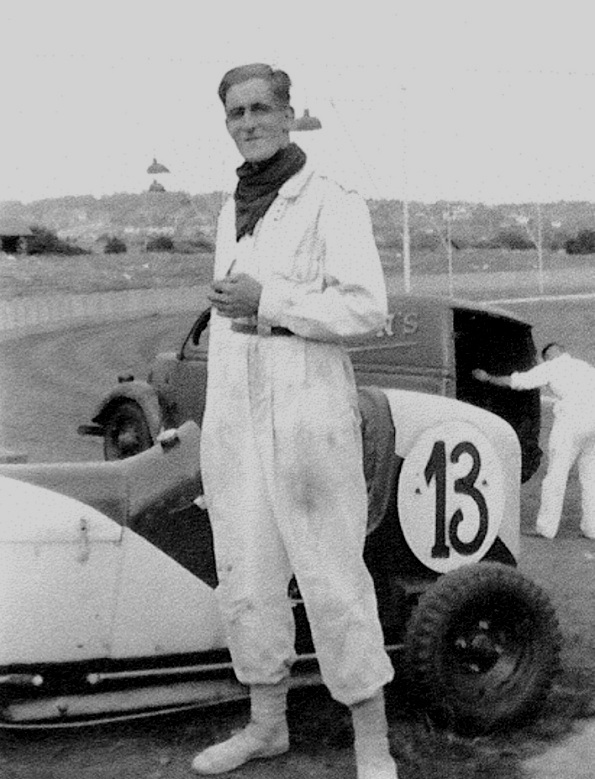
A publicity photo of midgets on the track.
he programme mentions something that not many people knew: Wilf Davis's brother Stringer Davis [1899-1973] was a film and stage 'character' actor who appeared in nearly 30 films. While in the army in 1945, Stringer married Dame Margaret Rutherford
. She was the famous stage and film actress, and Stringer appeared as her sidekick in several Miss Marple
films (at his wife's insistence to the studios), as well as being a devoted friend of Sir John Gielgud.
December 2013: More of Wilf Davis, courtesy of the excellent internet forum on midget cars, http://midgetcarpanorama.proboards.com/index.cgi. At the Brighton & Hove Stadium in 1950, we have a dirt-spattered Wilf on the far left at a trophy presentation, with "Spike" Rhiando on the far right. Then, Wilf is standing at the far right in this photo.
January 2011: Midgets
deserved to catch on better than they did, especially when "stars" like
the great Ronnie Moore were willing to demonstrate them, here at
Wimbledon :
Ronnie
was a brilliant speedway rider, twice World Champion ('54 and '59); he
won the first at the tender age of 21 and riding with a broken leg!
Also on my "Links" page, thanks to John Hyam,a site that will fascinate you: http://midgetcarpanorama.proboards.com/index.cgiIn
1948 film-star Lana Turner, with her millionaire husband,
helped ship 20 (twenty) midget racers from the States for an English
tour. Among the tracks they visited were Charlton Athletic's
Valley ground, Walthamstow Stadium, and Stamford Bridge. The
whole story is told and illustrated on this website.
I have
found a press photograph of Lana
Turner on a parade lap of Stamford Bridge stadium (Chelsea FC's
home). The arrival of the midget racers (with V8-60 motors)
brought in 50,000 fans on the day! One of the directors of
this tour was listed as Albert "Cubby" Broccoli, a name
we all remember popping up as producer on the early James Bond films. The
midget tour brought with it 8,000 gallons of methanol and 500 tyres. Midget racer, [more
photos below]
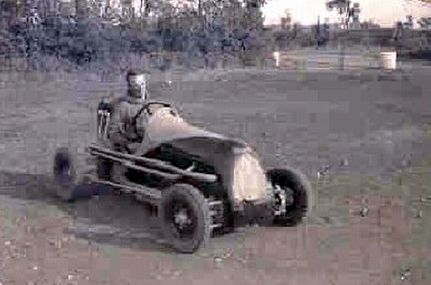
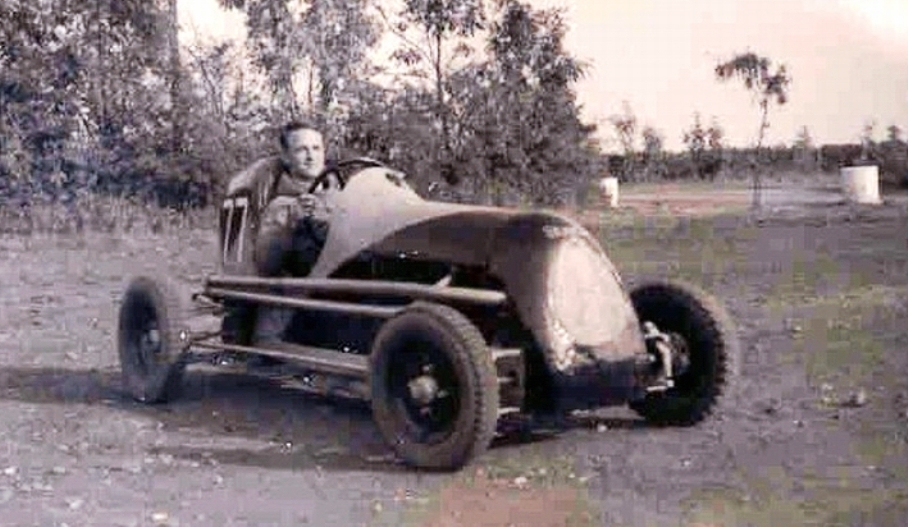
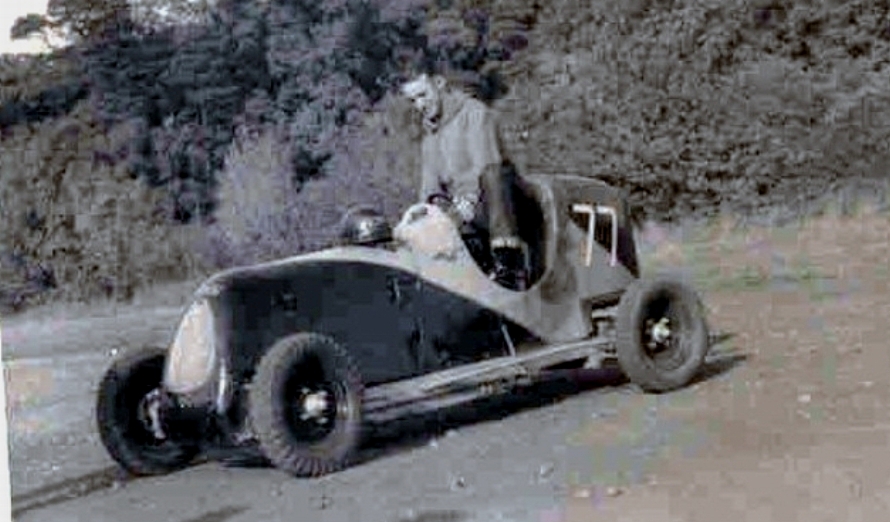
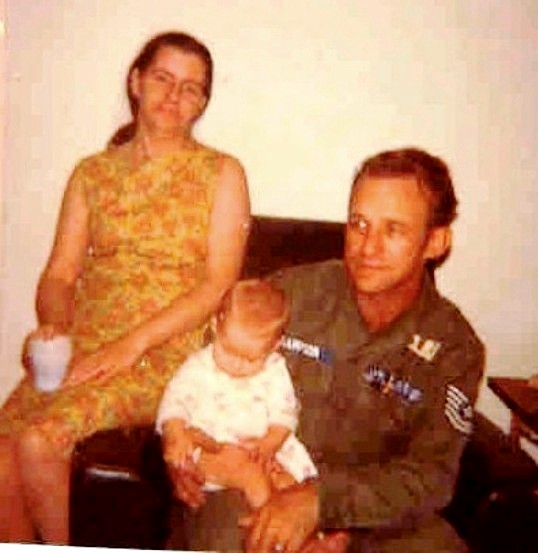
Courtesy of the late USAF racer Clayton Sampson,
who raced this midget. This Skirrow car was built in the 1930's
and was one of several owned by Dave Hughes, mentioned above. It used a
JAP 1100cc air-cooled V-twin motor, giving four-wheel drive, no
differentials, through TWO clutches -- one at each end -- (but only one
pedal). The motor ran on alcohol, with a wicked 15:1 compression
ratio, which engine-braked the thing so fiercely with the gas off that
no brakes were required. Some people may recall these motors
needed careful "pull-it-back-off-compression" before attempting a hefty
push-start. Clayton fondly remembered the very high performance
(and the unforgettable din) of these tiny cars, which he raced mostly
on shale tracks.
Clayton is no longer with us, but his wife
Margaret kindly sent these three snapshots
from those days.
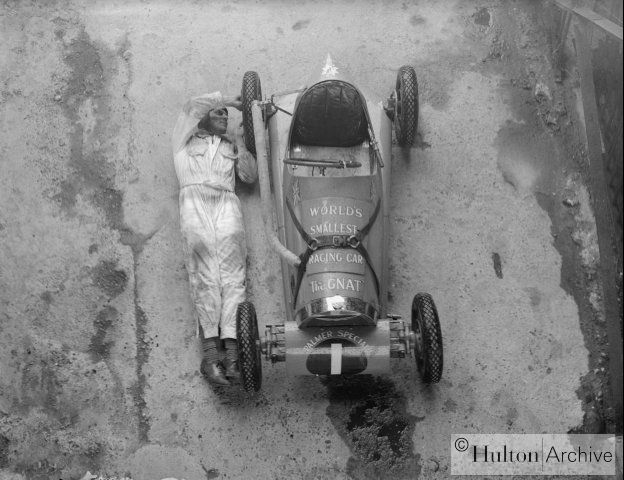
Just
for a comparison, fifty years later, here are two Grand Prix Midgets at
Buxton raceway in 2007, courtesy of Rogers Oval Racing Home Page.
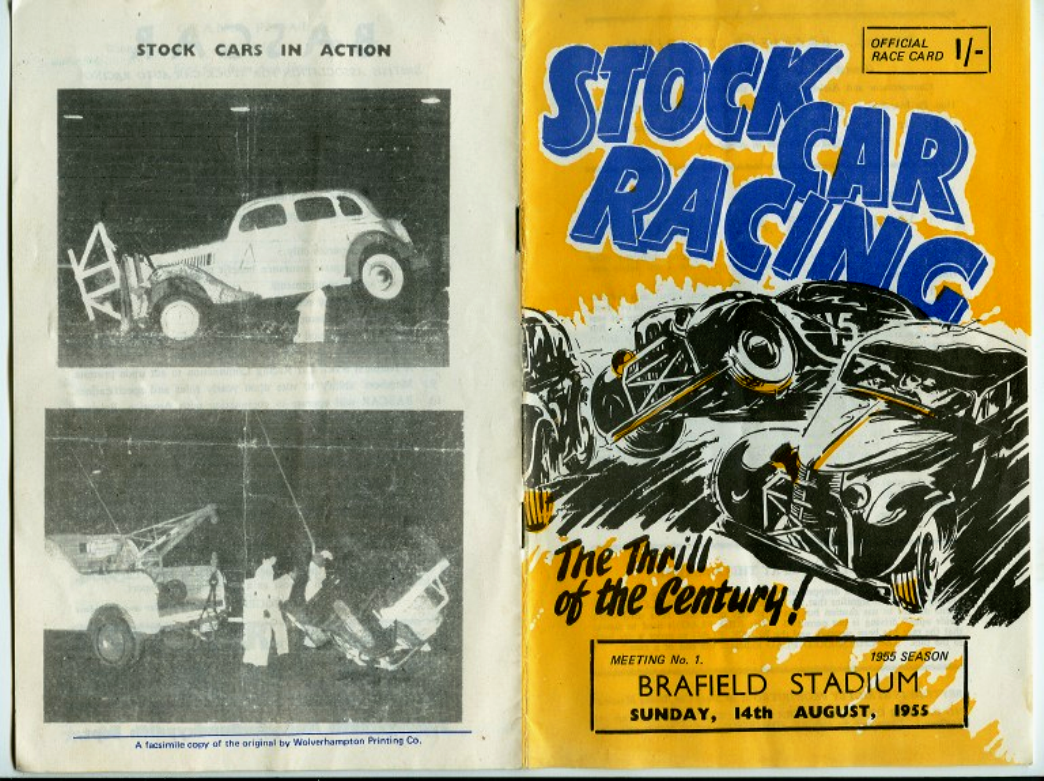
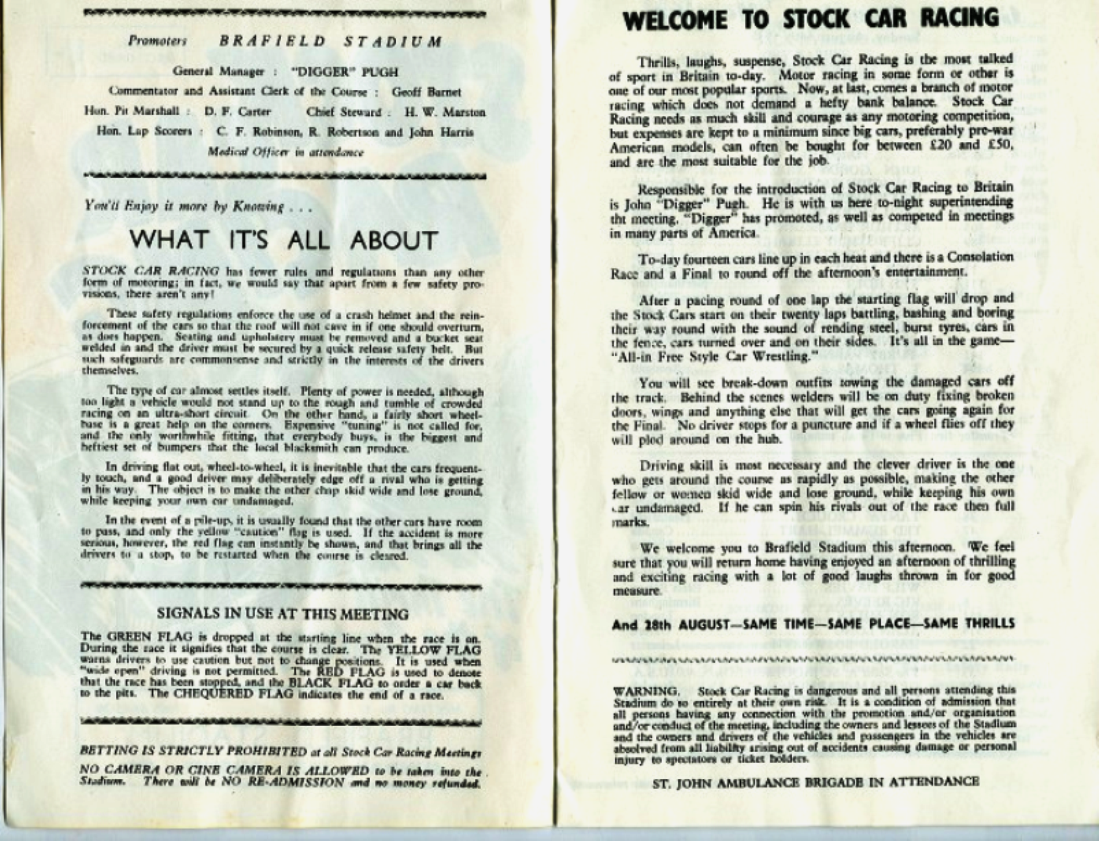
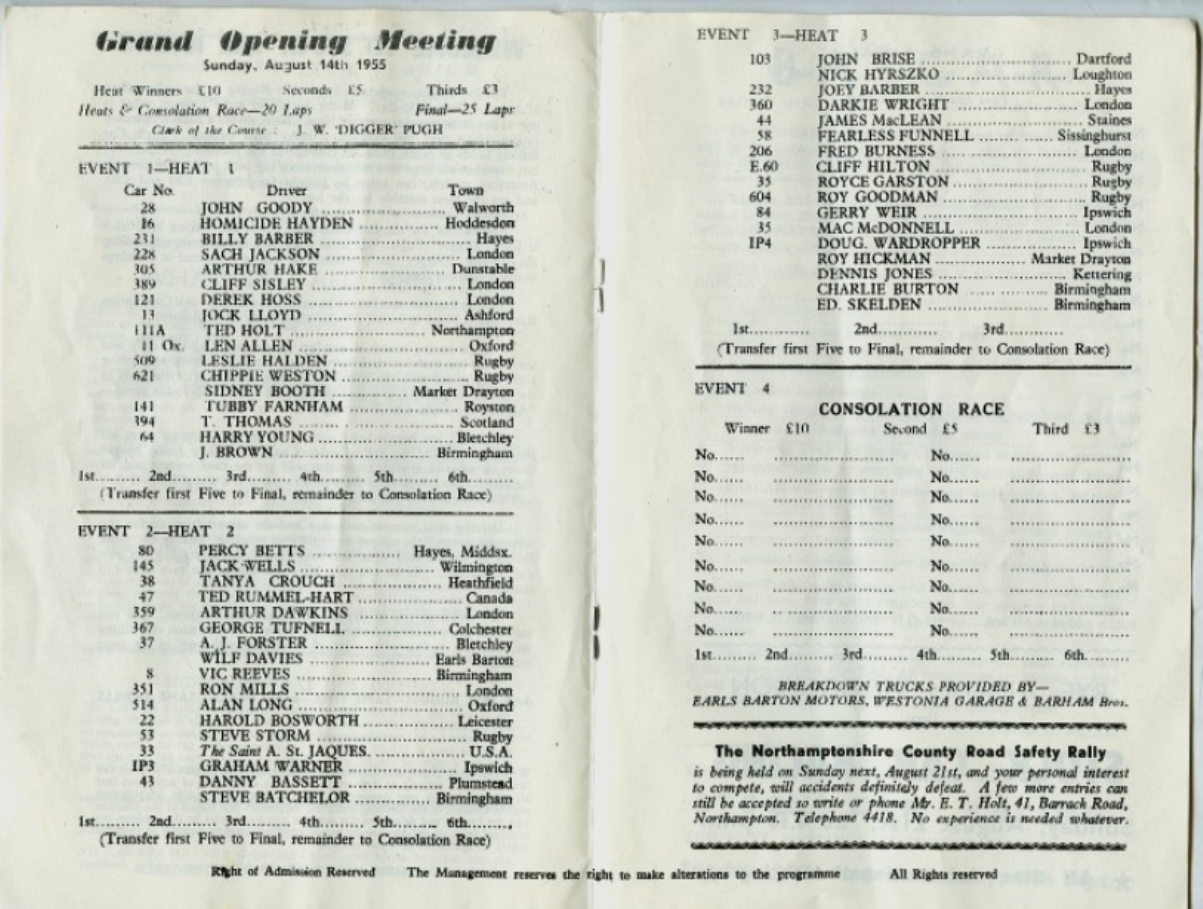
Brian Clements sends these four interesting scans of the very first Brafield programme, from a limited edition painstakingly reproduced by Keith Barber in the 1970's. [Keith also reproduced the first New Cross programme, and important Harringay and West Ham ones. Keith had studied Graphics at Coventry CAT, and was of course an accomplished draughtsman].
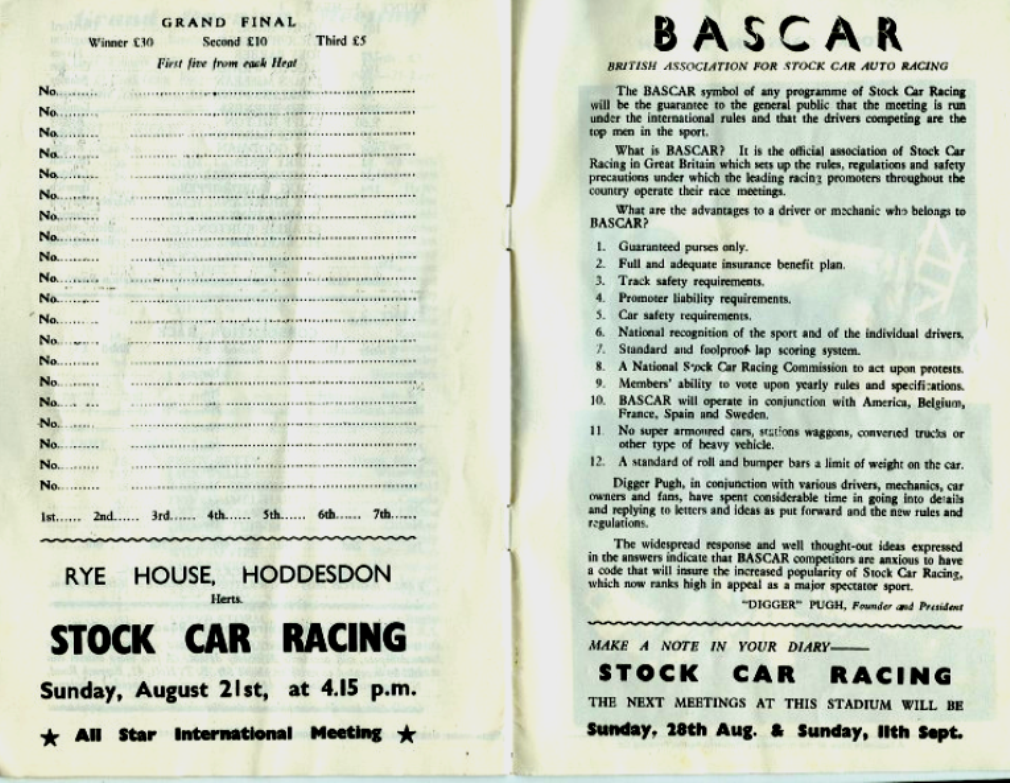
For Sunday 15th 1955, "Digger" Pugh wrote the inside notes.
- Here are the back and front covers.
- Here are pages 2 and 3,
with Geoff Barnet named, and that eternal warning "Cameras Prohibited",
which makes you smile, given the tens of thousands of Brafield
photographs over the years.
- Look at the centre spread of entrants and recall those names, e.g. Roy Goodman -- did he even dream he would still be racing 40 years later?
- The Grand Final paid 30 pounds
---- big money in 1955 (my gross wage ten years later in 1964 was 8
pounds a week) Notice that "B.A.S.C.A.R" intended to share racing
with Sweden, Spain, and Belgium. Thanks again to Brian Clements (who hastened to add that No, he was not there that day in 1955 ---.)
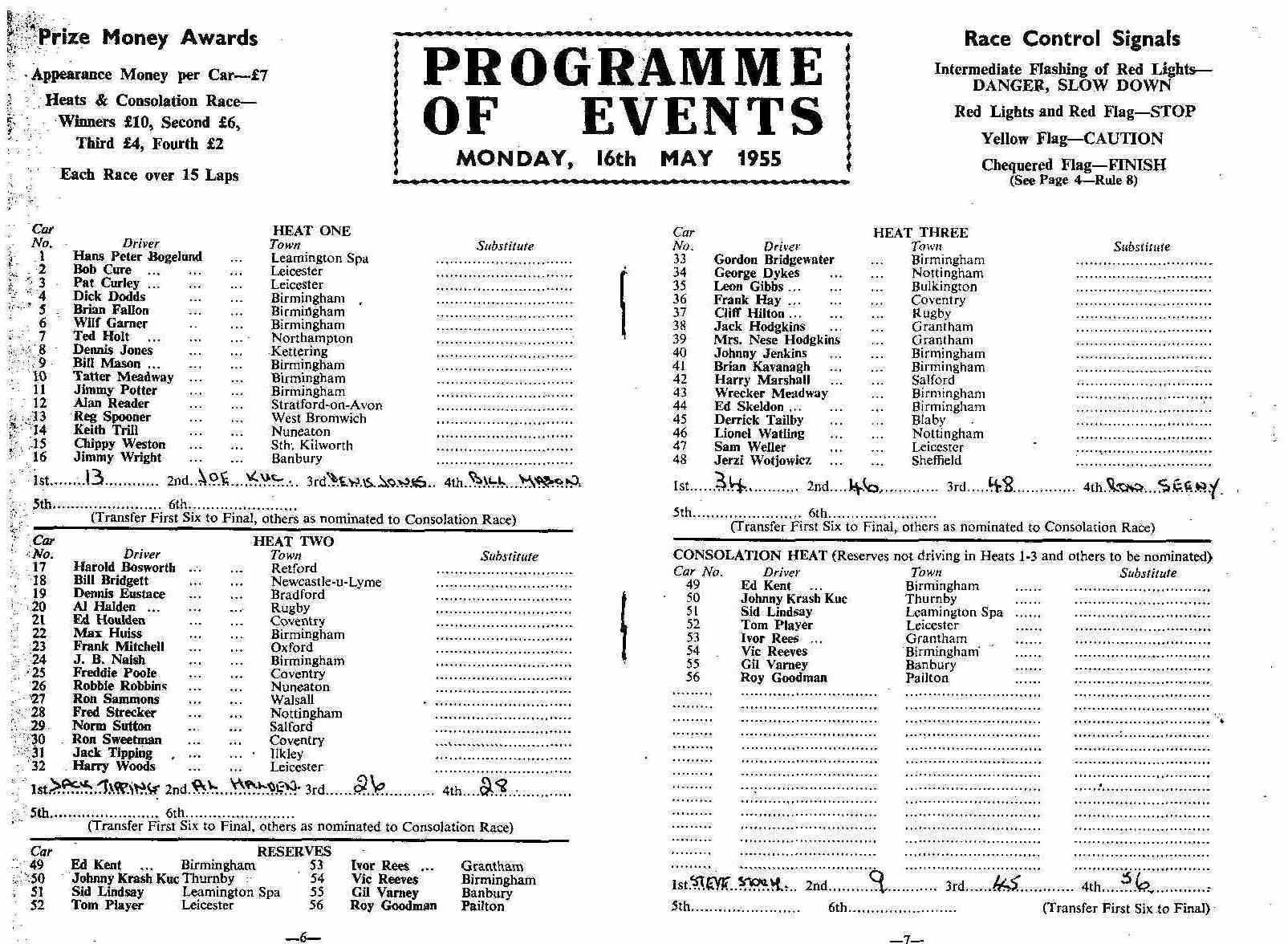
Tragedy we don't enjoy rembering. John Payne, who has contributed quite a bit to this 'early days' section, scanned three original
newspaper clippings in his archive that described the terrible 1955
crash at Brandon in which Mrs Nese ["Nessie"]
Hodgkins was killed,
driving car 39, in the same race as her husband Jack Hodgkins, #38.
In addition, Nigel Stennett-Cox, who used to work for Jack Hodgkins and
who today still knows him and his daughter, sent the night's Coventry programme and the following meet's programme notes. I have the scans of the three newspaper articles,
which of course are melodramatic and sensational, one of which is out to ban the sport. I will e-mail the scans to
anyone interested who contacts me,
but I don't feel like publishing 'tragedy trash' here. Nigel points out that
Nese Hodgkins, who raced stock cars at the same time as the better-known Tanya
Crouch, was driving a Ford Model 68 Touring on that fateful night.
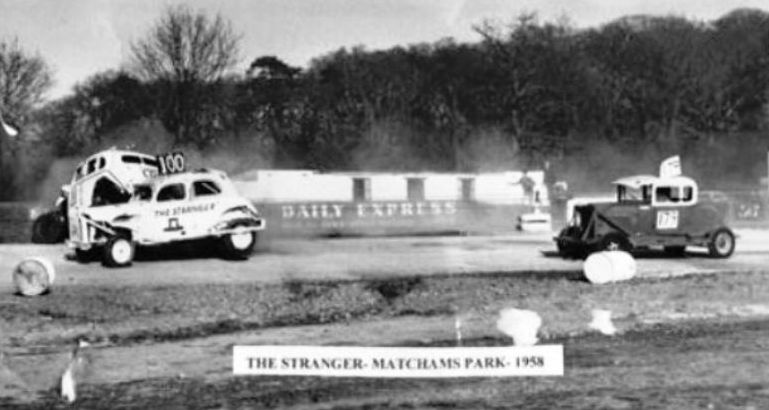
The Ranger STRANGER story:
A big thank-you to the Ranger family who have run Ranger's Garage in
Durrington near Stonehenge for over 50 years, for the following
historic photos. Alan Ranger scanned and sent them, and his
father Michael, ex-autocrosser, karter, and rally man, supplied the
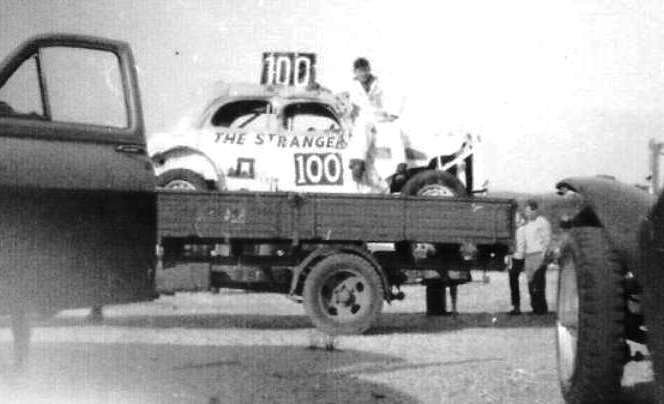
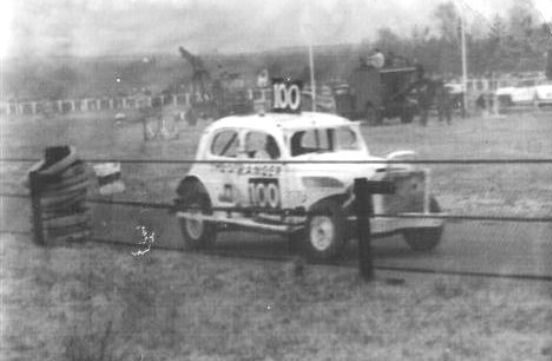
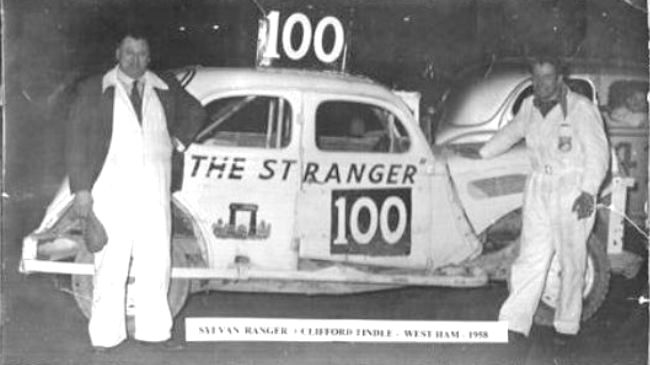
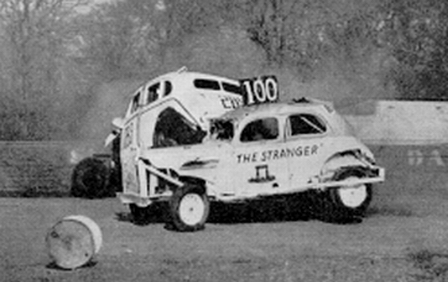
facts. It was grandfather Sylvan "Dub" Ranger who built the #100 "The Stranger" stock car raced by Cliff Tindall, shown here in 1958 at Matchams Park. Cliff and their mechanic Stan Cottrell were expert army-trained lorry mechanics. [I must point out that I've seen three different spellings of Cliff's last name.] The car in these photos looks a lot like a Pilot, but is identifiable [thanks to Ford V-8 ace Mick Gamble] as a Ford V-8 Model 62, with a side-valve of about 2.6L, smaller than the later Pilots .
September 2013: Thanks to Alan and his father Michael Ranger for posting the following historic cine film on YouTube: http://www.youtube.com/watch?v=H3vGEEbAMJE it was filmed in September 1958
at Pewsey carnival in Wiltshire, and shows a stock car demonstration
race. You can freeze scenes and try to identify drivers, but the
"definites" are 38 Fred Mitchell, 272 Frank Harris, 150 Nobby Brown,
253 Ron Smith, possibly 104 Ted Pankhurst, 20 "Oily Wells, and 98 Don
Mason or Killer Sayers. At the end are some charming informal shots of
the Ranger family and friends, and a carnival queen event.
No matter, as the Rangers were in it for fun, not for
championships, and were on that wonderful Southern circus circuit of
tracks with wild men like Pete Tucker and
Gerry Dommet, racing at Southampton, Aldershot, Matchams Park, Weymouth,
Staines (Michael remembers the hour-long traffic jam on Staines Bridge whenever there was a race), and West Ham with occasional expeditions to Brafield, Brandon, and even Long
Eaton --- a major trek in the fifties. Other
regulars who "Dub" and Michael knew were Don Mason from
Chichester, Reg May, Frank Harris from Southampton, Harry Foot who
drove from the back seat of his car; 'crossover' kart pioneers like
Chick Woodroffe and Johnny Brise, and early autocrossers who would
later dominate hot-rods, George Polley and Barry Lee. The
Rangers still have some early cine footage of races, including the
terrifying stunt antics of Exeter's Ellis Dore and his sister, and Pete
Tucker racing at Matchams, and of a demonstration race at Pewsey
Carnival in Wiltshire.
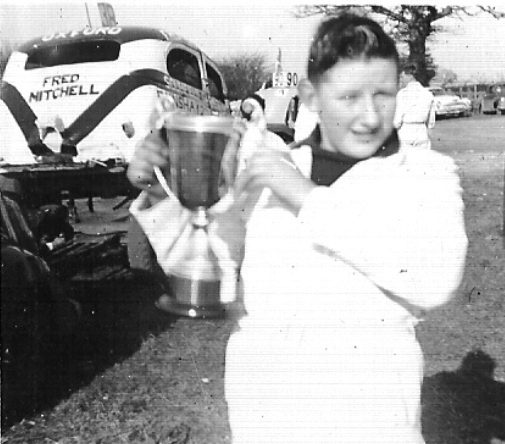
Next, Sylvan's proud son Michael Ranger holding up the Tongham Trophy
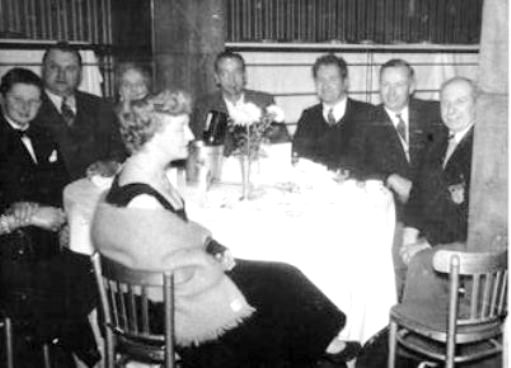
that Cliff had just won at Aldershot. Before we move on to
some other cars, also from the Ranger album, a fascinating photo
of a BSCDA dinner held in '58 or '59
in the Tottenham Court Road, with everyone in their best suits. I
am waiting for more definite information, but I believe that Sylvan and
young Michael are on the far left, and the rather elegant lady is the
wife of Gil Cox (#91) from Bournemouth, who was ex-Battle of Britain pilot, a 'gent' with money who
raced a powerful (and expensive) 4.5 litre Railton capable of 60mph in second gear. Gilbert Cox was from Moordown near Bournemouth. Once, when asked why he raced he said, “I just can`t do without the excitement after flying during the War ”. Cox raced until 1961 despite suffering a broken neck at Ipswich in 1959.
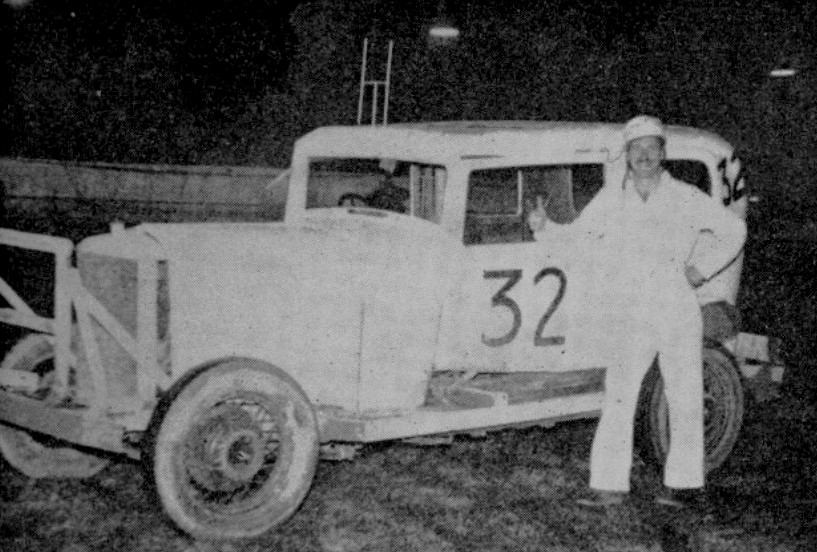
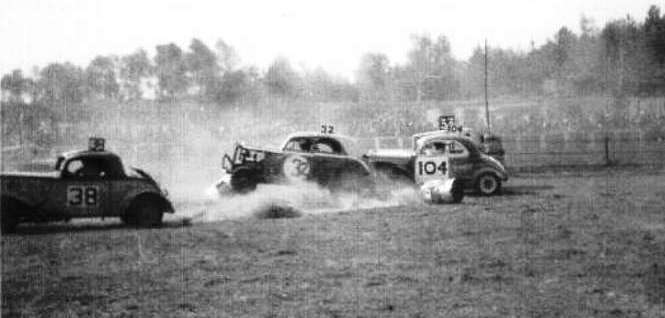
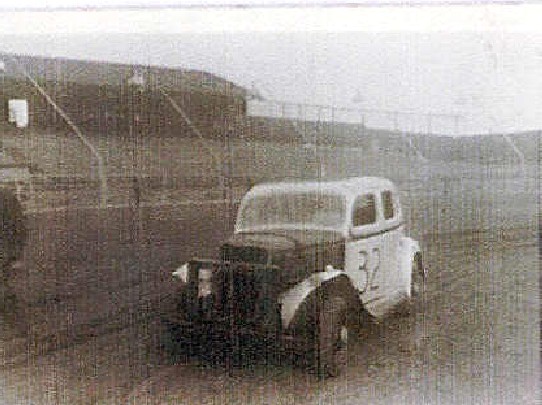
Now for "the others", from the Ranger album: Sprog Bennet #32 from Wembley jumps barrels between Freddie Mitchell and 104 Ted Pankhurst. ["Sprog'
was Pete Tucker's mechanic, and had the honour of being banned
from several tracks for his 'swing first and ask questions later' style
of confrontation]
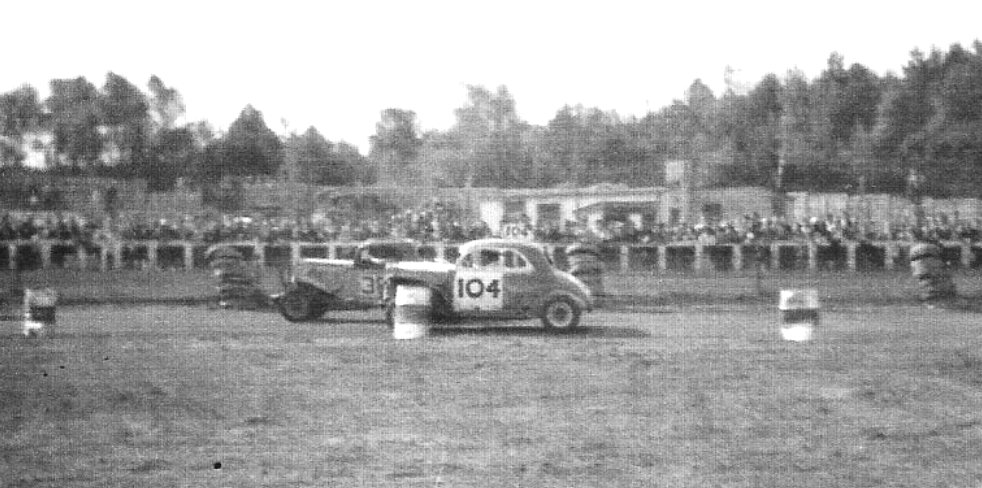
Fred and Ted neck-and-neck on track.
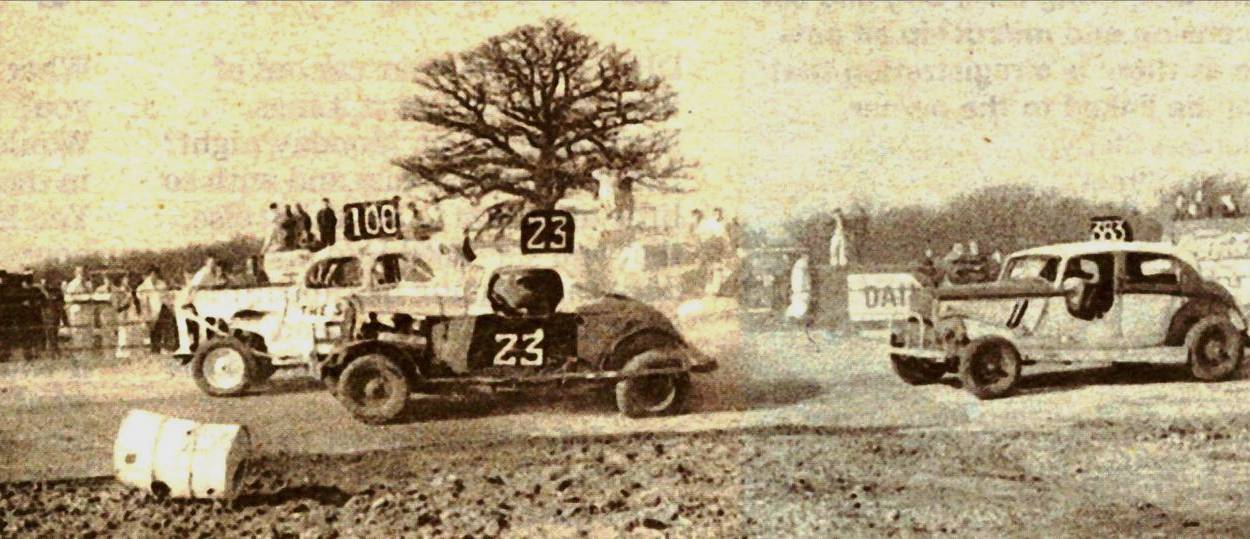
Matchams Park, with #23 leading the pack out of the corner. Ex-racer Steve Daily identified the roofed
building on the far right in the background as the lower entrance
turnstiles and the banking on the left extending right around to the
other side of the track like a horseshoe.
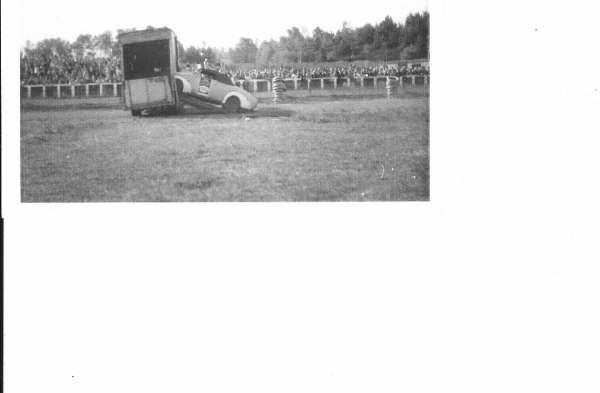
Finally, two photos of a stunt driver (same car in both) doing ramp jumps, one of them into a pantechnicon. (I threw that word in to see how many old 'uns remember the name officially used for furniture lorries: "pantechnicons").
Why call their car THE STRANGER? If you look closely at the side of the car you see a diagram outline of Stonehenge.
Cliff Tindall was from Salisbury ( Stonehenge country), and the name came from ST (Stonehenge) + RANGER
Thanks
to Stan and Diane Hollingdale for identifying Cliff as the driver
in my earlier older photograph on this site. Stan
and brother Ken raced in the golden era, Ken in Seniors/F1's from
1958, and Stan in Spedeworth from 1963.
Last 'Stranger' photo shows Cliff racing against our next hero #122 Tom Ryder of Stepney.
December 2011:
Tommy Ryder
has a great fund of memories from those days. The car you see was
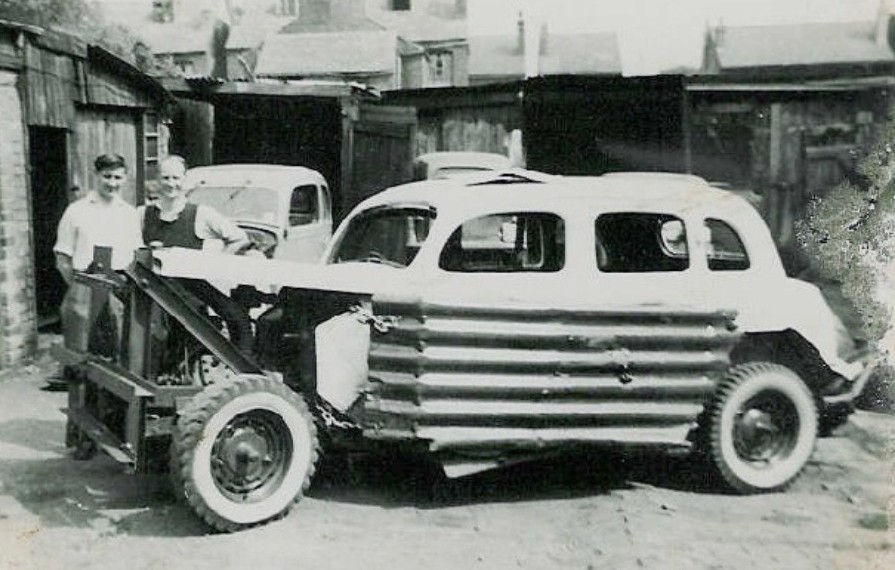
armoured with heavy-gauge corrugated iron from an air-raid
shelter. It was a 1934 Model A Ford that came with the
14.9hp 4-cylinder engine; of course Tom swapped in a flathead
32hp V-8 from a crashed lorry he got for £20. He then
adapted a gearbox from a 22hp commercial vehicle, and to "customize"
the body a bit he cut a section right out of the middle and welded the
two ends together! Tom had a scrapyard, like so many other
racers, so the work was second nature to him. The wheels were from a
1934 Buick straight-8, and the driveshaft was in a torque tube. On the back, Tom installed a railway sleeper for protection. Front bumper was a brutal 6"x3" steel girder, and he happily remembers a night at West Ham when he got a long straight run at Dirty Dennis ----
bang, hard enough to bend the girder. Like other veterans he
remembers the deafening racket of Dirty Dennis's tank engine (actually
from a Bren carrier) that shook the stadium.
Tommy often raced at
Ipswich, and one day on the way there towing his stock car up an
incline, he suddenly felt his car begin go faster. It was another
stock car driver, in a US command car towing a stocker, who had crept
up and started to push. He also remembers the get-togethers at a
transport cafe on the way back from Ipswich. Tom was one of the
pioneers at New Cross, promoted by Digger Pugh, racing against Whiskers Woolnough and Tanya Crouch.
One reason for being selected for the UK vs USA team series is that Digger noticed his surname RYDER conveniently rhymed with Crawfish CRIDER. Tom
was kind enough to chat with me from England, where at the spry age of
81 he was busy outside working on his patio, in December.
More
early history, and a big thanks to Charlotte White. The year is
"sometime in the fifties", and the scene is Birmingham's Perry Bar
track. From left to right the racers and fans are
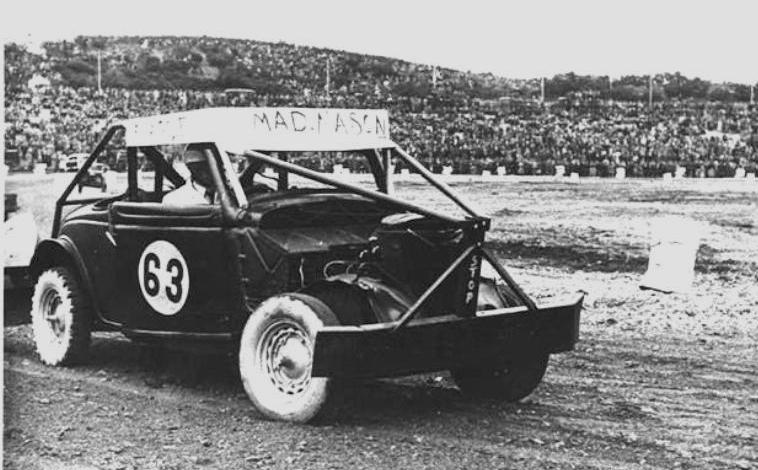
"Mad" Mason with his famous smirk, an unnamed man, then Charlotte's white-overalled grandfather
Reg White. The14-year-old Brian White (Charlotte's father, Reg's son) is standing next to Reg, then Georgie Chiswell peers
from the background, and Len Curtis. Next, traveling forward 10+ years, that same Brian White (76) is
racing a hot rod at Hednesford, a track that he and his father
tarmac'd; and just coming into the photo is Hednesford boss Bill Morris's son
Martin Morris (# 00). Hednesford --- one man's dream and mission
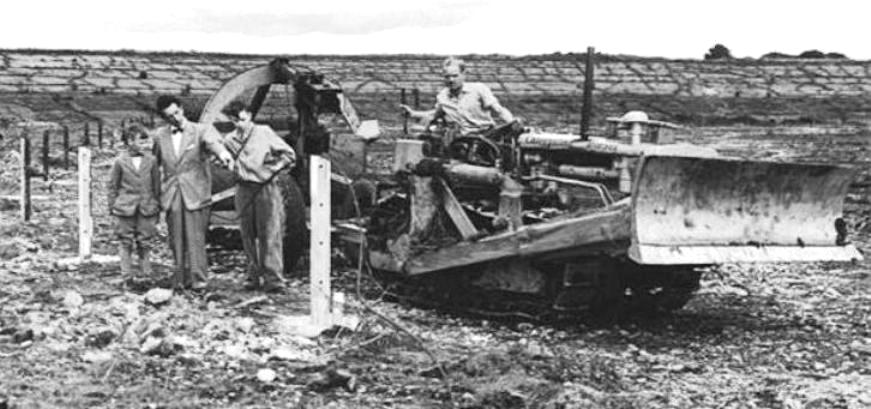
The
reservoir, actually called Scott House Reservoir, had been empty of
water for over 40 years, due to mine subsidence, when Claude took it
over. Conrad
remembers visiting the disused site with his father, and later putting
up posters and selling programmes when the racing first started.
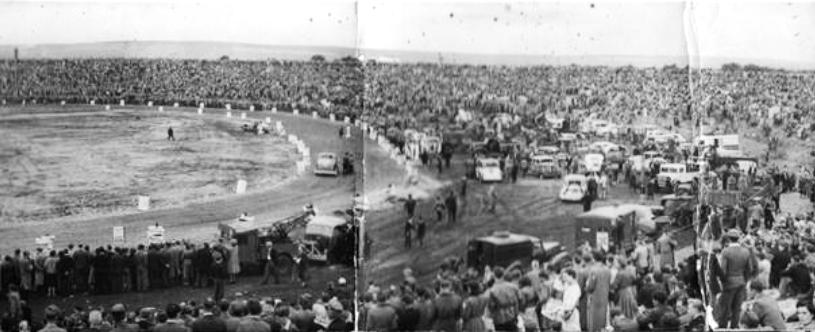
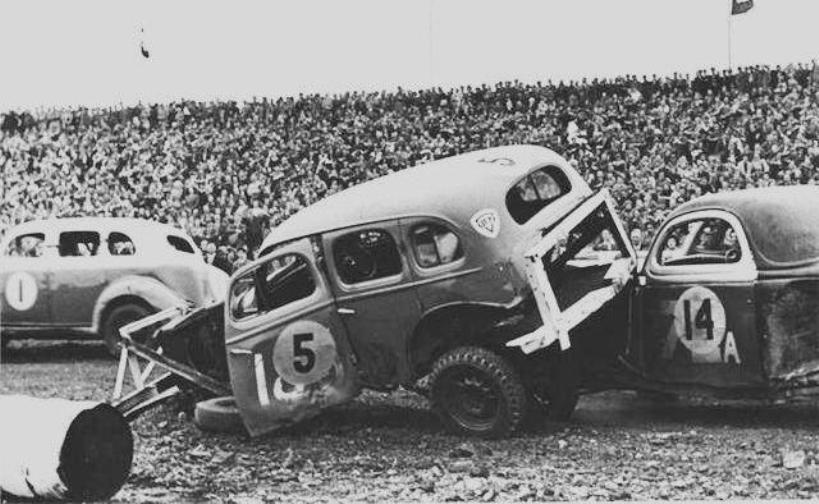
. A dramatic
crash scene, that also shows the amazing crowd size at
Hednesford. Here is the then-infamous "Mad" Mason lining up.
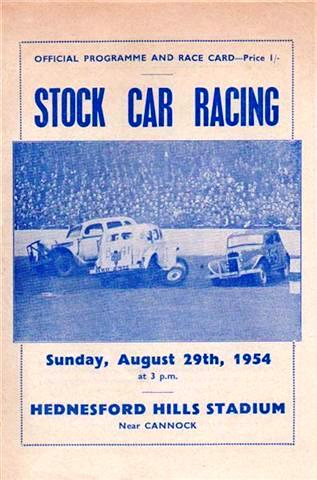
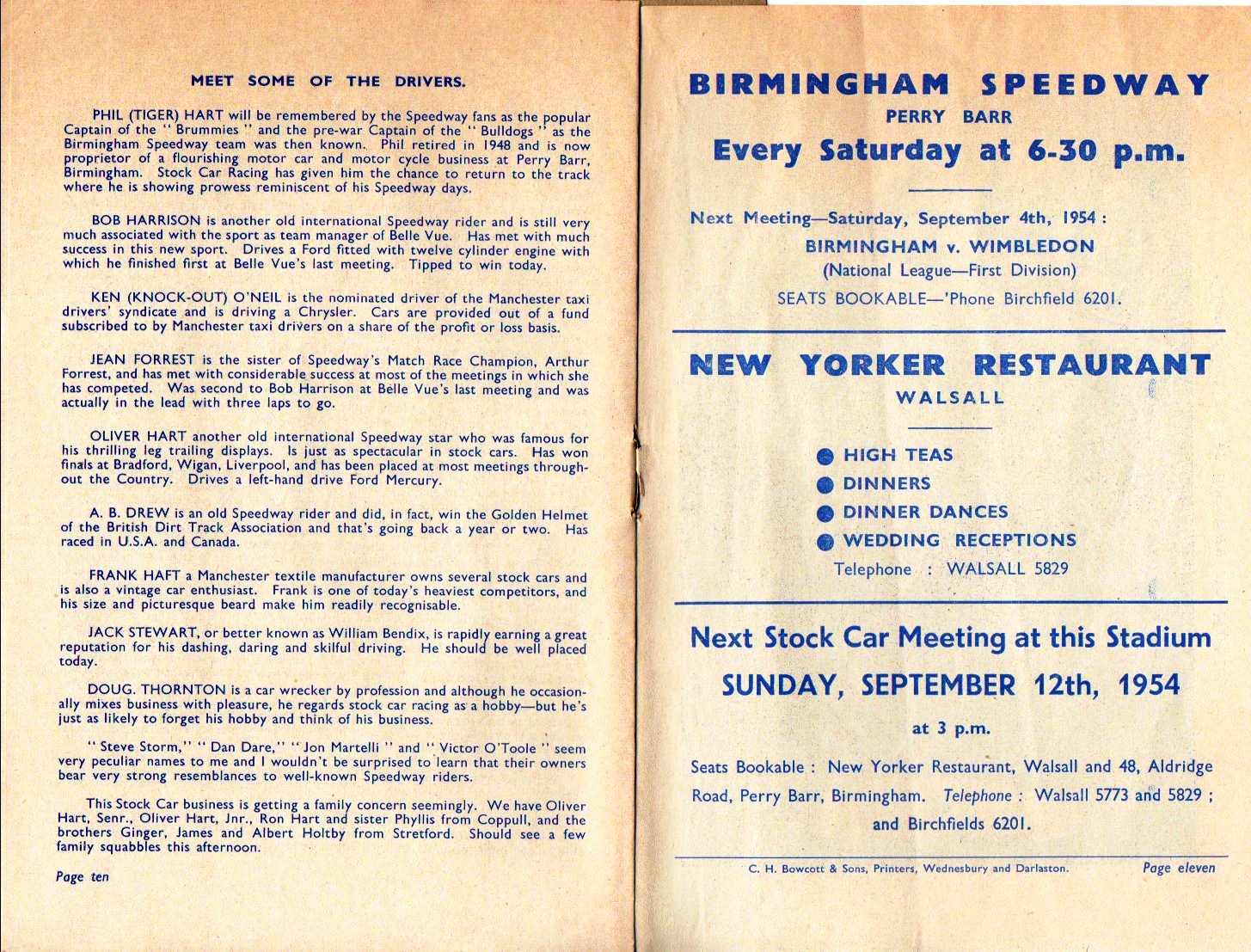
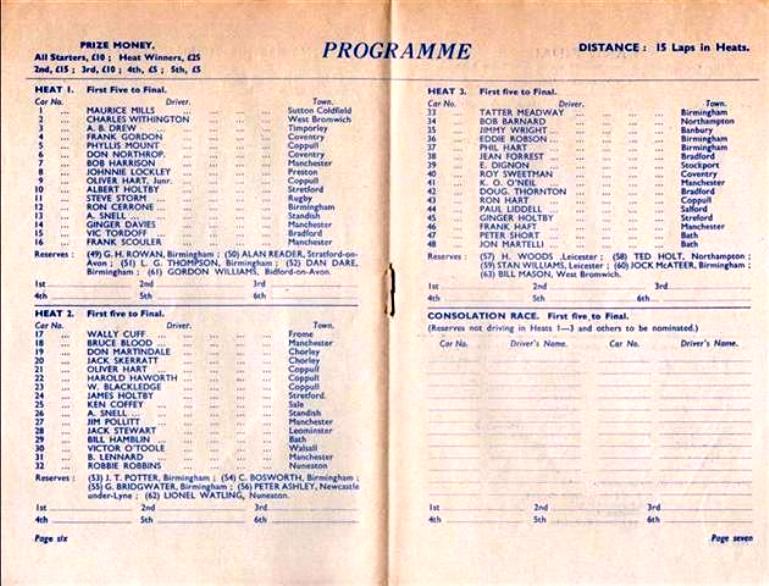
Conrad Roe preserved the following programme from the summer of
1954, clear enough to read the promoter's comments and the names of the
drivers [if you click on the images when they appear, they will enlarge enough for easy viewing]:
Cover; pages 2 and 3; pages 8 and 9; pages 10 and 11; centre spread with drivers' names.
Drivers at the later 12th September meet of 1954
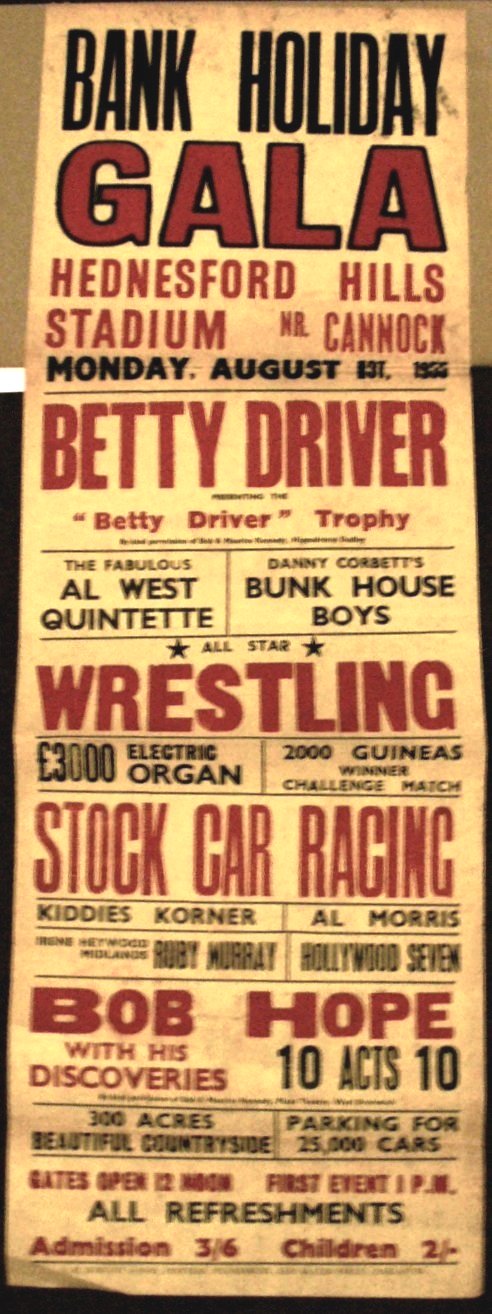
Claude Roe
was an energetic promoter and businessman who had started from nothing,
and put on a variety of events and entertainment at Hednesford, as shown by this playbill from
1955. The 'Bob Hope' listed there is not the one you're thinking of ----
but Ruby Murray was indeed top of the pops in the UK, with seven
top-ten records in 1955 ("Let Me Go, Lover") http://www.rubymurray.org/ .
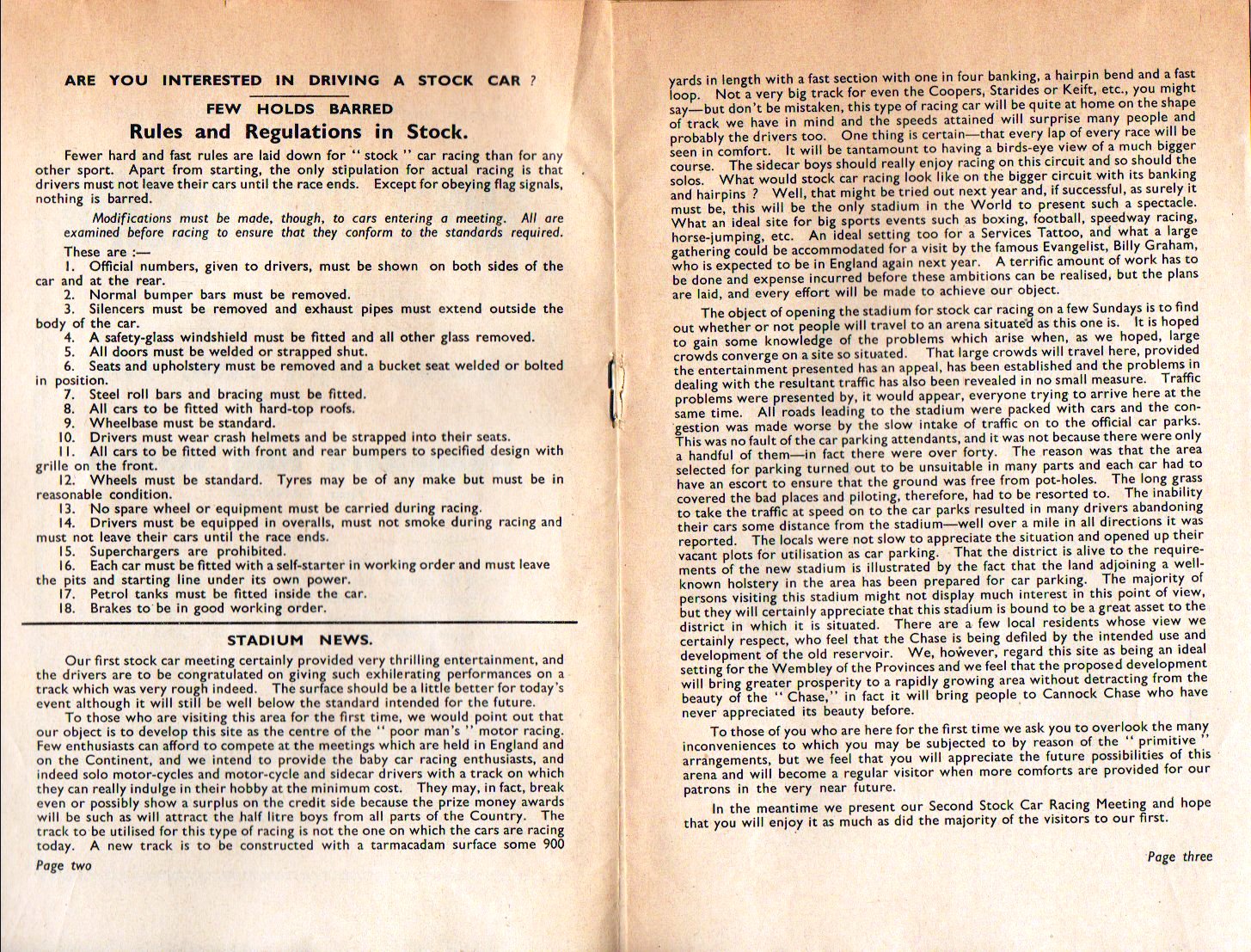
When
you think that folks in the fifties did NOT have a ton of money to
spend, but nonetheless they still walked, biked, bussed, or drove in
massive numbers to speedway and stock-car races; no "goggle box" at home
to drug them. Elsewhere on the site I have cited facts such as
Wembley Lions speedway team having a supporters' club with 66,000
paid-up members at the end of the 1940's, and nights when 80,000 packed
the stadium with another 20,000 locked out in the surrounding streets.
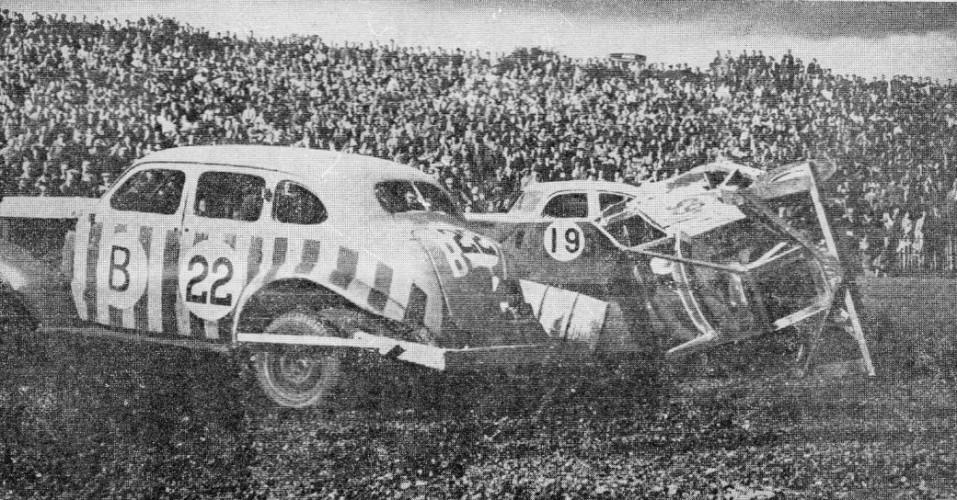
Cars 22 and 19 get involved; look at the size of that crowd.
More Hednesford history Thanks to Graham Brown for the text of this eloquent interview with Bill Morris.
And, below, the grand old man himself, Bill Morris with his son
Martin Morris, in front of the Doug Warner hot rod (before its restoration by Gordon Bland, who sent this photo): Bill Morris lived to be 94 years old, passing away in the autumn of 2008.
More
1950's programme scans from Trevor Richings. Mid-fifties driver
numbers are sometimes a mystery. As Mike Greenwood explains in
his superb and indispensible reference book "STOCK CAR DRIVERS", 3rd ed.,
regional and local promoters issued their own numbers until about 1957
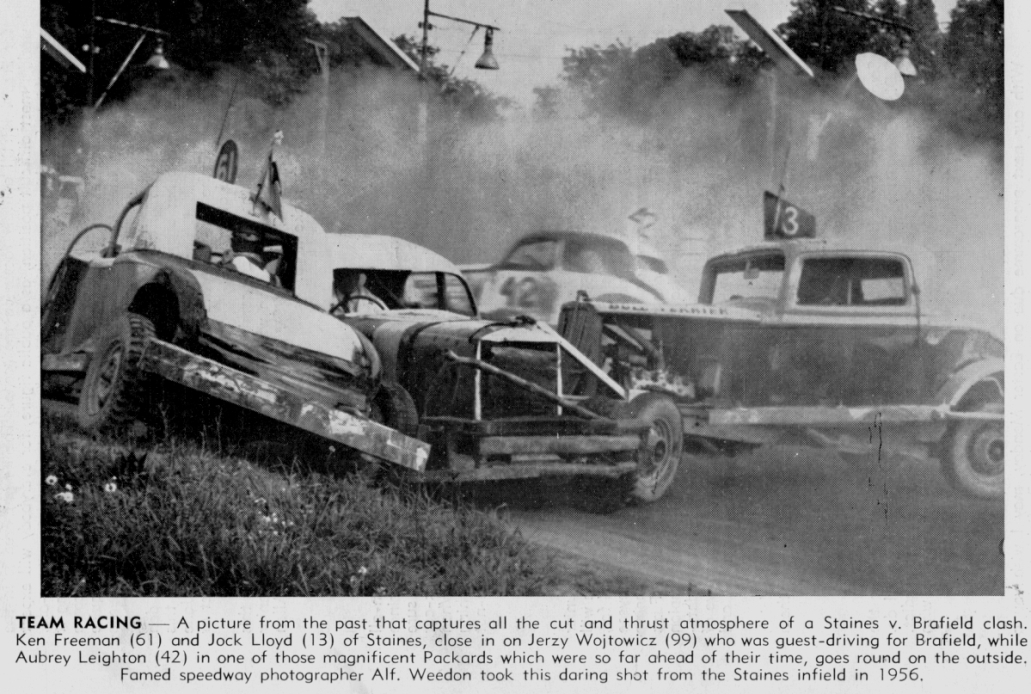
when a national system was instituted. Anyway, here we go: Staines was the scene
as Jock Lloyd (for the Staines team) mixes it with Ken Freeman #61,
with Aubrey Leighton 42 of the Brafield team in the background.
The programme identifies Jock as #13, whose bonnet says "Bull
Terrier", and underneath you can see the flathead Ford V-8 motor.
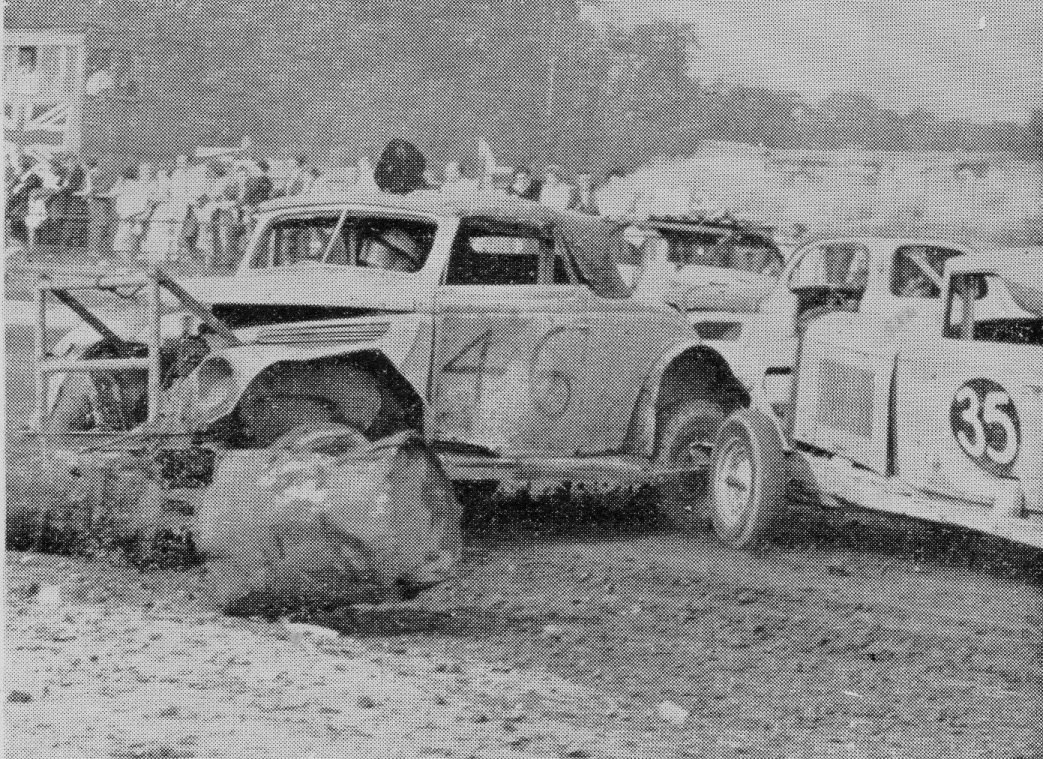
Heading North again (I think it's Brafield), we see Vic Muggeridge passing the "de-axled" car of Harry Bosworth. Another fifties programme scan, unknown location, probably Brafield, 46 and 35 in action; 46 is Arthur Hake from Dunstable. This
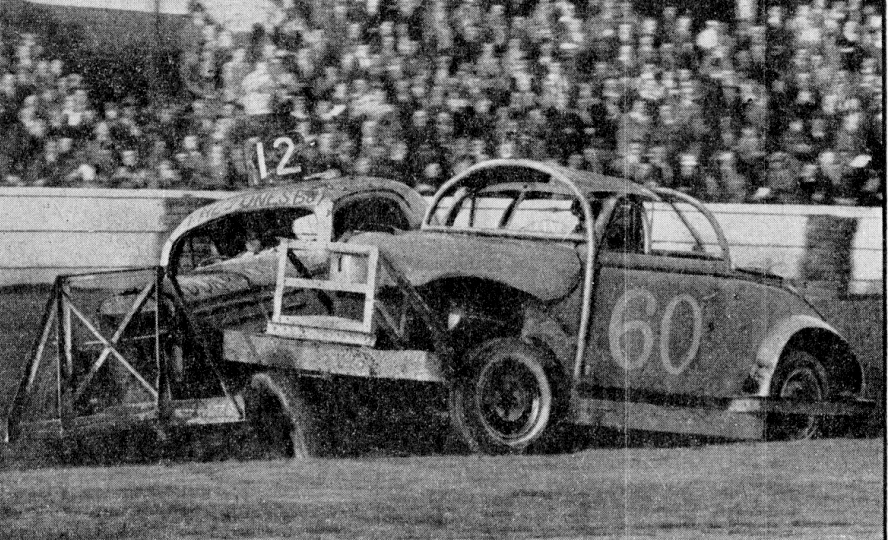
photo is famous and has also appeared in Keith Barber's publications; taken
at West Ham in the fifties, and reproduced in one of their early
sixties' programmes, it shows 12 and 60 coming to blows. #60 was registered to Pat Frost (Ipswich) in 1957, and to Eric Wilkinson (Southport)
in 1958. London's Fred Burness and Sheffield's "Stubby" Bell had
#12 in 1957 and 1958 respectively. Someone will tell me, I bet.
Thanks to Tony Jones for the following four early photos.
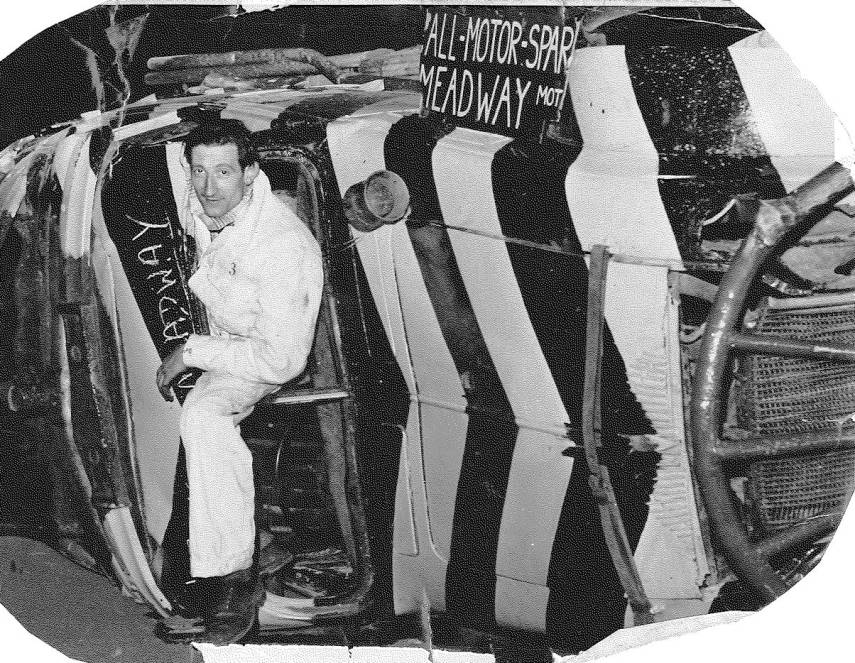
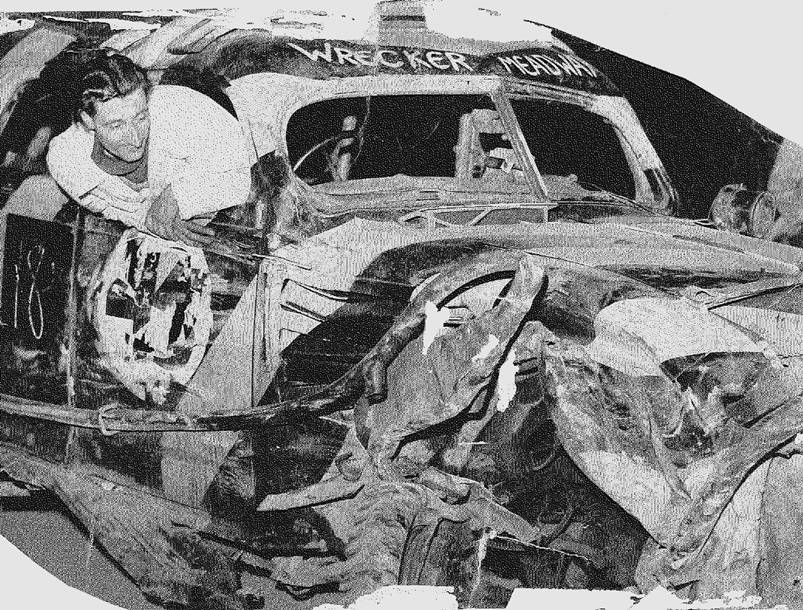
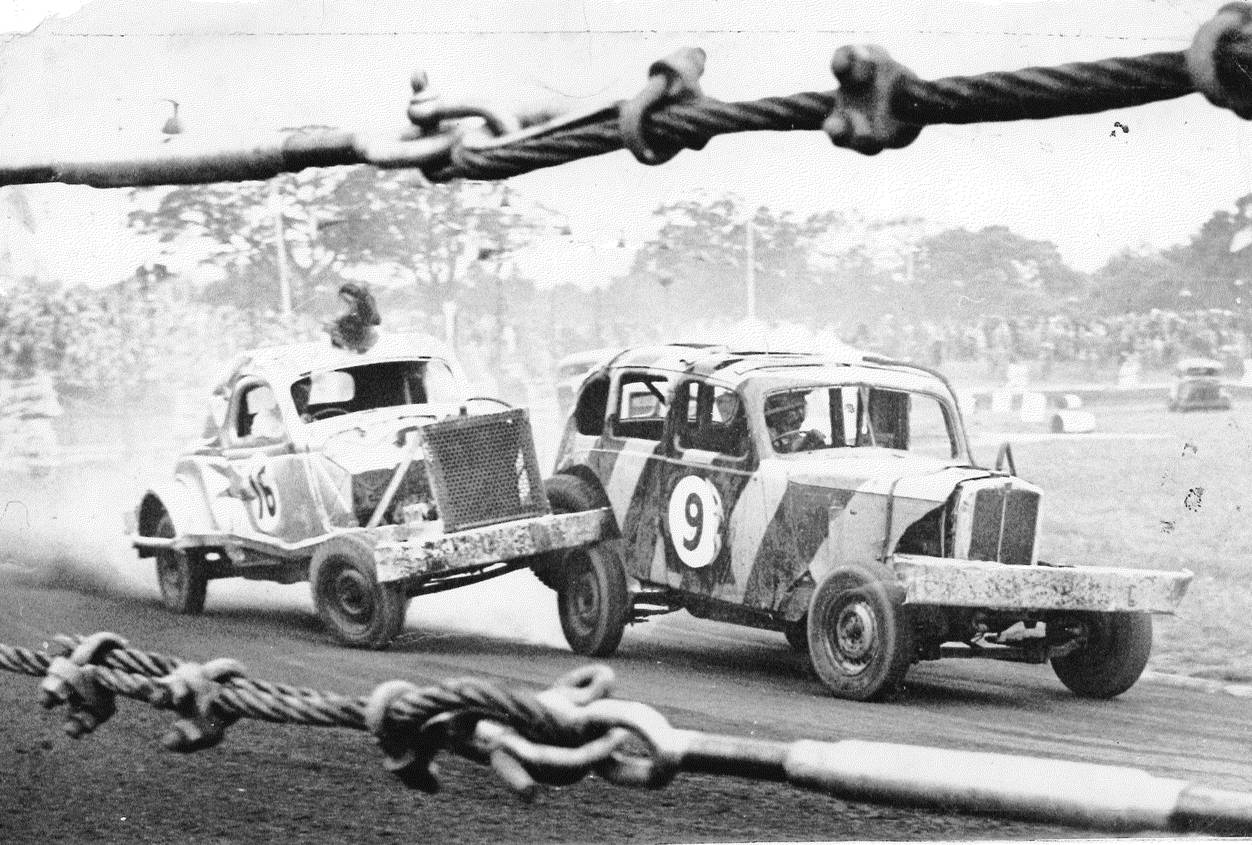
Two show Tony's father, Wal Jones, clambering through the wreckage of the "Wrecker Meadway" car at Brandon. The next one is also Brandon, and is a track photograph that also appears on the cover of Keith Barber's excellent History of UK Big League Stock Car Racing. Depending on the year,
#16 could be Vic Plioppa of Hornchurch, or Fred Zagni from Ipswich; and
there were too many # 9 registered drivers in the 50's to guess.
Wal
Jones was a close friend of the
late great Bill Morris as well as mechanic'ing for the Meadway
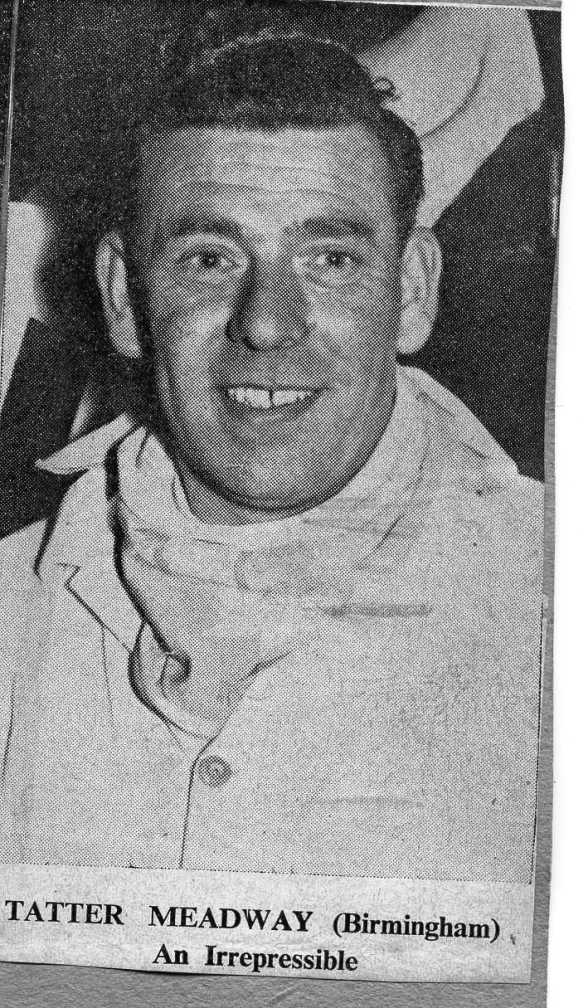
cars, also crewed for Bill's son Martin in Juniors and hot-rods. Tony explained the mystery behind the frequent programme listings of the two drivers "Wrecker Meadway" and "Tatter Meadway":
There were no such people; The cars were named for the
Meadway Motor Spares company that Bill owned and that his son Martin
later took over, in the Meadway district of
East Birmingham where it first operated before moving west to Bordesley Green. Bill Morris drove one car briefly, but handed both over to a mechanic and to his
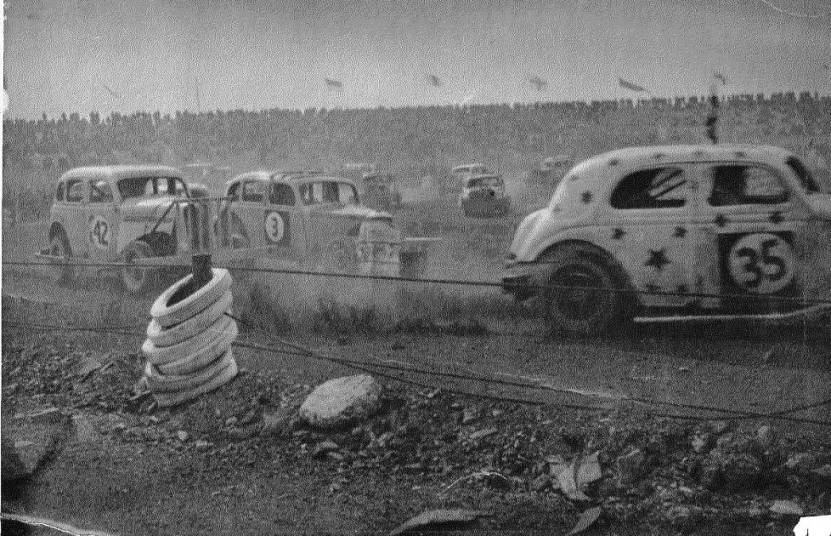
brother Derek. Lastly from Tony, a Hednesford photo showing # 35 heading out of the picture. That #35 car above has been recognized by Derek Bridgett --- it is that of his late brother Bill Bridgett. Derek says: "In
the fifties Bill built three cars; the 35 car in the picture was
his second. The first one had been painted with red and white
stripes (Stoke City's colours!) the second and third cars were white
with red stars, those being the colours worn by the Stoke Potters
Speedway team in the late 40's early 50's; Bill rode for them a
few times. The third car Bill built was also white with red stars but
he only raced it a few times as his "fling" with stock cars died out.
If you look on the top of the car you just might make out a Jolly Roger flag --- I haven't a clue why he put
that on!" 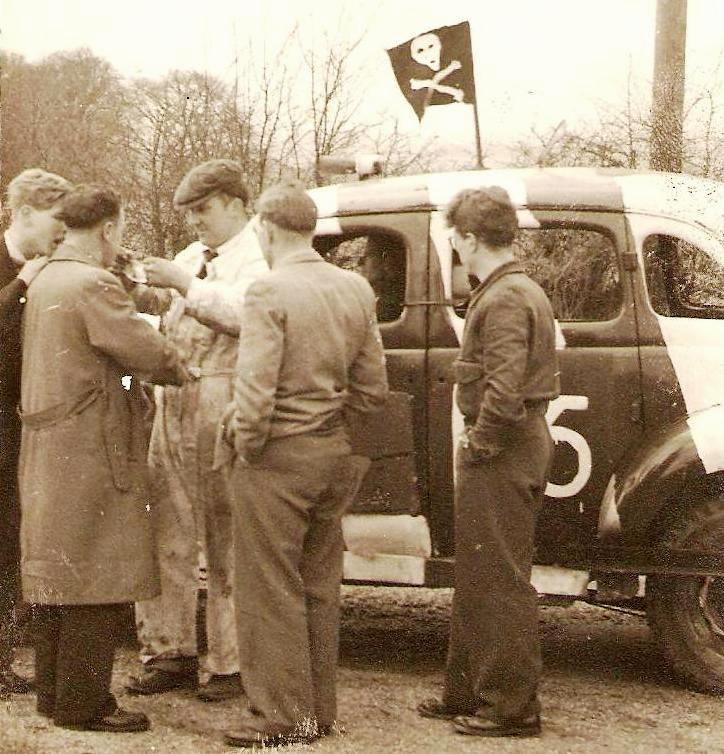 That
snapshot is 1955 [Bill started racing stock cars in 1954] as they set off for Hednesford, with Bill in the white
overalls and, of course wearing a tie; younger readers may not realize
that most tradesmen, lorry drivers for instance, always wore a proper shirt
and tie to work, and a cap. The
stocker was towed behind Bridgett Snr's 1937 Morris 14, with a simple
iron bar, so all wheels on the road, which meant that they had to have a
driver, with goggles, to steer the thing! On long steep hills, the "driver" would fire up the stock car and PUSH the Morris ---. Those were the days.] "After his stock car episode he began to concentrate
on his motor cycle grass track racing career, which he was very
successful at, eventually winning the National 350cc championship in
1968 at the age of 40! [Photo taken at Ledbury in '54 or '55 as Bill was starting to move from speedway to grass.] Bill did return to stock cars in the late
60's and 70's when he was in partnership with Mike Parker Promotions." Andy Lockett remembers, "Bill promoted at Wolverhampton from 1961 to 1980, great showman in his day." The Stoke Potters still race, 60 years later, a Newcastle-under-Lyme premier league team. I'd like to thank Derek Bridgett for those historic memories, and for appreciating his late brother Bill's adventures.
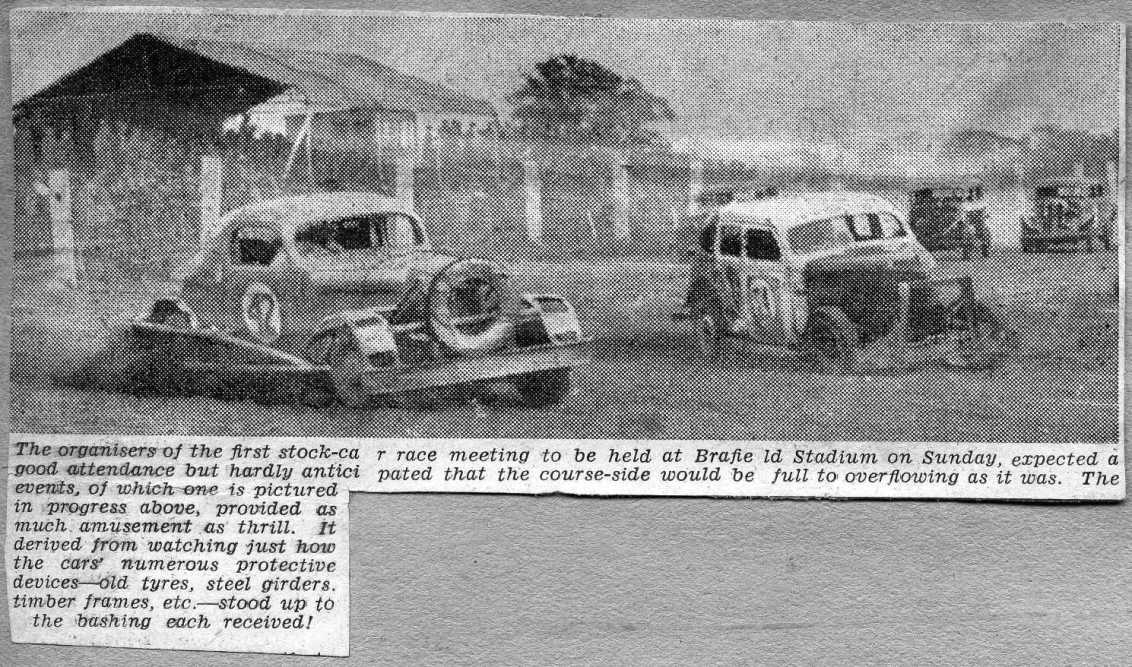
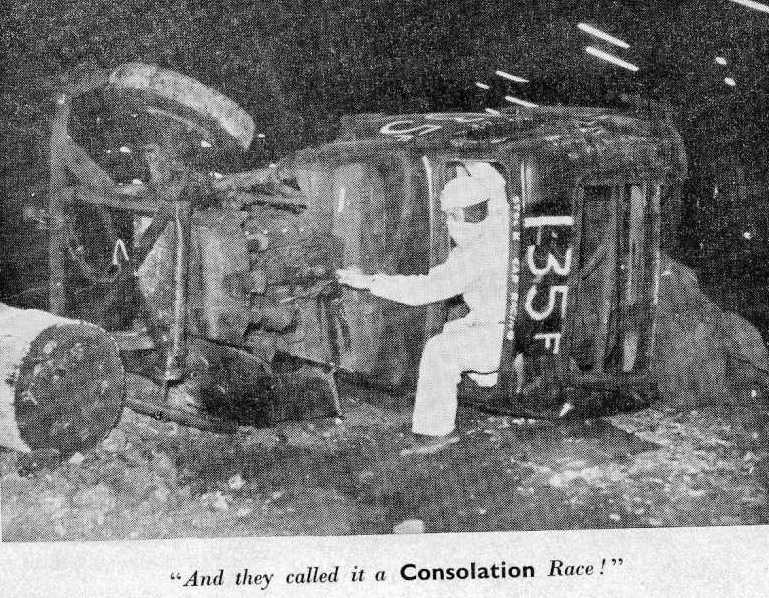
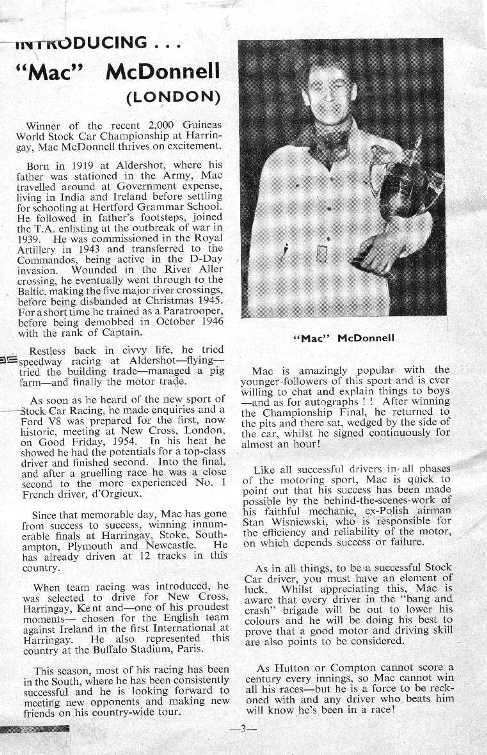
The Beginning: an historic news clipping, with a big thanks to John Payne, who searched his attic to find and send me a 54-year-old newspaper clipping that reported the VERY FIRST STOCK CAR RACE at Brafield Stadium. John also sent some other newspaper 'treasures', one of which is a photo from an early Brandon meet: Car 135F, with its driver exiting through the windscreen space. Famous among the mid-fifties pioneers was Mac McDonnell,
written up here. As I've commented elsewhere on this site, many
or most of the first racers had seen active service in WW2 or National
Service. Mac had served in a 'Commando' unit --- suitable
training for our sport, eh?! [More of John Payn'es items will appear here soon.] One of the crazy men at Brandon was Bill "Mad Mason", faintly photographed here with his car mascot, a stuffed badger. (note:
for all their antics, most racers were about as 'crazy' as General
Motors -- they knew how to build, organize, and put on a successful
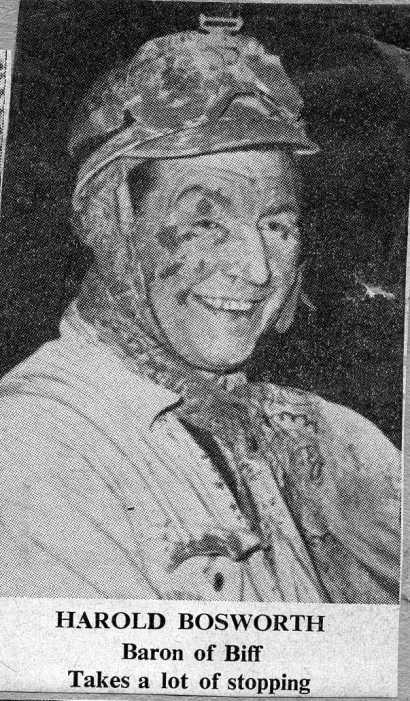
show, and genuinely 'loony' guys did not last long.) Note on viewing old scans: if your cursor shows a + plus sign or -
minus sign on a photo, give it a click. The old half-tone
newspaper photos look odd when digitally scanned at high resolution,
but computers seem to recognize high-res images and give you a chance
to improve viewing. Do
me a favour --- if you spot a name that's familiar and may know
the driver or their family, chase it up for me. Bill Mason's
("Mad Mason") grandson contacted me a few years back and I have lost
his e-mail. More from John: Look at this crowd! Below, from an early Hednesford Hills programme, identified
by eagle-eyed Trevor Chater, who attended Brum's Perry Bar track in
1955 as a babe in arms and after half-a-century of country-wide
spectating, still faithfully attends Coventry. 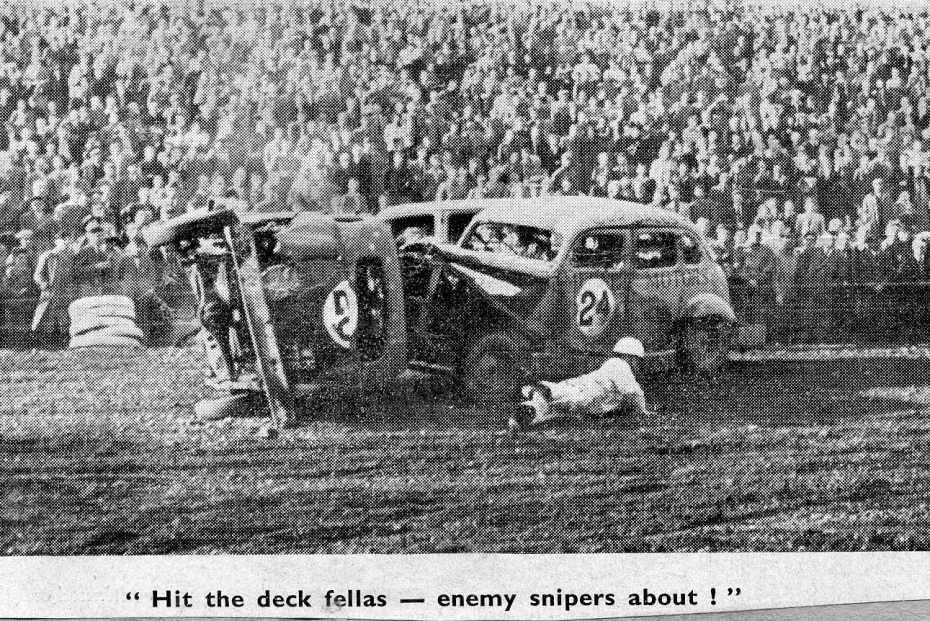
Here are some driver photographs from the 1950's -- remember to look up any family names:
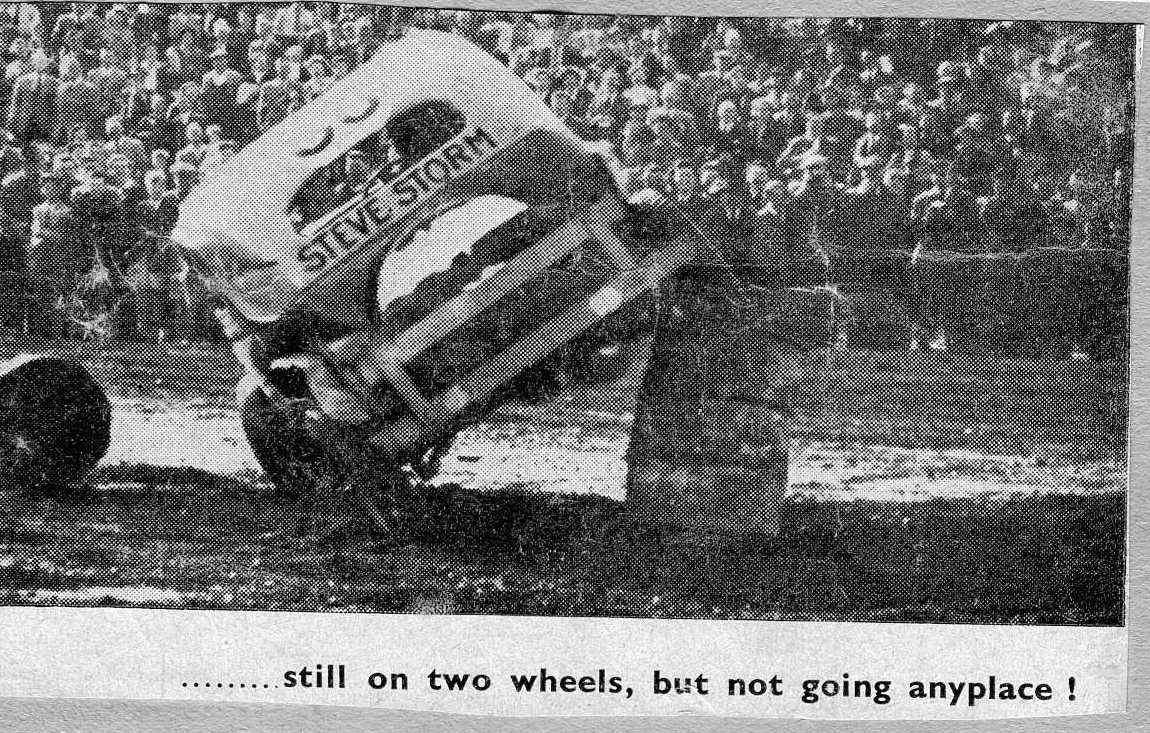
Steve Storm sits on a barrel. Nigel Harradine recalls
that "Steve Storm" was a fake name used by a speedway rider whose own
organization did not allow riders to race stock cars. Nigel jokes
that he too has bumped against that kind of rule ---. 1972.
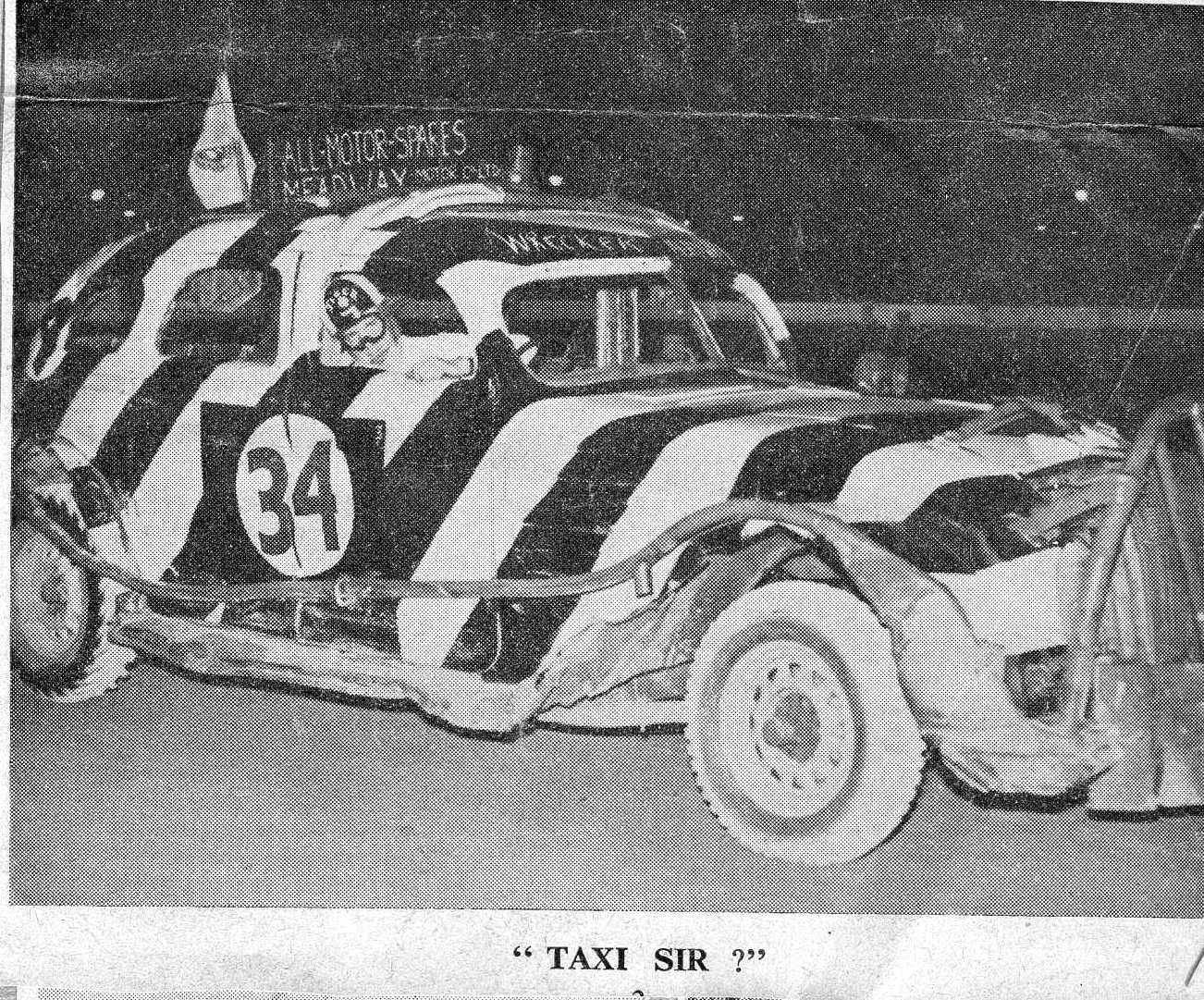
"Wrecker" Meadway wears tiger stripes.
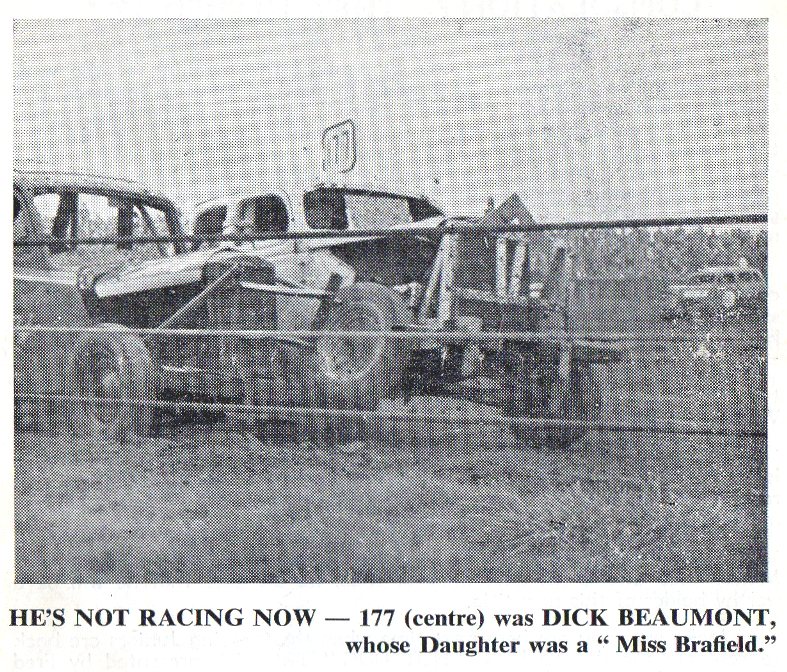
From Trevor Riching's archive, a typical "snag" into the unforgiving Brafield steel cable fence for Dick Beaumont #177.
Years
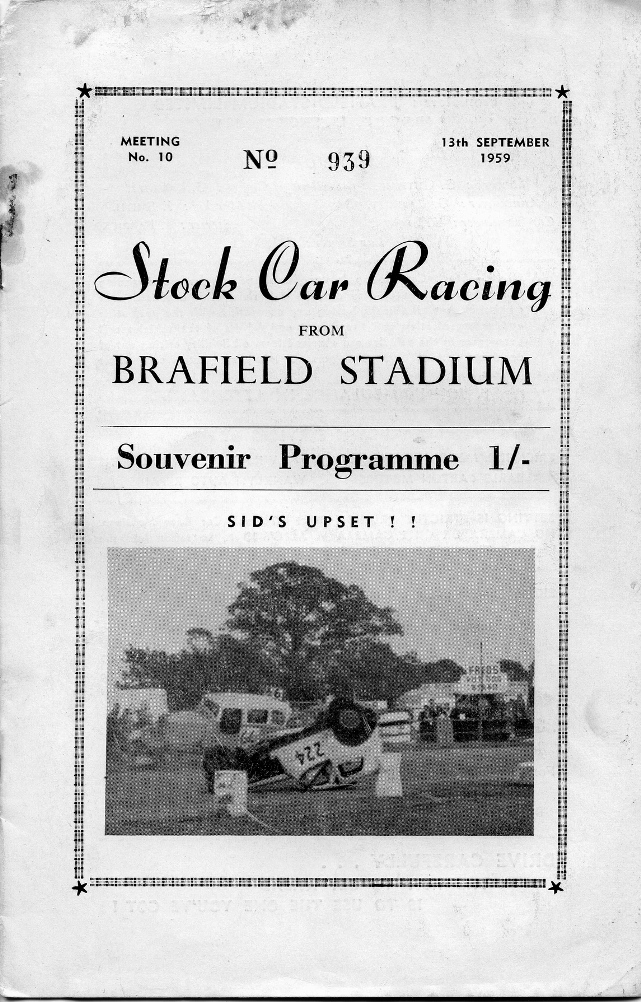
ago Keith Barber kindly gave me this 1959 Brafield programme. A word about my scanning (usually at 300-400
high resolution): if the image you see is blurry, click the mouse on it
and it may re-size more clearly; the computer seems to know when the
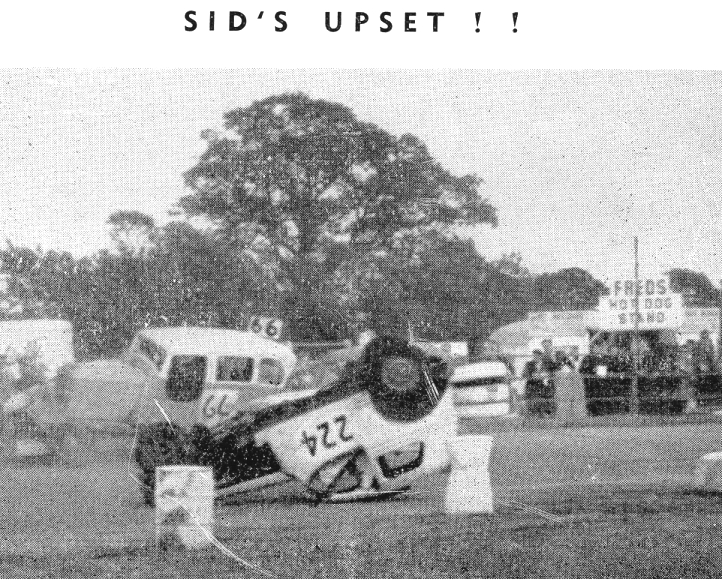
image is too big. Here is the cover: notice that Brafield had already run nine meetings that year. Then an enlargement showing Sid Farndon's rollover in
front of that venerable Brafield landmark, "Fred's Hot Dog Stand".
Thanks to Keith Green for pointing out that Sid Farndon's older brother was Tom Farndon, a Coventry speedway rider and one of the greatest British speedway stars.
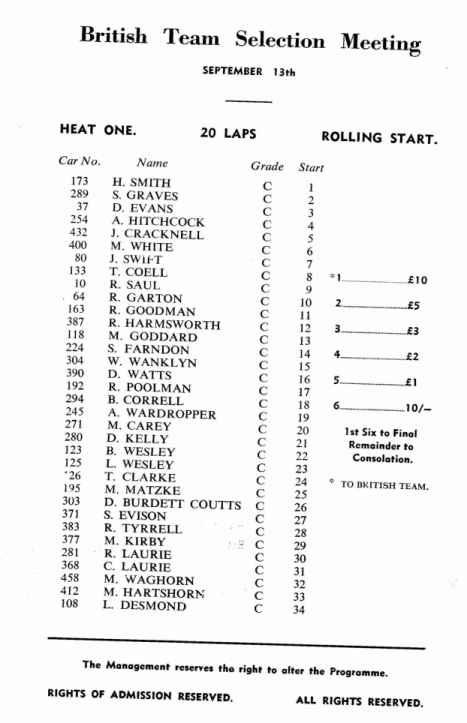
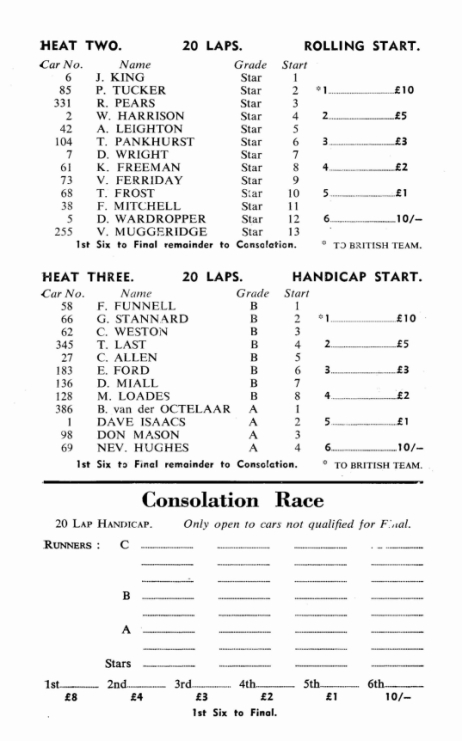
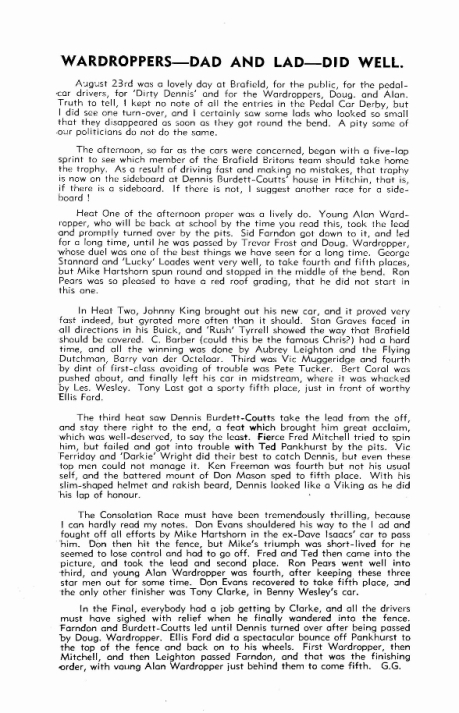
The crowded Heat One has 34 cars entered. Here are Heats Two and Three. I see famous names in all three races. Graham Guthrie's report of the August 23 meeting,
which sounds like it was a lot of fun (imagine Dirty Dennis staying in
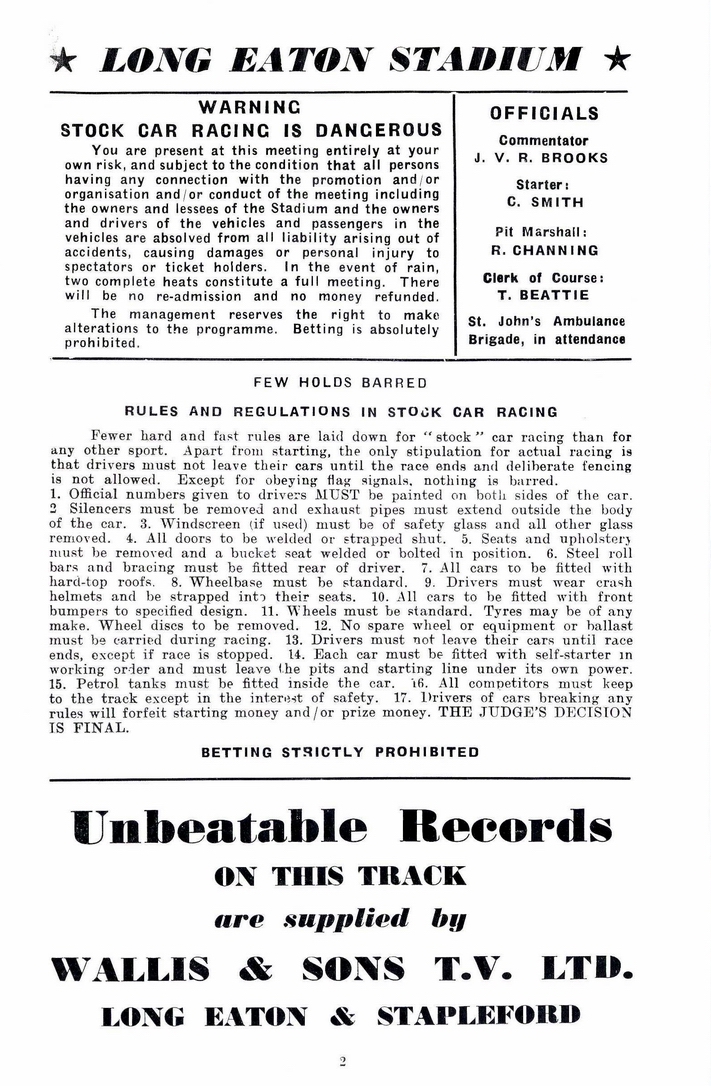
one piece and on four wheels, to finish in first place ---). Ken Mason sent me this scan of a 1958 Long Eaton programme,
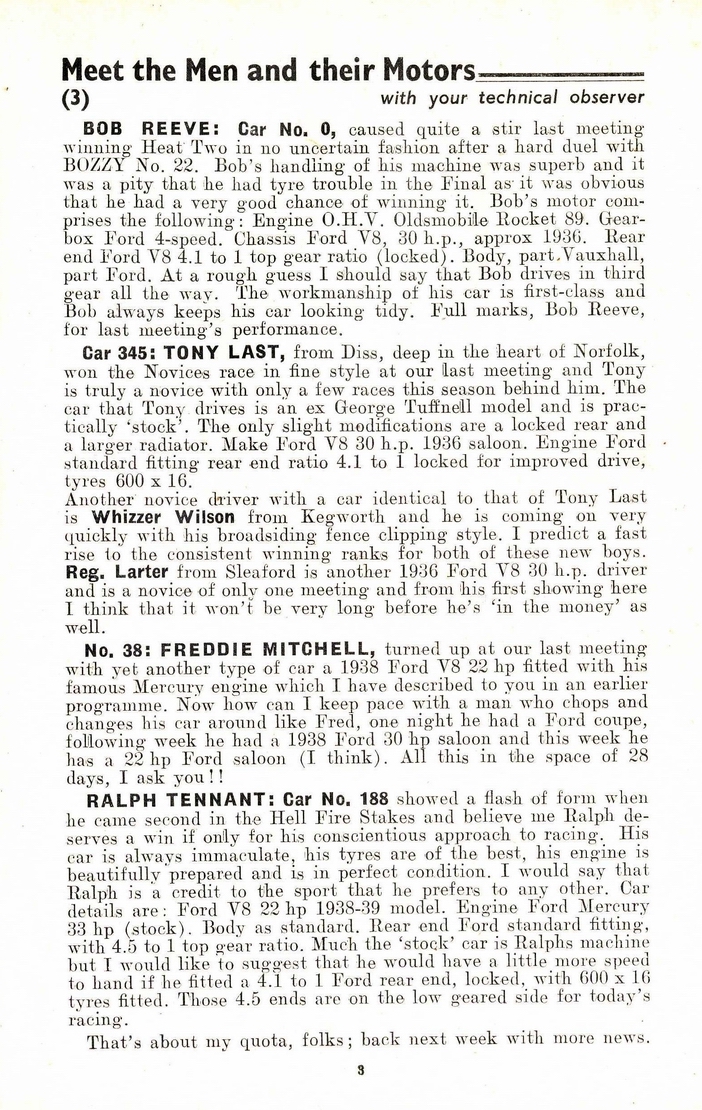
which matches some info received from Trevor Tennant, the son of Ralph
Tennant # 188, profiled here. The LE rules/regs are shown here.
Ralph raced at LE under "Bozzy" Bosworth's management, and at
Brafield where Geoff Barnet ran the show. Ralph's car was a
typical 3.6 litre side-valve Pilot. In the 1960's Ralph raced a
Junior F2, #584, at a time when the Wesley brothers wreaked havoc on
the track in their Rover 10's (Trevor has an old 8mm film of the
action). Later Ralph raced hot rods at Hednesford,
#45, a Ford 100E with a 1500cc BMC motor, AND a 'customized' Ford 10
van with a saloon top welded on, and a Hillman Minx engine.
Trevor Tennant and his own son Stuart are big in stock-car model making
and racing (Stuart was the 2000 champ).
Winner
of the 1957 World Championship. Aubrey was known for his
engineering 'perfectionism': one correspondent remembers seeing a
humble Ford 10 motor in the Earls Barton garage, prepped for racing,
that looked like a shining jewel, every external and internal surface
polished. Here are some snapshots
taken at Aubrey's garage in Earls Barton courtesy of ex-racer
Steve Gateley, whose father Alan Gateley also raced and knew
Aubrey. First, that
famous Leighton grin and moustache. Photos of the front of the championship car, ONE and TWO. Next is Aubrey's
family: wife 'Effie', daughter Carol and son Keith. Next,
perched proudly on dad's car is Aubrey's
son Keith. Keith went on to a stellar career, from Cosworth engines to Formula 2 and F1 Grand Prix
teams [World Champ Ronnie Peterson's engineer], to
Indy cars and more — see what a good stock-car background does for you. Aubrey
also adapted a Ford
fire engine that could hit 70mph, as his 'ambulance'. Here
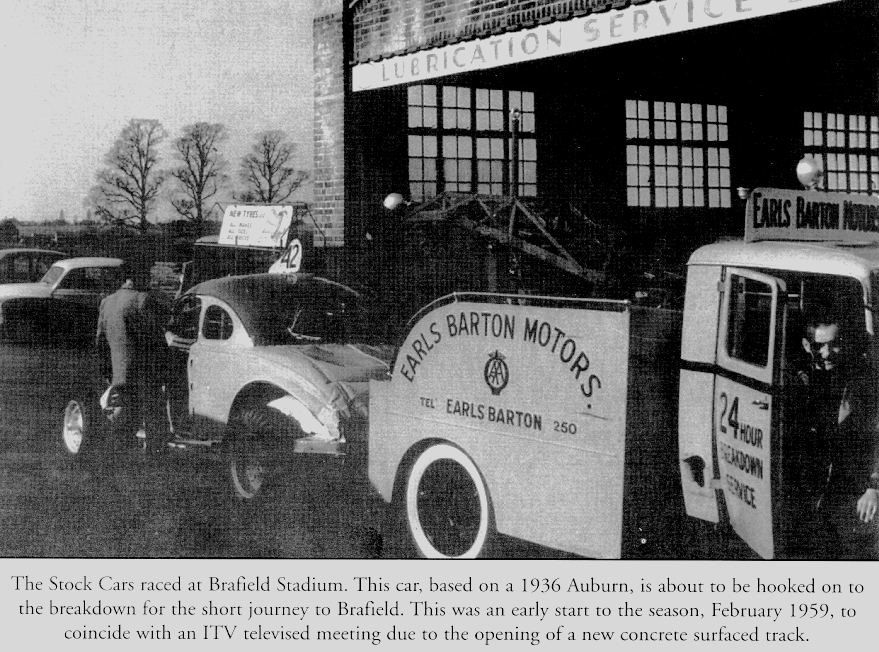
is his Auburn based 42 ready
for the first ITV televised race at Brafield in Feb 1959.
Priceless
family photos showing Aubrey Leighton's legendary and infamous
1950's Packard
"destroyer": One shows the
car by itself in the weeds beside Aubrey's garage (Wellingborough road
A45 in Earls Barton), and the second shows young Steve
Gateley [left] sitting with Aubrey's son
Keith on its roof. Steve estimates the date at 1960, but says the
car sat there for years even after it was banned; Aubrey always refused
offers for it. The widespread belief that Aubrey raced
the Packard with its original V-12 engine is not accurate --- the motor
was found to be in bad shape and not repairable, and he substituted a
Ford flathead V-8 from a Bren gun carrier. At one point his apprentice went with Aubrey down to Fred
Mitchell's yard to look at another V-12, but it's not known whether
that went anywhere. Thanks to Keith Barber and Harry Prigmore for
those facts. Thanks
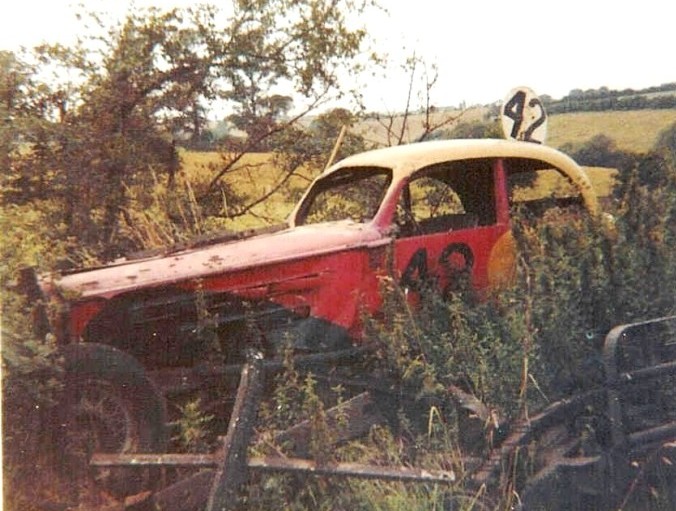
a lot to Steve for the photos. I recall Aubrey's final 42 "pink
un" also rusting by
the garage until it went on to other drivers, and eventually to Keith Barber.
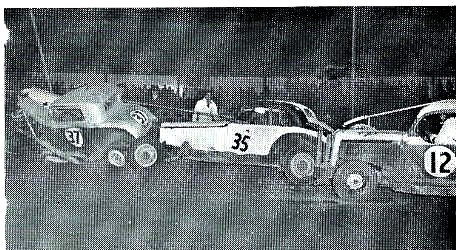
This
is a notorious photo, originally
printed in Stock Car Racing News in Feb 1965, and reprinted
in Keith Barber's Stock Car Magazine in the last three
or four years. The
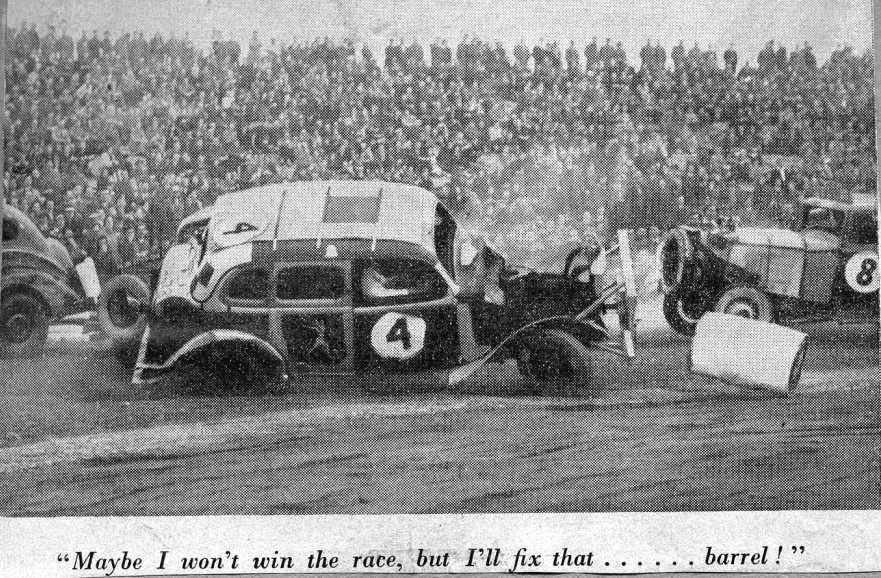
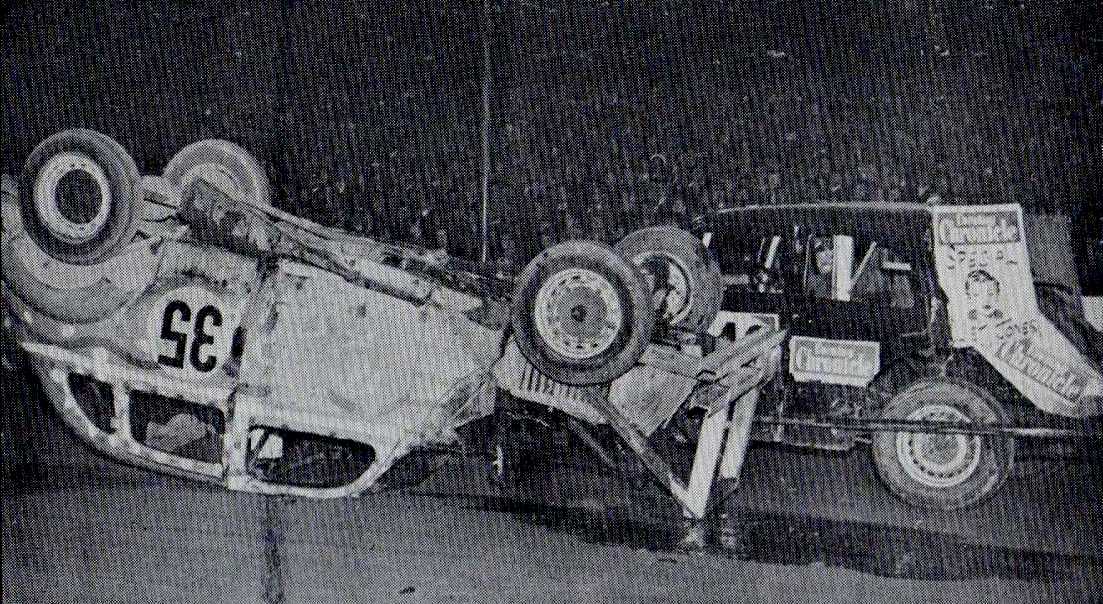
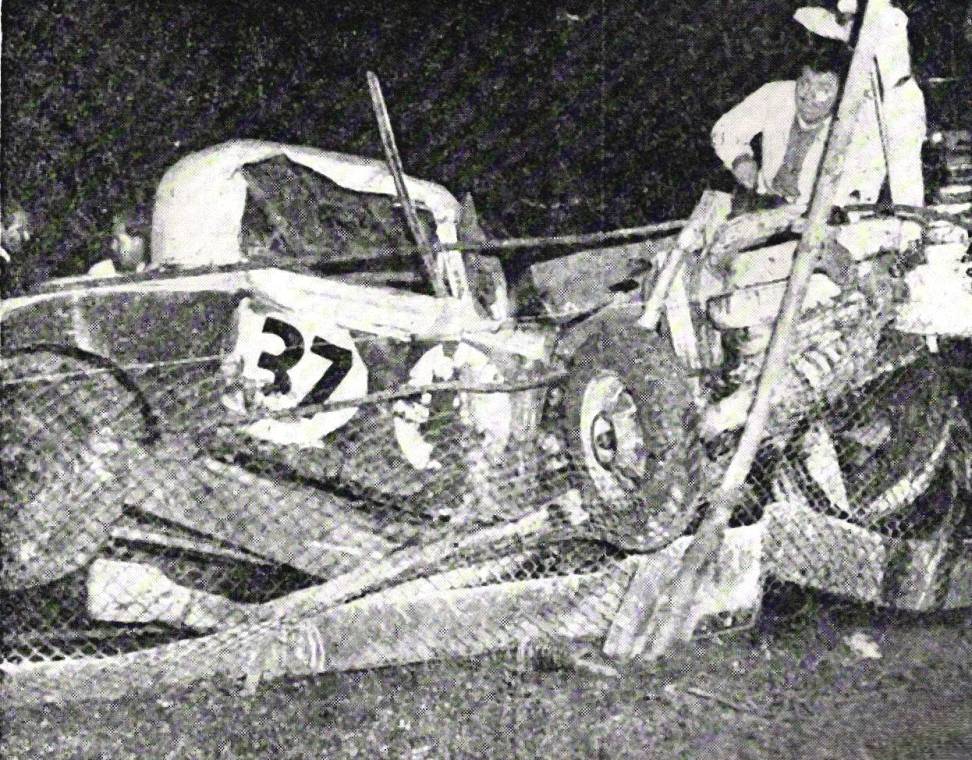
crash happened in September 29th,1956 at Brandon. Car
#35 is Wilf Davis, Aubrey Leighton's "team-mate" —
officially no teams were allowed — in one of Leighton's big
Packards July 2011: The Wilf Davis car used a big Chrysler straight-8 motor, with the
radiator inside the cab; Keith Barber recalls it had an ohv
conversion, which I am trying to identify. Steve
Gateley points out that the numbers visible here were assigned
only for this meeting: #37 is Vic Ferriday, and #12 is "Killer"
Sayers. March 2010: that
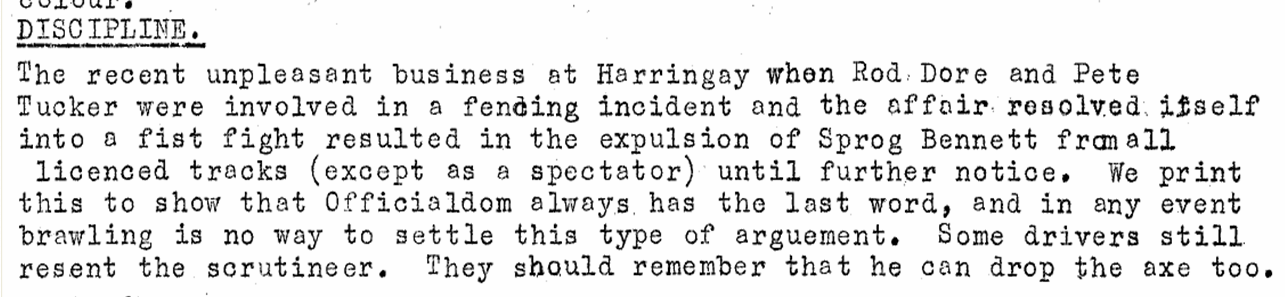
Brandon crash featured a chap who was easily annoyed: "Sprog" Bennett
from Wembley was Pete Tucker's mechanic (and a racer in his own right),
and at Brandon tried to start cutting up Wilf Davis's car.
Here's the famous photo of the Ferriday car 'folded'
nearly in half, with Sprog visible starting to climb the front of the
wreck -----. And 4 years later at Harringay in 1960, when Pete Tucker
and Rod
Dore got into a "fencing" incident, Sprog Bennet got into a fist fight
and the BSCDA banned him from all tracks until further notice. AUBREY and kart racing: Aubrey was one of the first people in
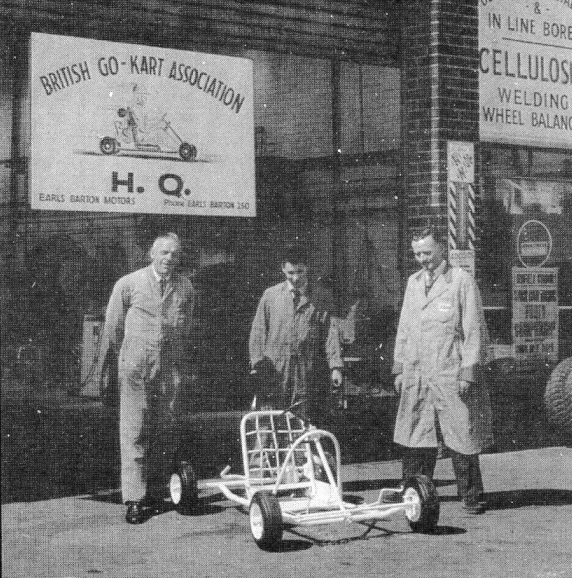
Britain to build a kart (UK kart history is a hotbed of competing "firsts" and I am staying out of it), and his design
was adopted by nearby AERO KARTS for production. Here is a high-res photo of that
first kart. The newspaper got it wrong about "bomb trailer wheels" ---- Aubrey and others used those only for their stock cars! March 2011: Here's a newspaper photo of Aubrey showing off the kart in the forecourt of Earls Barton Motors (from Russ Thomas / Chronicle & Echo). When the paper published that photo, Aubrey's daughter Carol wrote in to confirm the facts: Another early kart pioneer was Ralph Tennant
#188, a skilled engineer from Leamington Spa who not only built
Britain's second-ever kart, but raced stock cars (Seniors, Juniors, and
hot rods), and was a winner in grass-track racing with his home-built
Panther and BSA specials, and who bought extremely hard-to-find kart
wheels and tyres from Aubrey in 1960. Thanks for this info to Trevor Tennant, Ralph's son, who himself, and his champion son, race model stock cars.
Important Update, September 2009: One
of the top three sensational-historic events most stock-car fans
know about was the 1956 "Leighton-against-the-World" scuffle at
Brafield Stadium, which resulted in Brafield banning-for-life eight
BSCDA drivers, including Leighton and Danny Bassett. Here,
courtesy of ex-racer Barry Redman, is a large high-resolution image of
the Pete Arnold BSCDA newsletter
responding to that incident and explaining the lead-up to it.
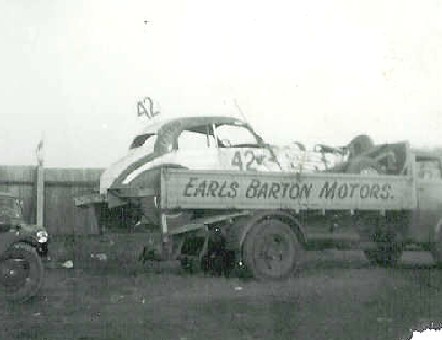
Keith Barber's book has a dramatic photo of the scuffle. The Leighton Packard
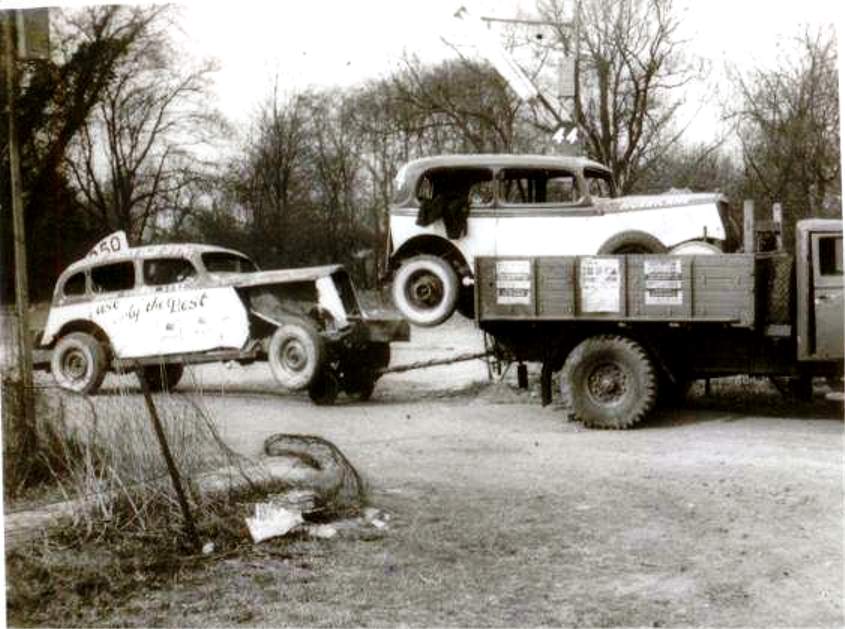
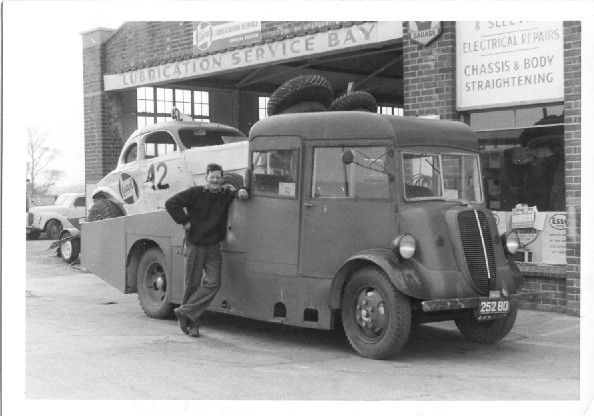
#42 on its lorry in the Brafield pits in 1956. [Steve
Gateley source for photo] [Next photos all courtesy
of Aubrey's daughter Carol:] As
always, Aubrey is
grinning broadly,
even though his 42 car has a major bend in it. The
mechanic's last name was Anderson — any memories? For some
years, Aubrey was affected by a mild form of poliomyelitis, which he
believed he contracted in France during 1957, the same year he had
won the world championship. By 1958 the news hit the local newspaper.
Aubrey walked with a stick for some time, and fitted a spring
inside his stock car cab to support his weakened left leg, so that
he could still push at the clutch pedal. Here
is the tidy
looking #42, fresh
before any damage, a lovely car.
— and here's the same
#42 getting into some bumper-busting action in 1960. [Programme
from Andy Lively]
The 1957
Champ and his son; notice
"free air" being advertised; also, that's an old Armstrong-Siddeley
hood mascot.
Next, Aubrey outside Earls Barton Motors with his towing
ambulance; notice the sign for "Chassis and body straightening" —
very appropriate. The Champ admires his 1957
World Championship trophy. The
garage front has hardly changed as of 2010. Frank Williams [Williams
Grand Prix] had his very
first single-seater circuit car fabricated there. From ex-racing mechanic Trevor Richings, a scan of Aubrey on a victory lap with his long-wheelbase Auburn special.
From Ian Melton --- the late great 1957 Aubrey Leighton World Championship Chrysler at Brafield.
February 2011: Undated programme shows Aubrey waving the flag at John La Trobe.
============================================================
Bill
Morris's Meadway
Atom, in 1954, with a young Steve Gateley in charge.
Unknown
cars, track and newspaper, but here is a 1954
photo of early stock car racing, showing one car with a soft
canvas top — health and safety? Alan Humphrey sent
the photo. Tanya Crouch at one of the first stock-car races to be held in England. Pathe
Newsreel film of Tanya
Crouch racing at Harringay in the 1950's:
Pathe
Newsreel film of the tiny "Atom" single-seater
racer for dirt tracks.
In
1959 the Brafield track had only just been concreted. Here
is Cliff Tindall (shown
elsewhere on this site) in
# 100 on the pits bend. Car 23 is George Tufnell from Colchester,
and #383 chasing them is Kettering's "Rush" Tyrell. Russ Thomas, who
sent this, points out the famous tree that appears in just about
everyone's Brafield photographs [and
nearly always bare of leaves!].
Who
sent me this historic Aycliffe programme
cover?
Pioneer
Doug Warner from Birmingham, in 1960. Doug raced under "The
Saint", and his
car ran a big straight-8 Buick motor. [Photo
from Steve Gateley]. Tough
old engines: I remember drag-racer Alan "Bootsie" Herridge's
first slingshot in about 1963/4, used a Buick straight-8 with deafening stub exhausts.
Marty Page
#333,
but this photo was printed
in an Ipswich newspaper in 2004, to celebrate stock-car
racing's 50th anniversary.
Jimmy
Wright from
Oxford was a pal of Fred Mitchell's and also raced speedway. He
raced under #236 (here, I think) from 1958 to 1962. Thanks
to Pete Schafer, Fred's mechanic, for the photo. Classic
'flathead' engine and upright armour, and see those 'agricultural'
tyres on the back.
Reg Walker today
is, I'm told, a leading
"Pig Roast" man. Over 40 years ago Reg, from Cheltenham, was
racing #320. First snapshot also shows "the
usual suspects" who were the vital ingredient for any racer. Here's Reg nose-on-barrel and about
to roll. Third, here's Reg's car posing
in a field. Thanks
to Reg Walker for the photos, which Andy Lively scanned for me.
An old photograph of Ron Rogers at Long Eaton in approx 1956 .
Darkie's
first car? Photo taken
in 1955 or 1956 at Brafield; can this number
7 be an early appearance of the late great Darkie Wright
from London? [Steve Gateley
photo]
- The
famous all-out good-times racer Pete Tucker, American
car fanatic and author of his privately-published "Thrill-of-the-Century", has dated this photo as 1956, at Brafield, car
#85. [Gateley, one more time, ta.]
- Pete's
immaculate # 85 car.
- Another
shot shows a very early Tucker
car:— 1954 at New Cross. [Gateley
photo]
- Many fans will
already have spotted this press
photograph in the wonderful Hulton Archive; Pete Tucker
at the first (or one of the first) New Cross races: the very
beginning of British stock-car racing.
On
the wrecker at Hednesford Hills raceway back in 1955 [Steve
Gateley photo]. Here's
an unidentified racer #49
being towed at Hednesford; in that year there were still three
rival promoters with their own numbering / licensing systems; anyone
have a file on this one?
Two famous
names tangle: probably at the Eastbourne track, probably
1954, it's Allen Briggs 138 and Johnny
Brise 103 getting down to business; thanks
to Pete Schafer for passing on this photo.
The smartly-dressed
kid here, Steve Gateley, would grow up to race F2 and F1 cars,
but here in 1956 he is showing us the car of "Lofty"
West, racer and one-time BSCDA treasurer, from Finchley. Here
is Lofty West in the midst of some
dusty action at Brafield in 1956 [Steve
G. photos] . "Lofty", E.J. West, began racing at the sport's start in 1954, and was based in Finchley.
Naughty,
naughty -- in 1955 this car caused
fits among the authorities at Brafield when it appeared decorated with saucy pinups
pasted on -- so Chippie Weston #62 had to remove them before being allowed
on the track. [Steve Gateley photo] Billy Barber came
from Hayes, Middlesex, to race this
#23 car at Brafield; it's the then-popular 1935 Ford Pilot. What
was it about Hayes?
Scores of hot-rodders, drag-racers, and stock-car nuts came from there. A big thank-you to Russ Thomas, the Brafield deejay
for these: by photographer
Rowland Holloway: first,
on an August Bank Holiday 1956, is Royce
Garton # 63, from Lutterworth, hopping out of his overturned
car. Second is a 1958 photo of "The Cisco Kid", Johnny
Fry # 94,
from Barking, Essex, and Newham, London. The Kid would cheerfully stand
around the pits in full cowboy regalia --- maybe something from the
"props" department, as Fry was also a stunt man in the movies, and here he is as a speedway rider in 1960. Note, Johnny Fry was also an alias, as his real name was Ronnie Wright (Johnny Fry was a "Pony Express rider in the wild west!) The
Cisco TV series from 1950-1956, was filmed in colour, which was no good
for me.
Hey, Pancho! Hey, Cisco!
Four
more 1950's treasures from Steve Gateley, of his father Alan
Gateley's stock car. - Alan G. knew Bill Morris (the
legend of Hednesford), and in 1954 got this ex-Canadian Embassy Ford
Mercury from Bill's local Medway Spares yard.
- Here's
the car in full body armour.
- Here
in action pushing two
more into the fence.
- Here's another of
Alan's car, with its proud mechanics grinning.
- Post-race
picnic for the Gateley family and their
cars, outside Hednesford in 1955.
- "On the
hook", Alan Gateley's car needed
a tow here in 1955, again at Hednesford. [Thanks
again to Steve for these great photos.]
Not
sure of the track (a temporary field track, Whip Chicken Farm perhaps) or year, but here is Fred
Mitchell # 38 roaring past an overturned Tanya Crouch.
Here's
a 1960 photo from a Brafield programme thanks
to Ken Mason, showing Doug Wardropper
#5, Ellis Ford as # 183 (before he switched to 3, and number 29
is George
Foulger from Norwich.
Some very
faint half-tone photos that I scanned from 1959 Brafield programmes
Another
50s shot, the elegant Alan
England
Brafield crash, a 1958 photo of car # 475
in the fence by Clayton Sampson, USAF vet; any historian
tell me name of the driver? Ian
Snoad, e-mailed to identify this as George
Ansell. I should have recognized
the number as George still had 475 in 1964 (see the "More 60's Seniors"
section). In the background is 412, probably Johnny Radford from Stanley. Here's
an early shot of Doug Wardropper in approx 1956, at Brafield, with
wire-spoked wheels and a flathead engine: Wardropper
# 5. This
photo is copied from the original copyright print owned by Simon
Lewis of "Transport Bookshop" in England.
Here
is Harry Prigmore in action in cars #4 and #70, both built
with the help of and sponsored by Aubrey Leighton, in the days
even before Aubrey himself started racing. Harry was apprentice at Aubrey's, and
it was thanks to a trial race in Harry's car that Aubrey Leighton "got
the bug" and went on to fame. All thanks to Harry! Harry 1 Harry 2 (with 61 Ken Freeman in the background) - Harry 3
Harry 4.
The #50 car that Harry is harrying [groan, pun] is that of Doncaster's Cal Wills: a 1933 Lagonda M45. If it had been preserved and polished for 55 years longer, it might look like this today,
--- but then Cal Wills would have had much less fun with it.
Keith Barber tells me that Cal once adapted a V-12 Lagonda
fire engine to stock car racing!
Harry
eventually emigrated to Western Australia, where he successfully raced
and mechanic'd on fast Sprint cars at tracks like Forrestfield
Speedway.
Below: an
early photo of Willie Harrison, that determined man who persisted
for 20 years to win the World Championship.
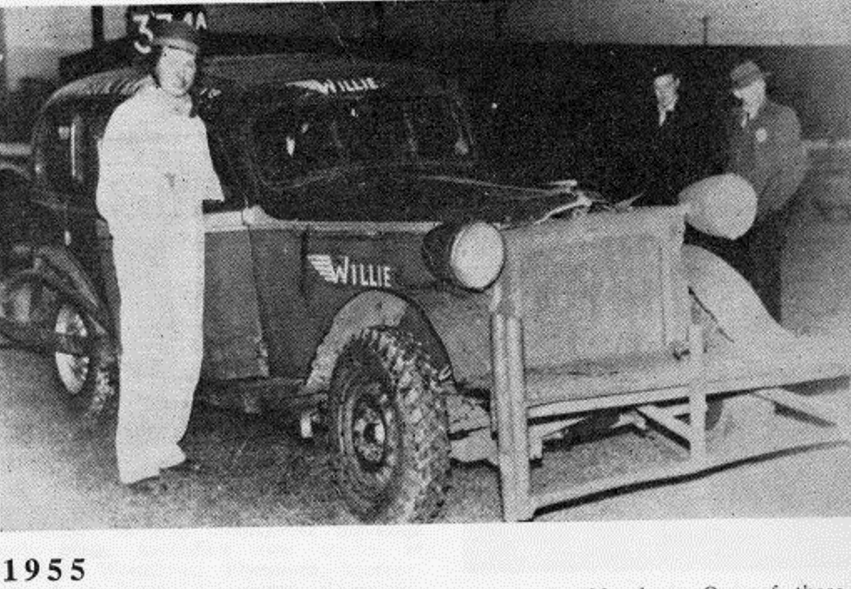
Tony
Allen leaps over some barrels: #145. Tony, a teenager when this photo was taken, hailed from Luton (Beds.),
and enjoyed a long long career. In
the 1960's he earned a red top in Juniors as # 766, then moved
up to Seniors, moving through blue to another red top in # 348,
around 1972. He toured New Zealand, and eventually emigrated
there, taking a super-lightweight Jaguar special, and went
on racing stock-cars. Tony's son Mike also raced sprints
there. In the 1950's, Tony's mother too raced stock-cars
(pioneer Tanya Crouch inspired a lot of people). (Programmes
courtesy of Keith Barber)
|